
In-house annotation trades money and speed for control; outsourced data annotation trades some control for elastic scale, managed QA, and predictable cost. This guide compares both models across cost, quality, scalability, turnaround, and security, and shows why most enterprise AI teams land on a hybrid model.
Contents
- Why Your Annotation Strategy Decides More Than You Think
- What is In-House Data Annotation?
- What is Outsourced Data Annotation?
- In-House vs Outsourced: Comparison Table
- Cost Comparison: What Per-Label Pricing Hides
- Quality Comparison: Process Beats Proximity
- Scalability Comparison
- Turnaround Time Comparison
- Security and Compliance Considerations
- When In-House Data Annotation Makes Sense
- When Outsourced Data Annotation Makes Sense
- The Hybrid Model
- Decision Checklist
- Common Mistakes to Avoid
- How to Choose the Right Data Annotation Partner
- Expert Insight
- Final Recommendation
- Frequently Asked Questions
Why Your Annotation Strategy Decides More Than You Think
Model accuracy has a ceiling, and that ceiling is your training data. MIT researchers found label errors in the test sets of the 10 most-used ML benchmarks, averaging at least 3.3 percent, enough to flip model rankings (Northcutt et al., NeurIPS 2021). In our own controlled comparison, annotation errors dragged model accuracy from 73.6 to 54.2 percent; we documented that experiment in why data annotation quality matters for ML.
Gartner has predicted that through 2026, organizations will abandon 60 percent of AI projects unsupported by AI-ready data. [Link: Gartner press release, Feb 2025]
So the in-house vs outsourced question is not a procurement detail. It decides what each training cycle costs and how fast you get from pilot to production.
This article compares both models across cost, quality, scalability, turnaround time, security, and ROI. It ends with a decision checklist you can run against your own project.
What is In-House Data Annotation?
In-house data annotation means your own employees or contractors label your training data, on your infrastructure, under your management.
That involves more than hiring annotators. You need to:
- Recruit and screen people who can hold accuracy over thousands of repetitive tasks.
- Train them on your annotation guidelines and retrain them every time the guidelines change.
- License or build annotation tooling, then maintain it.
- Own QA: reviewer layers, spot checks, inter-annotator agreement tracking.
- Assign a project manager, because annotation work does not run itself.
In-house works best when data volumes are small and recurring, the data is highly sensitive, or the labels require domain knowledge your own staff already has. A radiology team labeling scans is a good example. A startup labeling 800,000 street images usually is not.
What is Outsourced Data Annotation?
Outsourced data annotation means a specialist provider delivers labeled datasets against your guidelines, accuracy targets, and deadlines.
A managed provider typically brings:
- Trained annotation teams that already work across image, video, text, and 3D formats.
- Human-in-the-loop workflows, where people label, verify, or correct model-assisted output. We covered why this raises accuracy in how human-in-the-loop boosts AI data annotation.
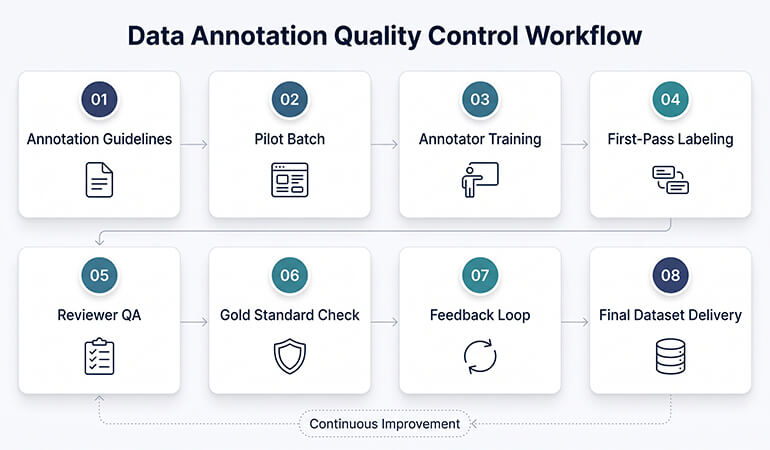
- Built-in QA: first-pass labeling, reviewer checks, gold standard sampling, feedback loops.
- Elastic capacity. Ten annotators this month, sixty next month, back to ten after the sprint.
Outsourcing fits when volumes are large, deadlines are tight, or your engineers are spending their week reviewing bounding boxes instead of training models.
In-House vs Outsourced: Comparison Table
| Factor | In-house | Outsourced | Best fit |
|---|---|---|---|
| Setup cost | High: hiring, tools, training before the first label | Low: pilot batch to start | Outsourced for fast starts |
| Operating cost | Fixed salaries regardless of workload | Variable, tied to volume | Outsourced for fluctuating volume |
| Hiring effort | Weeks to months per annotator | None on your side | Outsourced |
| Training time | You run it, repeatedly | Provider runs it against your guidelines | Outsourced, unless niche expertise |
| Tooling | You license or build | Provider supplies or adapts to yours | Either |
| QA process | You design and staff it | Multi-level QA included | Outsourced for structured QA |
| Annotation quality | High for expert-heavy tasks | High with gold standards and IAA tracking | Depends on task complexity |
| Scalability | Limited by headcount | Elastic workforce | Outsourced |
| Turnaround time | Slower to start, steady after | Fast ramp, parallel teams | Outsourced for deadlines |
| Data security | Full physical control | Contractual controls: NDAs, access restrictions, audits | In-house for the most sensitive data |
| Compliance | Your burden entirely | Shared, verify vendor certifications | Case by case |
| Flexibility | Hard to pause or pivot | Scale up, down, or switch formats | Outsourced |
| Long term ROI | Pays off at stable, permanent volume | Pays off for variable or one-time volume | Hybrid, often |
Cost Comparison: What Per-Label Pricing Hides
Per-label rates are the most quoted and least useful annotation metric. The real cost of in-house annotation includes:
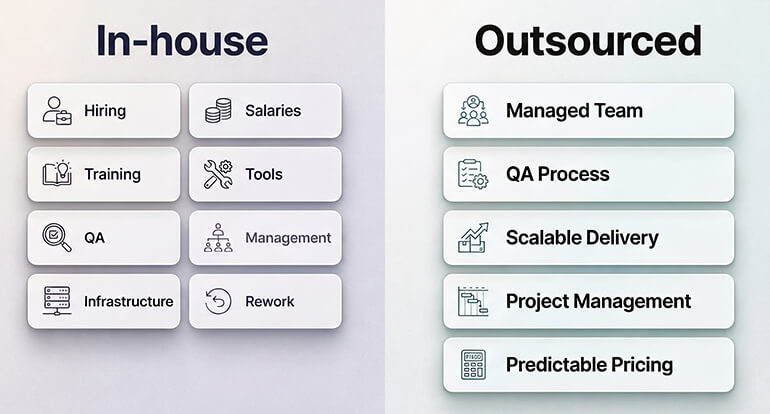
- Recruitment: sourcing, screening, and the roles you fill wrong the first time.
- Salaries and benefits, paid whether or not there is labeling work that week.
- Training: your engineers’ hours writing guidelines and running calibration sessions.
- Tool licenses, or engineering time if you build your own.
- A project manager, which is a salaried role most annotation budgets forget.
- QA review and rework, which grow with task complexity and are rarely priced upfront.
- Idle capacity between projects. This is the cost nobody budgets for.
Outsourced pricing bundles most of this into the rate. You pay for delivered, QA-passed labels, not for the machinery behind them. That does not automatically make it cheaper; it makes the cost visible and tied to volume, which is what most budget owners actually want.
An illustrative example: 500,000 images
Say you need 500,000 images with bounding boxes at 97 percent accuracy in four months.
In-house, that might mean hiring 8 to 10 annotators plus a QA lead and a project manager, licensing a platform, and spending the first four to six weeks on hiring and training before real throughput starts. Then, when the project ends, you either find new work for the team or absorb the wind-down.
Outsourced, the same project starts with a pilot batch in week one, ramps a trained team by week three, and ends when the dataset ships. There is no residual payroll. For a sense of what this looks like in practice, one documented client review on Clutch describes a 50,000+ image outsourced project that reached 97 percent detection accuracy and cut model training time by roughly 30 percent.
These numbers are illustrative. Actual costs depend on data complexity, annotation type, QA depth, and turnaround pressure. A pixel-level segmentation project prices very differently from simple classification. Run a pilot and extrapolate from measured throughput, not from a rate card.
Working on an image-heavy dataset? Our image annotation services page covers how bounding box, polygon, and segmentation projects are typically scoped and priced.
Quality Comparison: Process Beats Proximity
The common assumption is that in-house means higher quality because annotators sit near the ML team. Sometimes true. Often not.
Annotation quality is a system with several parts:
- Accuracy: does each label match ground truth?
- Consistency: do two annotators label the same edge case the same way? Measured as inter-annotator agreement (IAA).
- Gold standard datasets: pre-labeled samples seeded into work queues to catch drift.
- Multi-level QA: first pass, reviewer check, statistical sampling.
- Edge case handling: a documented escalation path, not individual guesswork.
- Guideline updates and feedback loops: so corrections change future behavior instead of repeating.
Small in-house teams often skip half of this because nobody has time to build it. A mature outsourcing partner runs it as standard operating procedure, because their business fails without it. As a benchmark when evaluating either model: production teams generally treat 95 percent IAA, validated through multi-stage human review, as the working standard for computer vision datasets.
The part that matters for your model: inconsistent labels are worse than sparsely wrong ones. A model can tolerate random noise. It cannot tolerate systematic disagreement about what a “pedestrian” is. The MIT label-errors study showed even benchmark test sets carry enough error to reorder model leaderboards (arXiv:2103.14749).
Quality also needs traceability. If you cannot see which annotator labeled which item, under which guideline version, with what QA outcome, you cannot debug your dataset when the model misbehaves.
Scalability Comparison
Scaling an in-house team means hiring, and hiring is slow. Doubling throughput next month is rarely realistic.
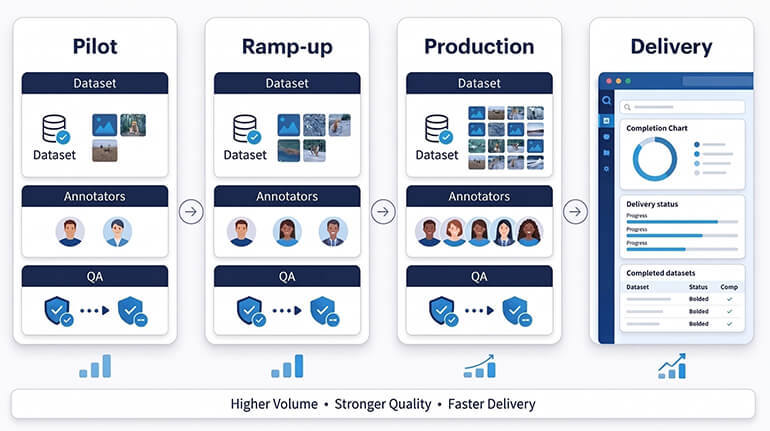
Outsourced scaling looks different:
- Pilot to production: start with 5,000 items to validate guidelines, then ramp to full volume with the same trained team as the core.
- Workforce availability: providers keep benches of annotators trained across formats.
- Multi-format work: image, video, text, documents, and LiDAR in parallel, without you hiring four different specialist profiles.
- Multilingual annotation without recruiting per language.
- Volume spikes: a new data source lands, or a launch date moves up, and capacity follows within days.
Video and 3D point cloud work deserve a special mention. A single minute of video can contain thousands of frames needing object tracking. LiDAR scenes demand annotators trained on 3D cuboids and spatial reasoning; our step-by-step LiDAR annotation guide shows why. Building that skill in-house for one project rarely makes sense.
Predictability matters as much as raw capacity. A good provider commits to weekly delivery volumes and reports against them, which is what lets your training schedule stay a schedule.
Turnaround Time Comparison
| Stage | In-house | Outsourced |
|---|---|---|
| Time to first label | 6 to 12 weeks (hire, tool, train) | 1 to 2 weeks (pilot batch) |
| Guideline creation | Yours alone | Collaborative, provider flags ambiguities |
| Production speed | Capped by headcount | Parallel teams |
| QA cycle | Depends on internal bandwidth | Built into delivery |
| Rework | Competes with new work | Handled within SLA |
| Delivery reliability | Vulnerable to attrition and leave | Contractual commitments |
Timeframes above are typical ranges, not guarantees. The pattern holds though: in-house pays a long fixed setup cost, while outsourcing compresses time-to-first-label to days.
Security and Compliance Considerations
Security is the strongest argument for in-house annotation, and it deserves honest treatment rather than fear-based selling.
Legitimate outsourcing risk controls include:
- NDAs at both company and individual annotator level.
- Role-based access, so annotators see only the data assigned to them.
- Secure annotation environments: no downloads, no personal devices, restricted networks.
- Data masking or de-identification before data leaves your systems.
- Audit trails showing who accessed what, when.
- Vendor due diligence: ask for the provider’s security documentation and verify it.
For regulated data, check which frameworks apply: GDPR for EU personal data, HIPAA for US health data, and SOC 2 or ISO 27001 as general security attestations. Look for concrete mechanisms behind the badges: encrypted transfer, a signed BAA where health data is involved, and documented access controls. Whatever vendor you evaluate, ask for current, verifiable documentation rather than taking a website badge at face value.
Some data genuinely should not leave your walls. Unreleased product imagery, certain defense data, raw patient records without de-identification. For that slice, keep annotation internal and outsource the rest.
When In-House Data Annotation Makes Sense
- Small, recurring datasets where a two-person team stays busy year-round.
- Data too sensitive to share even under strict controls.
- You already have an internal AI operations or labeling team with spare capacity.
- Labels require deep subject matter expertise: pathology, legal contracts, proprietary schematics.
- Guidelines change weekly and you need annotators inside the daily conversation.
When Outsourced Data Annotation Makes Sense
- Volumes in the hundreds of thousands or millions of items.
- A deadline that hiring cannot meet.
- You need to ramp from zero to full production in weeks.
- The project spans multiple annotation types: bounding boxes, polygons, segmentation, transcription.
- Your ML engineers are doing annotation QA instead of ML.
- You want structured, reportable QA without building the function.
- The work covers image, video, text, LiDAR, documents, or multimodal data, and you would otherwise need several specialist hires. For NLP-specific tradeoffs, see our practitioner’s guide to text annotation.
The Hybrid Model: how most enterprise teams actually run this
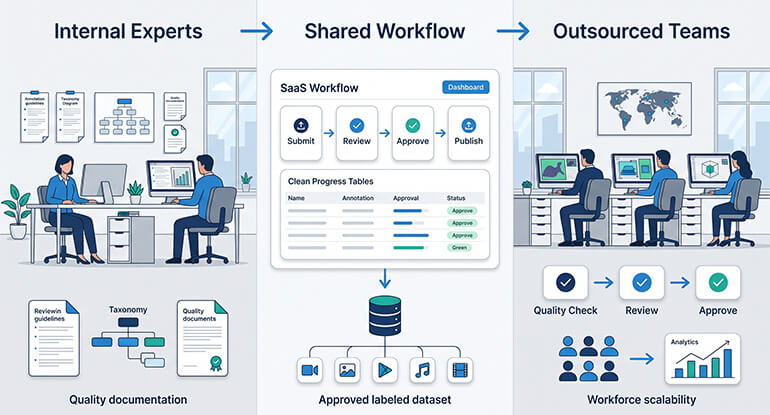
The in-house vs outsourced framing suggests a binary choice. In practice, mature AI teams split the work:
- Internal team owns the annotation guidelines and the definition of done.
- Internal subject matter experts review escalated edge cases and ambiguous samples.
- An outsourced team handles production-volume labeling.
- The vendor manages workforce, throughput, and first-line QA; the internal team audits samples.
This works because it puts each side where it has an advantage. Your experts spend their hours on the 2 percent of items that genuinely need them. The provider handles the 98 percent that needs discipline and scale.
It also de-risks the relationship. Your internal audit layer catches drift early, and your guidelines stay your intellectual property.
Decision Checklist
Answer these before choosing a model:
- How much data needs annotation now, and how much per quarter after that?
- How complex is the task? Classification, bounding boxes, or pixel-level segmentation?
- What accuracy threshold does the model actually need? 95 and 99 percent are different projects.
- How sensitive is the data, and can it be masked before labeling?
- When does the training pipeline need this dataset?
- Do you have internal QA capacity, honestly measured in hours per week?
- Could your team double throughput in a month if asked?
- What is your total cost of ownership, including management, tools, QA, and idle time?
- Is this a one-time dataset or an ongoing pipeline?
If your answers cluster around large volume, tight timeline, and thin internal bandwidth, outsource. If they cluster around small volume, extreme sensitivity, and available experts, stay internal. Mixed answers point to hybrid.
Common Mistakes to Avoid
- Comparing vendors and in-house on per-label cost alone. TCO is the real number.
- Ignoring QA cost until rework blows the budget.
- Skipping the pilot batch. A 5,000-item pilot exposes guideline gaps a contract never will.
- Writing thin annotation guidelines and expecting annotators to read minds.
- Underestimating training time, internal or external.
- Choosing the cheapest vendor and paying the difference in rework.
- Scaling to full volume before accuracy and IAA benchmarks are stable.
- Never measuring inter-annotator agreement, then wondering why the model plateaus.
How to Choose the Right Data Annotation Partner
Evaluate providers on evidence, not sales decks:
- Experience with your annotation types and data formats. Ask for anonymized examples or, better, independent client reviews.
- The QA process, described step by step. If they cannot explain it in five minutes, they do not have one.
- Security practices you can verify: access controls, environment restrictions, audit logs.
- Tool flexibility. Can they work in your platform, or only theirs?
- A structured pilot with defined accuracy targets before any volume commitment.
- Communication: named project manager, response times, escalation path.
- Pricing transparency, including how rework and guideline changes are billed.
- Proven scaling: ask how they handled their last 3x volume spike.
- Edge case management: an escalation workflow, not silence.
- Reporting: accuracy, IAA, throughput, and QA outcomes, delivered on a schedule.
Expert Insight
From an annotation operations perspective, after years of running labeling projects at scale: the ones that fail rarely fail on price. They fail because accuracy was never defined numerically, so “good labels” meant something different to every reviewer. Set the accuracy target, the IAA threshold, and the gold standard pass rate before the first batch. The cheapest model is the one that never forces you to relabel.
Final Recommendation
In-house annotation earns its cost when data is small, sensitive, and expert-dependent. You trade money and speed for control.
Outsourced data annotation wins on scale, speed, cost predictability, and managed quality. For most teams labeling at volume, it is the difference between shipping a model this quarter or next.
For enterprise AI teams, hybrid is usually the strongest answer: internal experts own the guidelines, an external partner owns production.
Whichever route you choose, decide it on measured numbers: run a small pilot, track accuracy and IAA against your target, and extrapolate the true cost from there.
If you want to run that pilot with an outsourced team, HabileData’s data annotation services cover the formats discussed here, from bounding boxes to 3D point clouds. Send a sample dataset and your accuracy target to scope it
Frequently Asked Questions
Usually, yes, once you count total cost of ownership: recruitment, salaries, tools, QA, management, and idle capacity. For small permanent workloads with an existing team, in-house can be cheaper. Run the TCO comparison, not the per-label one.
When datasets are small and recurring, data is too sensitive to share, or labels need deep internal expertise that cannot be transferred through guidelines.
Vendor quality gaps, data security exposure, and communication friction. All three are manageable: run a pilot with accuracy targets, verify security controls contractually, and require scheduled reporting.
Through layered QA: annotator training on your guidelines, first-pass labeling, reviewer checks, gold standard sampling, inter-annotator agreement tracking, and feedback loops that update guidelines.
It can be, with the right controls: NDAs, role-based access, secure environments, data masking, encrypted transfer, and audit trails. Verify a vendor’s practices and certifications before sharing regulated data.
Outsourced or hybrid. Elastic, trained workforces handle millions of items faster and more predictably than internal hiring can.
Your internal team defines guidelines and reviews edge cases. An outsourced team handles production labeling and first-line QA. You audit samples to keep both sides honest.
Compare total annotation cost, including management and rework, against the value of the model improvement and the time saved. Include the opportunity cost of ML engineers doing QA instead of model work.



Biju Peter is a Senior Project Manager with 22+ years in the BPM industry, specializing in large-scale data operations and annotation-driven projects. He brings deep expertise in data processing, web research, scraping, and multi-modal annotation across image, text, audio, and video domains. He has successfully led 200+ projects, managed large teams, and delivered scalable, high-quality solutions for global AI and machine learning initiatives for clients across the globe. 🔗Connect with Biju on LinkedIn