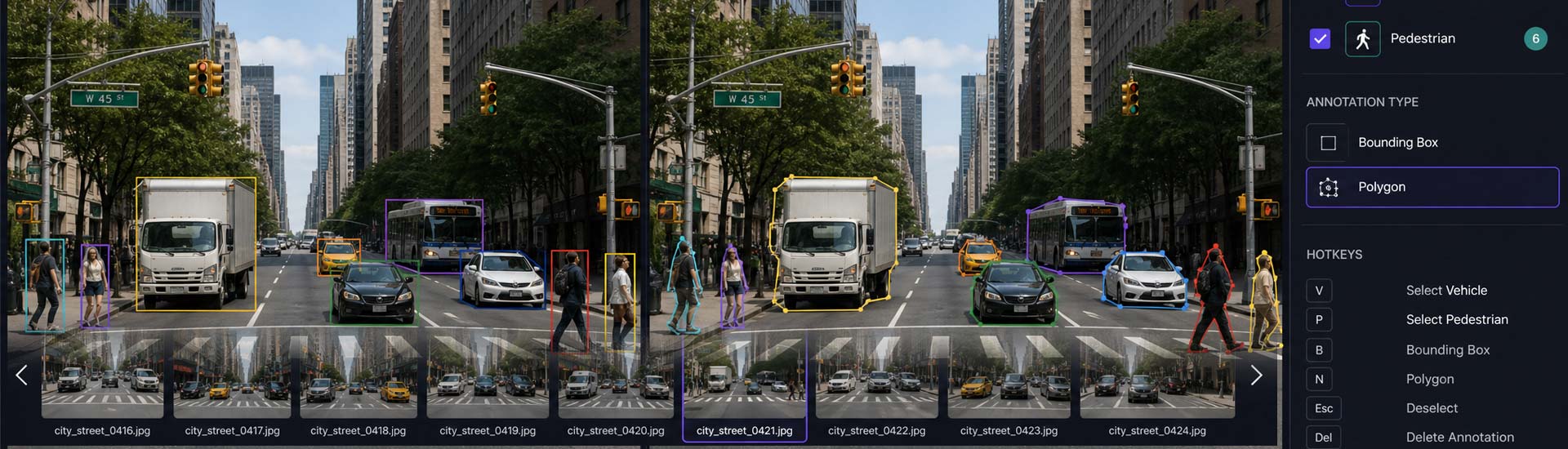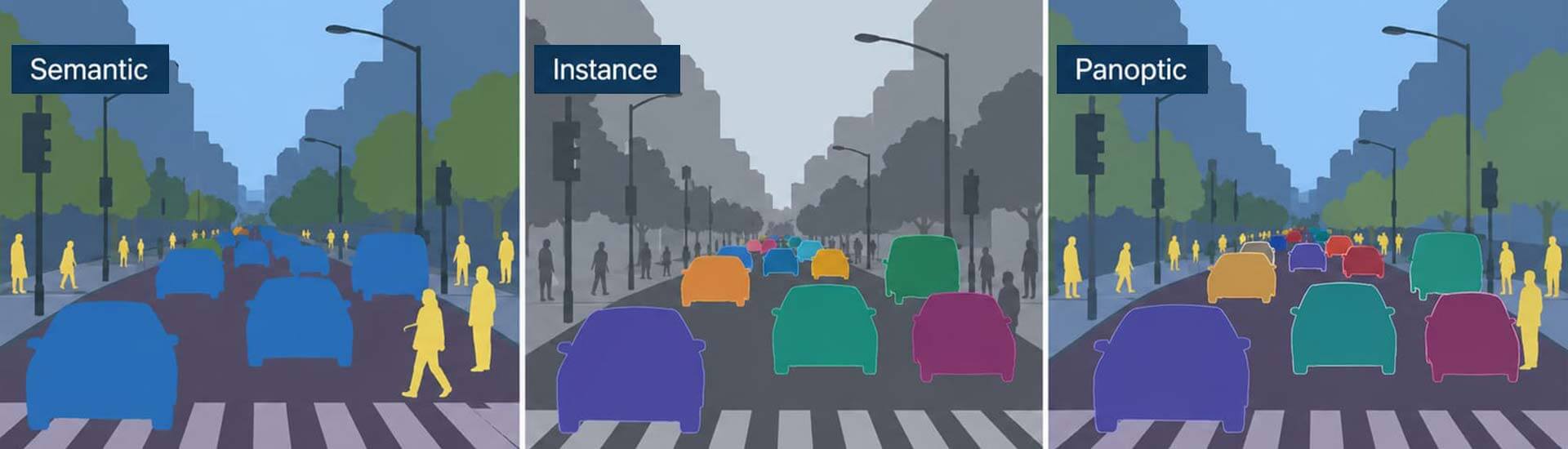
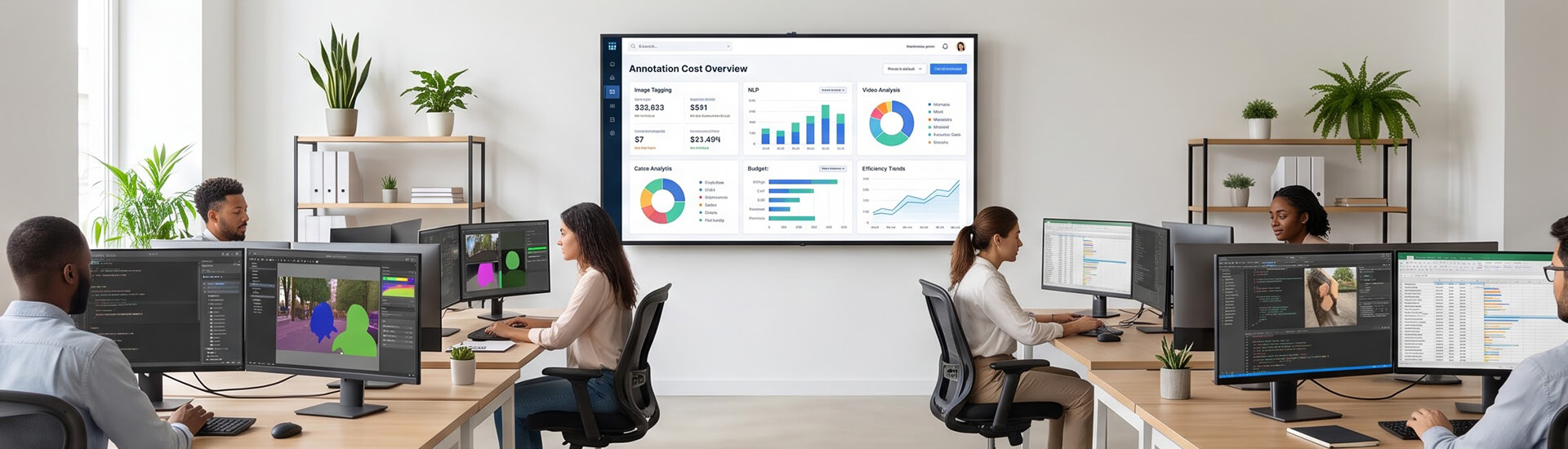
Data annotation typically costs $0.03 to $0.12 per bounding box, $0.50 to $6.00 per segmented image, $0.02 to $0.30 per text item, and $6 to $60 per annotator hour depending on region and skill. Specialist work such as medical or LiDAR annotation runs far higher. All figures are indicative industry ranges; actual quotes vary by vendor, complexity, and volume.
Contents
- What Is Data Annotation and Why Does It Cost Money?
- The Main Data Annotation Pricing Models
- Typical Annotation Rates by Data Type
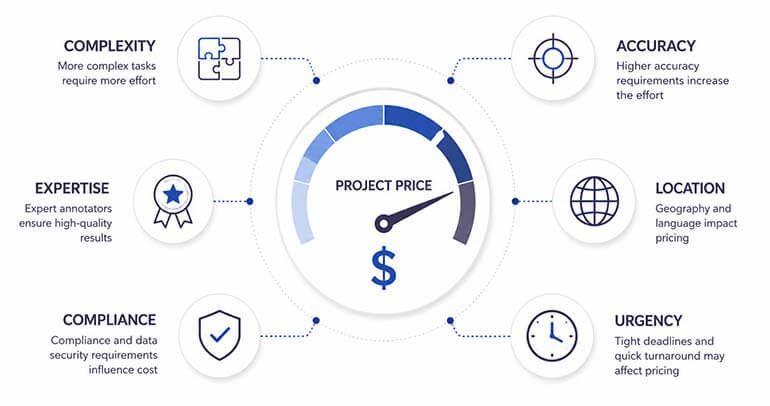
- Key Factors That Influence Data Annotation Cost
- In-House vs Outsourced vs Crowdsourced vs Automated Labeling
- Budget Benchmarks: What Real Projects Cost
- Hidden Costs Teams Often Miss
- How to Reduce Data Annotation Costs Without Sacrificing Quality
- Real-World Examples
- Risks of Choosing Annotation Vendors on Price Alone
- Best Practices Before Signing an Annotation Contract
- Conclusion
- Frequently Asked Questions
Ask five annotation vendors for a quote on the same dataset and you’ll get five numbers that differ by 400%. That’s not dishonesty. It’s what happens when one vendor prices per bounding box, another per hour, and a third quotes a dedicated team.
Data annotation is the work of labeling raw data, such as images, video, text, or audio, so a machine learning model can learn from it. A human draws the box around the pedestrian. A human tags the sentence as “complaint.” Models only learn what labeled examples teach them.
The cost question is hard to answer because the unit of work varies so much. Labeling a cat photo takes seconds. Segmenting a surgical image takes twenty minutes and a trained eye.
Teams also underestimate the total budget, usually by a lot. The per-label rate is only part of it. Guidelines, quality checks, rework, and project management routinely add 25% to 50% on top. If you’re comparing quotes from professional data annotation services against building in-house, this guide gives you the numbers to do it honestly.
What Is Data Annotation and Why Does It Cost Money?
Data annotation costs money because it is skilled human labor, layered with quality control, tooling, and management. You are not buying labels. You are buying judgment, applied thousands of times, consistently.
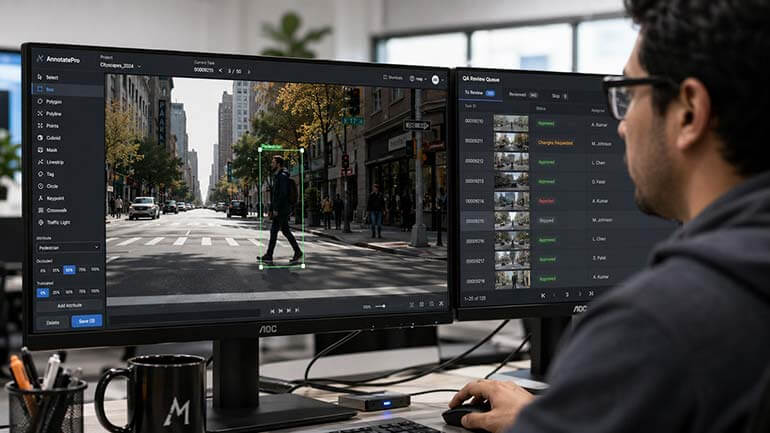
A supervised machine learning model needs labeled examples to learn. The label is the answer key: this X-ray shows a fracture, this review is negative, this pixel belongs to “road.”
Here is where the money actually goes:
- Annotator wages, the largest line item on almost every project.
- Quality assurance, meaning reviewers, audits, and consensus checks on ambiguous items.
- Tooling and infrastructure: labeling platforms, storage, secure access, and integrations.
- Project management, including scheduling, throughput tracking, and client communication.
- Domain expertise. A radiologist reviewing chest CTs bills at a very different rate than a generalist tagging shoes.
QA deserves a special mention because buyers often forget it. A common setup is one annotator plus one reviewer, with a “gold set” of pre-answered items mixed in to measure accuracy. Teams also track inter-annotator agreement, which is a score for how often two people label the same item the same way. Low agreement means unclear guidelines, and unclear guidelines mean rework.
Every one of those layers is priced into your quote, whether the vendor itemizes it or not.
The Main Data Annotation Pricing Models
Vendors price annotation in seven main ways: per-label, per-item, hourly, fixed-price project, FTE (dedicated team), platform subscription, and hybrids of these. Each model shifts risk differently between you and the vendor.
| Pricing model | How it works | Best for | Watch out for |
|---|---|---|---|
| Per-label / per-object | Pay for each box, polygon, or tag | High-volume, well-defined tasks | Dense images get expensive fast |
| Per-item (image/document) | Flat rate per file regardless of contents | Predictable, uniform data | Vendors pad rates for variance |
| Hourly | Pay for annotator time | Exploratory or evolving tasks | No throughput guarantee |
| Per-project (fixed price) | One quote for the whole dataset | One-off datasets with a frozen spec | Change requests cost extra |
| FTE / dedicated team | Monthly rate per full-time annotator | Continuous pipelines, 3+ months | Underused during slow periods |
| Subscription / platform | License fee for tools, labor separate | Teams with their own workforce | Fees stack on top of labor |
| Hybrid | Mix, e.g. FTE base plus per-label overflow | Variable-volume programs | Contracts get complicated |
Per-label pricing feels transparent, and for simple, high-volume work it usually is. The trap is label density. At $0.06 per box, an image with 3 objects costs $0.18. A crowded street scene with 40 objects costs $2.40.
Hourly pricing fits work you can’t fully specify yet, such as a new task type where guidelines are still moving. You trade cost certainty for flexibility.
FTE pricing, sometimes called a managed workforce, gives you the same annotators month after month. They learn your edge cases. For ongoing pipelines, that consistency usually beats per-label rates on both cost and quality.
How to compare models fairly: convert everything to cost per finished, QA-passed unit. Take the hourly rate, divide by realistic throughput after review, and you get an effective per-item price. Ask vendors for their throughput assumptions in writing. If an annotator does 200 boxes per hour at $8 per hour, the true rate is $0.04 per box before QA, not whatever the sales deck says.
Typical Annotation Rates by Data Type
Indicative market ranges: image annotation runs $0.03 to $6.00 per image depending on technique, text tasks run $0.02 to $0.30 per item, audio transcription runs $0.50 to $3.00 per minute, and LiDAR runs $5 to $25 per frame. Treat every figure below as a planning estimate, not a quoted price.
| Data type | Task | Indicative rate range |
|---|---|---|
| Image | Bounding box | $0.03 – $0.12 per box |
| Image | Polygon | $0.10 – $1.00 per object |
| Image | Semantic segmentation | $0.50 – $6.00 per image |
| Image | Keypoints | $0.02 – $0.10 per point |
| Video | Object tracking | $0.05 – $0.25 per object per frame |
| Text | Classification / sentiment | $0.02 – $0.10 per item |
| Text | Named entity recognition (NER) | $0.04 – $0.30 per document |
| Audio | Standard transcription | $0.50 – $1.50 per audio minute |
| Audio | Diarization / timestamps | $1.50 – $3.00 per audio minute |
| 3D / LiDAR | Cuboids, full scene | $5 – $25 per frame |
| Medical | Expert review | $30 – $150+ per hour |
| RLHF / LLM | Preference ranking | $0.50 – $8.00 per comparison (generalist) |
Sources: aggregated from public vendor pricing pages (e.g. AWS SageMaker Ground Truth, Google Cloud AI labeling docs) and project quotes reviewed by the author. Indicative only.
How much does image annotation cost per image?
Simple bounding boxes cost a few cents each. Polygons cost more because tracing an outline takes longer than dragging a rectangle. Professional image annotation services usually quote after seeing a sample batch, because density and image quality change everything.
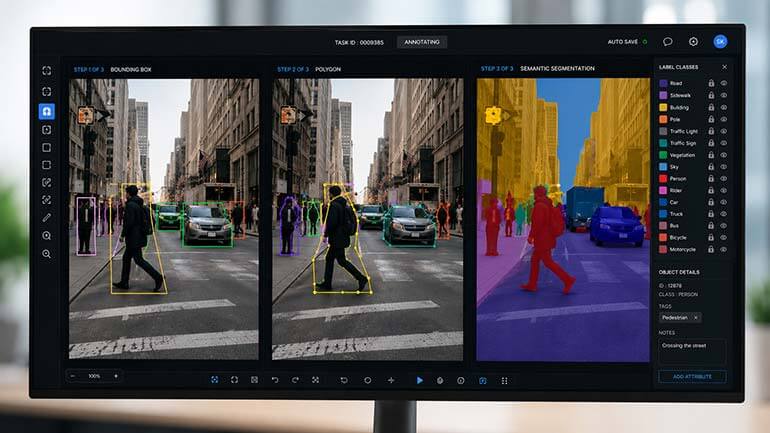
Semantic segmentation sits at the top of the image price range. Every pixel gets a class, so a cluttered street scene can take 20 to 60 minutes of careful work. That is why semantic segmentation services price per image or per hour rather than per object. Budget $2 to $6 per complex image, sometimes more.
How much does video annotation cost?
Video is priced per object per frame, per second, or per minute. A 30-second clip at 5 annotated frames per second is 150 frames. With 10 tracked objects, you’re paying for 1,500 object instances.
Interpolation tooling, where the software fills frames between keyframes, cuts that dramatically. Ask any video annotation services provider how their tooling handles interpolation before you accept a per-frame quote.
How much does text annotation cost?
Short classification tasks are the cheapest labels in the industry, often 2 to 6 cents each at volume. NER, where annotators mark names, dates, and organizations inside text, costs more because each document contains many decisions. Entity linking, which connects a mention to a knowledge base record, costs more still. Text annotation services typically discount steeply past 100,000 items.
How much does audio annotation cost?
The industry prices per audio minute, not per work minute. One minute of clean, single-speaker audio takes roughly 4 minutes to transcribe. Add speaker diarization (who spoke when), timestamps, or noisy call-center audio, and rates double or triple. Medical and legal transcription costs $2 to $5 per minute because of terminology and liability.
How much does LiDAR annotation cost?

LiDAR point clouds are the expensive end of computer vision. Annotators place 3D cuboids around cars and pedestrians inside sparse point data, often fused with camera images. Expect $5 to $25 per frame for full scenes, and specialist 3D point cloud annotation teams command premium hourly rates because the skill takes months to build.
What does RLHF and LLM training data cost?
RLHF stands for reinforcement learning from human feedback. Humans rank or rewrite model outputs, and the model learns from those preferences. Generalist preference rankings run roughly $0.50 to $8 per comparison. Expert tasks, such as grading code or medical answers, can run $20 to $100+ each. Providers of multimodal annotation services increasingly bundle text, image, and audio judgment work for LLM fine-tuning.
Across all data types, three things push rates up: complexity per item, the precision the model demands, and edge cases. Pixel-perfect masks cost more than loose boxes. A dataset full of occluded, blurry, or ambiguous items slows everyone down, and slow means expensive.
Key Factors That Influence Data Annotation Cost
Twelve factors move annotation pricing, and complexity, accuracy targets, and annotator expertise matter most. Volume helps, but a 50% discount on the wrong workforce is still money wasted.
| Cost driver | Typical budget impact |
|---|---|
| Task complexity and label density | Can multiply per-item cost 5x-20x |
| Required accuracy / consensus layers | Double review adds 60%-100% |
| Annotator skill and domain expertise | Experts cost 3x-15x generalists |
| Workforce location | Onshore runs 3x-6x offshore rates |
| Dataset volume | Discounts of 10%-40% at scale |
| Turnaround urgency | Rush premiums of 25%-100% |
| Tooling and platform fees | 5%-20% on top of labor |
| Guideline development | $2,000-$15,000 up front (indicative) |
| Edge cases and ambiguity | Slower throughput, more rework |
| Security compliance (HIPAA, GDPR, SOC 2) | 15%-40% premium for certified facilities |
| Language and localization | Rare languages cost 2x-5x English |
| Rework cycles | Each full revision pass adds 20%-40% |
A note on accuracy targets, because this one surprises buyers. Moving a requirement from 95% to 99% accuracy does not add 4% to the cost. It can double it. Hitting 99% usually means every item gets a second reviewer, plus consensus workflows for disagreements.
Compliance works the same way. HIPAA-compliant medical annotation requires certified facilities, trained staff, access controls, and audit trails. GDPR adds data residency constraints. SOC 2 certification signals mature security practices. None of that is free, and vendors who offer it cheaply usually don’t actually have it.
In-House vs Outsourced vs Crowdsourced vs Automated Labeling
Outsourced managed teams win on cost-per-quality for most production workloads. In-house wins when data is too sensitive to leave, crowdsourcing wins on burst speed for simple tasks, and automation wins as a multiplier on any of the three rather than a replacement.
| Factor | In-house | Outsourced (managed) | Crowdsourced | Automated / model-assisted |
|---|---|---|---|---|
| Cost structure | Salaries + tools + management | Per-label, hourly, or FTE | Micro-payments per task | Platform + compute + human review |
| Fully loaded cost | Highest per label | Moderate | Lowest sticker price | Lowest at scale, after setup |
| Quality control | Direct, strongest | Vendor QA layers, strong | Weakest; needs redundancy | Depends on human review rate |
| Scalability | Slow to scale | Scales in weeks | Scales in days | Scales instantly |
| Speed | Limited by headcount | High with ramp time | Very high for simple tasks | Very high |
| Security | Best | Good with certified vendors | Poor | Good if self-hosted |
| Hidden overheads | Hiring, training, attrition, idle time | Vendor management, onboarding | Rework, spam filtering, task design | Model drift, false confidence |
The in-house number that shocks people is the fully loaded cost. A $45,000 salary becomes $60,000+ with benefits, tools, management time, and office overhead. Divide by realistic annual output and in-house labels often cost 2x to 4x a managed vendor’s rate.
That said, in-house is the right call for genuinely sensitive data, or when annotation IS your product knowledge. Many teams split the difference: a small internal team owns guidelines and QA, while AI data services partners handle production volume.
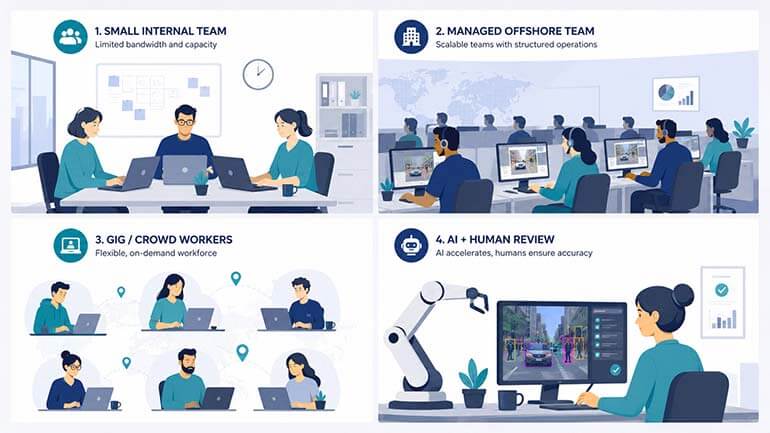
Crowdsourcing platforms look cheap per task. Factor in redundancy (sending each item to 3-5 workers), spam filtering, and rework, and the effective rate climbs toward managed-service pricing without the accountability.
Automation deserves its own paragraph. Model-assisted labeling means a model pre-draws labels and humans correct them. Pre-labeling with a decent model can cut human time 30% to 70%. Active learning goes further: the model picks which items humans should label next, so you label fewer items overall. Neither eliminates humans. Both change what you pay humans to do, from drawing to verifying.
Budget Benchmarks: What Real Projects Cost
A useful rule: take your per-unit estimate, multiply by volume, then add 30% to 40% for guidelines, QA, and project management. The scenarios below are illustrative estimates built from the indicative rates earlier in this article, not quotes.
| Scenario | Volume | Assumed rate | Labeling cost | With 35% overhead |
|---|---|---|---|---|
| Pilot: retail object detection | 5,000 images, ~8 boxes each | $0.05 per box | $2,000 | ~$2,700 |
| Mid-size CV: segmentation | 60,000 images | $2.50 per image | $150,000 | ~$202,000 |
| NLP corpus: classification + NER | 400,000 items | $0.05 avg per item | $20,000 | ~$27,000 |
| AV / LiDAR program | 80,000 frames | $12 per frame | $960,000 | ~$1.3M |
| Ongoing RLHF pipeline | 6,000 comparisons/month | $4 per comparison | $24,000/month | ~$32,000/month |
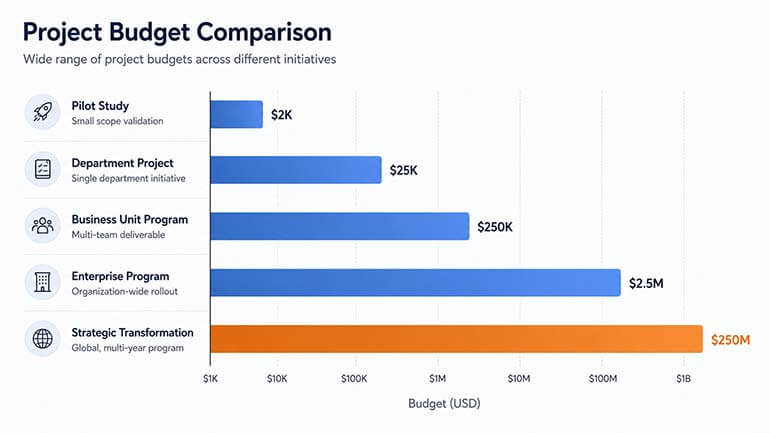
Two observations from these numbers. First, the pilot is cheap. Almost any team can afford a $3,000 pilot, and skipping one to “save money” is how six-figure mistakes happen.
Second, notice how the same math produces wildly different totals. The NLP corpus has 5x the volume of the segmentation project at roughly one-eighth the cost. Volume is not the cost driver. Seconds-per-item is.
For ongoing pipelines like the RLHF row, run the FTE comparison. If $32,000 per month buys the equivalent of 12 dedicated offshore annotators at $2,000 each ($24,000), plus leads and QA, the dedicated team may deliver more throughput for the same spend.
Hidden Costs Teams Often Miss
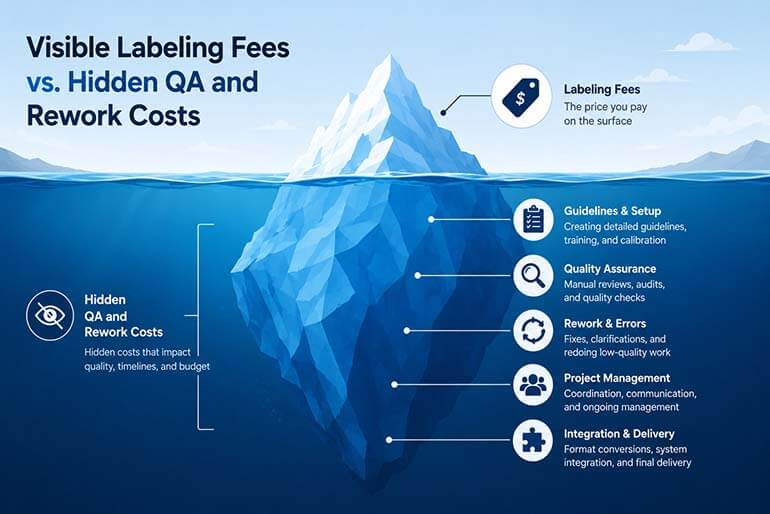
The quote covers labeling. Your budget has to cover everything else, and “everything else” commonly adds 25% to 50%. Here is what actually shows up on invoices and timesheets:
- Guideline creation and calibration rounds. Expect 2 to 4 revision cycles before annotators and your ML team agree on edge cases.
- QA, audits, and inter-annotator agreement checks, which keep consuming reviewer hours long after launch.
- Rework caused by unclear instructions. This one is usually your fault, not the vendor’s, and you pay for it either way.
- Internal project management time. Someone on your team will spend 5 to 10 hours a week on a live annotation project.
- Tool onboarding and pipeline integration, including format conversions and API work.
- Data preparation before labeling starts. Sourcing raw data through data collection services and fixing duplicates or corrupt files via data cleansing services both happen before a single label exists.
- Vendor management overhead: contracts, security reviews, invoice reconciliation.
- Label iteration. Your model will reveal that the taxonomy was wrong, and version 2 of the labels costs real money.
That last bullet is the one nobody budgets for. Requirements change once you see model results. Plan for at least one significant re-labeling pass on any serious project.
How to Reduce Data Annotation Costs Without Sacrificing Quality
The biggest savings come from labeling fewer items, labeling them right the first time, and matching the pricing model to the work. In practice, seven tactics do most of the heavy lifting:
- Write and test guidelines before scaling. A $5,000 investment in clear instructions routinely prevents $50,000 in rework.
- Run a paid pilot of 500 to 2,000 items with every serious vendor candidate. Measure accuracy against a gold set, not vibes.
- Use model-assisted pre-labeling wherever a baseline model exists. Verifying is faster than drawing.
- Apply active learning. Label the items your model is least confident about instead of labeling everything.
- Use tiered QA. Full double-review on 100% of items is rarely necessary; sample-based review at 10% to 20% with escalation catches most problems.
- Negotiate volume tiers and commit only to volumes you’re sure about.
- Match the pricing model to the task: per-label for defined high-volume work, hourly for exploration, FTE for pipelines.
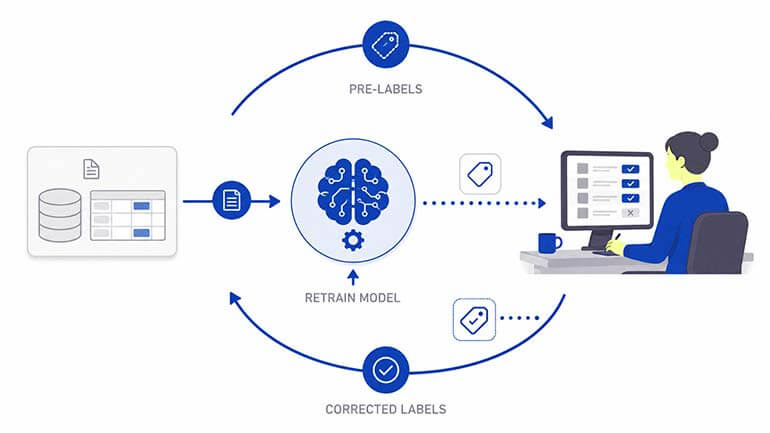
One caution on pre-labeling: it introduces bias. Annotators tend to accept the model’s suggestion, including its mistakes. Counter this with gold-set items where the pre-label is deliberately wrong, and track how often annotators catch them.
Real-World Examples
The scenarios below are composites drawn from real annotation programs, with details generalized. They show how the pricing math plays out when plans meet reality.
- The startup that missed segmentation costs by 3x. A food-tech company budgeted $0.30 per image for waste-detection data, based on bounding-box quotes. Their model actually needed polygon segmentation of overlapping food items. Real cost: around $1.00 per image. A similar image annotation case study shows how a Swiss food waste assessment firm handled exactly this class of imagery with an outsourced team. The lesson: quote the actual technique, not the category.
- Per-label vs FTE for a continuous video pipeline. A city-infrastructure client needed live traffic footage annotated indefinitely. Per-label pricing came out near $38,000 per month at their volume. A dedicated 14-person team cost $29,000 per month and improved consistency, because the same annotators saw the same intersections daily. This live video annotation project for traffic management and road planning followed the same dedicated-team logic.
- The NLP team that cut costs 40% with pre-labeling. A media analytics firm needed hundreds of thousands of news articles classified and tagged. After 30,000 manually labeled items, they trained a baseline model to pre-label the rest. Humans corrected instead of created, and throughput roughly doubled. A comparable text annotation project on news articles used trained annotators with layered review to keep accuracy up while volume scaled.
- The medical AI project where experts set the price. A diagnostics startup assumed standard rates for pathology slide annotation. Regulators and their own validation plan required annotations reviewed by board-certified pathologists at $120+ per hour. The data budget grew 6x. They adapted with a two-tier workflow: trained generalists did initial marking, and pathologists reviewed and corrected, cutting expert hours by more than half.
- The crowdsourcing project that cost more than the managed quote. An e-commerce team chose a crowd platform at $0.02 per product tag over a managed vendor at $0.05. Accuracy came back at 78%. After adding 3-worker redundancy, adjudication, and a full rework pass, effective cost passed $0.06 per usable tag, and the schedule slipped six weeks. Cheap labels you can’t use are the most expensive labels there are.
Risks of Choosing Annotation Vendors on Price Alone
The cheapest quote frequently produces the most expensive dataset. Label errors flow straight into model errors, and by the time you see them in production metrics, you’ve paid for labeling, training, and evaluation.
Four risks show up repeatedly. Quality: noisy labels cap your model’s ceiling no matter how good the architecture is. Timeline: underpriced vendors overpromise capacity, then miss deadlines when the work turns out harder than they bid. Security: rock-bottom rates often mean uncontrolled home-worker environments, a serious problem for regulated or proprietary data. Model performance: a few percentage points of label noise can erase months of modeling work, and diagnosing it is miserable.
None of this means expensive equals good. It means price should be the fourth question you ask, after quality process, security posture, and pilot results.
Best Practices Before Signing an Annotation Contract
Run a structured evaluation before committing budget. This checklist covers the questions that separate strong vendors from good salespeople:
RFP and evaluation questions
- What is your QA process, specifically? Ask for reviewer ratios, gold-set usage, and how disagreements get resolved.
- What accuracy will you commit to in writing, and how is it measured? (Per-label F1 on audited samples beats vague “99% quality” claims.)
- Who are the annotators, where do they work, and what security certifications cover the facility?
- What are your throughput assumptions, and what happens to price if they prove wrong?
- How do guideline changes get priced mid-project?
Pilot design
- Pay for a pilot of 500 to 2,000 representative items, including your ugliest edge cases.
- Score it against a gold set your team labels independently.
- Score communication and turnaround during the pilot alongside accuracy.
Contract and SLA terms
- Define accuracy thresholds, measurement method, and remedies (free rework, credits) if quality slips.
- Fix turnaround times per batch, with rush terms priced up front.
- Pin down data handling: storage location, retention, deletion, and breach notification.
- Require pricing transparency: per-unit rates, QA inclusion, tool fees, and minimums all itemized.
If a vendor resists a paid pilot or written quality metrics, that is your answer.
Conclusion
Data annotation cost comes down to seconds of skilled human attention per item, multiplied by volume, wrapped in quality control. Cheap tasks cost pennies. Expert tasks cost dollars, sometimes tens of dollars, per decision.
The teams that control annotation budgets do three things. They pilot before scaling. They convert every quote to cost per QA-passed unit. And they budget the 30% to 40% overhead that always shows up.
Frequently Asked Questions
Indicatively, $4 to $10 per hour for offshore generalist annotators, $8 to $20 nearshore, $20 to $60 for onshore generalists, and $50 to $150+ for domain experts such as clinicians or lawyers.
Roughly $50 to $500 for bounding boxes depending on object density, and $500 to $6,000 for full semantic segmentation. Always price from a sample batch.
Crowdsourcing has the lowest sticker price, but managed offshore teams usually deliver the lowest cost per usable label once rework is counted.
Per-label suits stable, well-defined tasks where you can verify throughput. Hourly suits evolving tasks. For pipelines running months, dedicated FTE pricing usually wins.
Simple classification runs about $0.02 to $0.10 per item at volume. NER and entity linking run $0.04 to $0.30+ per document (indicative).
Generalist preference comparisons run roughly $0.50 to $8 each. Expert evaluations for code, medical, or legal content can exceed $50 per task.
It requires credentialed experts, HIPAA-compliant environments, and heavy review layers. Expert time at $30 to $150+ per hour dominates the cost.
Yes. Discounts of 10% to 40% are common past roughly 100,000 units, usually structured as pricing tiers.
95% is a common production target for general tasks. Safety-critical and medical applications often require 98%+ with consensus review, which costs substantially more.
Outsource production volume unless your data is too sensitive to leave or annotation knowledge is core IP. Keep guidelines and QA ownership in-house either way.
Still guessing at your annotation budget? Share a sample batch and we’ll price it properly.
Request a custom annotation quote »


Biju Peter is a Senior Project Manager with 22+ years in the BPM industry, specializing in large-scale data operations and annotation-driven projects. He brings deep expertise in data processing, web research, scraping, and multi-modal annotation across image, text, audio, and video domains. He has successfully led 200+ projects, managed large teams, and delivered scalable, high-quality solutions for global AI and machine learning initiatives for clients across the globe. 🔗Connect with Biju on LinkedIn