

Land Record Digitization Services for Accurate, Searchable Property Records
Land record digitization converts paper land documents into searchable digital records. Scanning alone is not enough, since a deed image cannot be searched. The value is in the extracted data: grantor and grantee names, parcel identifier, recording date, and legal description.
HabileData digitizes sale deeds, survey documents, cadastral sheets, tax receipts and lease files for land administration bodies, recorders, title companies and property data aggregators. Using our property data expertise, we scan, extract, validate and index each record so it arrives as a structured database rather than a folder of untagged images.
Paper archives carry costs that never appear on a budget line. Documents degrade, and the oldest degrade fastest. Records exist in one place, so a fire or a misfiling is permanent. Retrieval takes minutes or hours per request instead of seconds. Nothing can be searched across, so a question like “which parcels in this township changed hands in 1974” cannot be answered without reading everything. Digitized records fix those problems in order: preservation first, retrieval second, then analysis once the data is structured enough to support it.
Organizations that scan without indexing usually discover the problem two years later, with staff opening files one at a time looking for a parcel number. We build the index to your schema, or design one where none exists, and deliver through data conversion workflows that keep the source image linked to every record.
Get a Free Digitization Quote →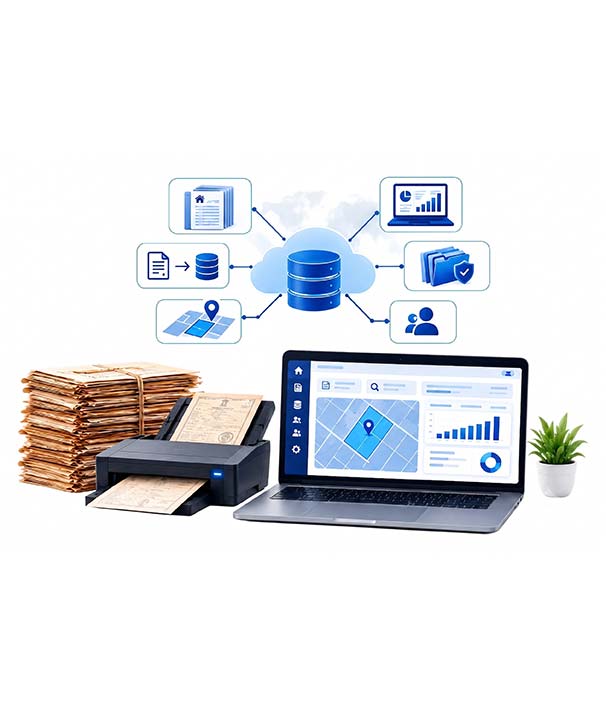
Land Record Digitization Services We Offer
Our land record digitization services cover scanning, data extraction, indexing and database delivery for deeds, survey documents, cadastral maps and property tax records.
- Sale Deed Data Entry
- Land Document Scanning & Imaging
- Title Document Digitization
- Government Survey Record Digitization
- Cadastral Map Digitization
- Parcel & Boundary Data Conversion
- Property Tax Record Digitization
- Lease & Land Agreement Abstraction
- Historical Land Record Digitization
- Land Records OCR & Data Extraction
- Land Records Indexing & Metadata Capture
- Land Records Database Creation
Types of Land Records We Digitize
Condition matters more than document type. A brittle handwritten register from 1890 and a printed deed from 2015 can both be digitized, but they need different handling and different accuracy expectations.
Registered Sale Deeds & Conveyances
Title Documents & Ownership Records
Grantor & Grantee Indexes
Historical Deed Books
Survey Records & Field Notes
Survey Plats & Cadastral Sheets
Parcel & Boundary Records
Property Tax Receipts & Assessment Rolls
Lease & Land Agreements
Easement & Encumbrance Records
Mutation & Chain-of-Title Records
Handwritten Land Registers
Send us a sample of anything not listed here. Assessment costs nothing and tells us more than a description would.
Our Land Record Digitization Process
Five stages, in order. Image quality sets OCR accuracy, and OCR accuracy sets how much manual entry an archive needs.
Intake & Scoping
We audit a sample archive to set document types, capture fields and accuracy targets before pricing anything.
Scanning & Image Preparation
Documents are scanned, deskewed and cleaned. Unreadable pages get flagged for rescan before entering the pipeline.
Classification, OCR & Extraction
Images route by type and jurisdiction. OCR captures printed text; low-confidence fields go to manual entry.
Data Entry, Cleaning & Standardization
Specialists key handwritten and degraded records. Critical fields are double-entered, then deduplicated and normalized to your schema.
Quality Assurance & Delivery
Rule checks and sample audits run before delivery as CSV, XML, JSON, database load or API.
Land Record Digitization Success Stories
Parcel Data Aggregation for Leading Data Aggregator Led to High Performing Database
The client a leading real estate parcel data aggregation company empowering its global clientele with real estate data and insights. Leading Real Estate Data Aggregator, USA
Read full Case Study »Who Uses Land Record Digitization Services

Government Land Registries
National and regional record holdings digitized with preservation and public access as parallel goals.

County Recorders & Archives
Historical deed books and grantor/grantee indexes converted to support public search portals.

Real Estate Data Aggregators
Parcel, ownership and transaction data from jurisdictions where nothing exists digitally and scraping is not an option.

Title Companies & Abstractors
Searchable back-title archives that cut the time spent on manual chain-of-title work.

Surveying & GIS Organizations
Analog plats and cadastral sheets converted into parcel datasets that attach to spatial layers.

REITs & Corporate Real Estate
Property files consolidated from acquisitions where every portfolio arrived with a different filing system.
Why Outsource Land Record Digitization to HabileData

Experience
Over 30 years in data processing, with a dedicated property data practice covering title search, deed processing and parcel aggregation. Land records are not a side capability here.

Domain-Trained Teams
Operators trained to read legal descriptions, recognize instrument types and spot the discrepancies that matter. A metes-and-bounds description flattened into an address field looks complete and is worthless.

Accuracy Controls
Double entry on critical fields, automated rule-based validation and pre-delivery audits are standard on land record work, not upgrades.

Automation Where It Holds
Custom macros and rule scripts handle classification, routing and merge steps. On handwritten historical records, automation is withdrawn and the work is done manually.

Scale & Time-Zone Advantage
Sustained throughput of over 650,000 records monthly on live property projects, with work moving overnight while your office is closed.
Tools, Technologies and Data Security
We combine OCR, custom automation and manual verification, and we set the balance per project rather than applying one pipeline to every archive. Land records carry ownership and personal information, so every project runs under NDA with access-controlled handling.
Document Processing
- OCR with per-field confidence thresholds, routing low-confidence output to manual entry
- Custom macros for classification, routing, format validation and merge steps
- Image quality control for legibility, skew, cropping and completeness, with failed pages returned for rescan
Data Delivery
- CSV, XML, JSON and Excel output for flexible reporting
- Structured database loads and direct export into client systems
- API integration for pushing records into your application or portal
Quality & Security
- Double entry on parcel identifiers, party names and recording references
- Rule-based validation on formats, date logic and cross-field consistency, plus pre-delivery sample audits
- NDA-backed handling, access-controlled facilities and secure transfer. See our data security and confidentiality practices
Land Record Digitization FAQs
Converting paper land documents into digital records with structured, searchable data attached, including scanning, data extraction, validation and indexing. The scanned image alone is not enough.
Outsourced conversion of a land archive: intake, scanning, OCR, manual entry, cleaning, validation, indexing and delivery into your system. Used when volume exceeds internal capacity.
Paper records deteriorate, exist in one location and cannot be searched. Digitization preserves ownership evidence, cuts retrieval to seconds and speeds title verification and tax assessment.
Sale deeds, title documents, grantor/grantee indexes, deed books, survey records, cadastral maps, tax rolls, leases, easements, mutation records and encumbrance certificates. Condition matters more than type.
Five stages: intake and scoping, scanning, classification and OCR, data entry and standardization, then quality assurance and delivery. Scoping happens before pricing.
Yes. Handwritten deed books and brittle registers need gentle scanning, higher resolution and mostly manual entry, since OCR reads historical script poorly. Expect longer timelines.
Critical fields are double-keyed by two operators and reconciled. Automated rule checks and sample audits run before delivery. Illegible records are flagged in an exception report rather than guessed at.
Outsourcing turns a one-time backlog into a variable cost with scalable capacity, and brings in operators who have processed land records before. Usually cheaper than building internally.
What Our Client’s Say about HabileData


















Recent Articles