

Boost Your AI with Custom Bounding Box Annotation Services
Object detection models underperform in production because of annotation, not architecture. Boxes drawn pixels too wide teach your model the wrong boundaries.
HabileData’s bounding box annotation services are built on one core principle: annotation consistency is an engineering problem, not a training problem. Tight fit is a contractual standard enforced by per-batch IoU measurement against a gold standard set. Our annotation guidelines define the object boundary precisely as the outermost visible pixel.
Tight fit is a contractual standard – not a guideline suggestion
Per-batch IoU measurement against a gold standard set enforces tight fit as a contractual standard on every delivery. Our annotation guidelines define the object boundary as the outermost visible pixel. Boxes drawn 5 to 10 pixels wider than the object are caught and corrected before they reach your training pipeline.
Fine-detail boundaries decided in writing – before annotation begins
For bicycle spokes, mesh fences, and tree branches, the guideline explicitly states whether fine detail is included or a convex hull approximation applies. That decision is written down before annotation begins, because ten annotators following the same written rule produce ten consistent labels. Ten using individual judgment produce ten different datasets.
IoU measured per batch – not averaged across the entire project
300+ trained annotators and a three-stage QA process that measures IoU per batch – not as a project-level average. Our image annotation services cover multi-class annotation, multi-label attribute classification, hierarchical taxonomies, and persistent track ID assignment for video object detection datasets.
Format configured before the project – not after a mismatch
COCO JSON, Pascal VOC XML, YOLO TXT, and any custom format your object detection framework requires – configured before the project begins, not after the first batch reveals a format mismatch. Your pipeline receives data in the exact schema it expects from delivery one.
Bounding Box Annotation Services Offerings
We deliver the full range of annotation capabilities for this technique – each configured to your specific ML framework and output requirements.
2D Bounding Box Annotation for Images
Tight-fit rectangular boxes around every object instance in the image, classified to your defined class taxonomy. Supports single-class, multi-class, and multi-label annotation. Attribute labels (colour, state, orientation, damage level) applied per box where required. Occlusion severity flags applied at three levels: fully visible, partially occluded, truncated.
Video Bounding Box Annotation with Object Tracking
Frame-by-frame bounding box annotation with persistent track IDs across the full video sequence. CVAT frame interpolation applied for smooth trajectories between annotated keyframes. Human review on every interpolated frame. Written track ID continuity rules prevent the ID swap errors that corrupt MOT training datasets.
Geo-Tagging and Location-Aware Annotation
Bounding boxes augmented with GPS coordinates, altitude data, and geographic metadata for aerial and satellite imagery annotation. Used for object detection models in geospatial AI, drone surveillance, and infrastructure inspection applications.
Multi-Attribute Object Classification
Each detected object classified with both a primary class label and secondary attribute labels — a vehicle annotated as class ‘car’ with attributes ‘sedan’, ‘red’, ‘parked’, ‘undamaged’. Enables training of attribute classification models alongside object detection in a single annotation pass.
Bounding Box Annotation Success Stories
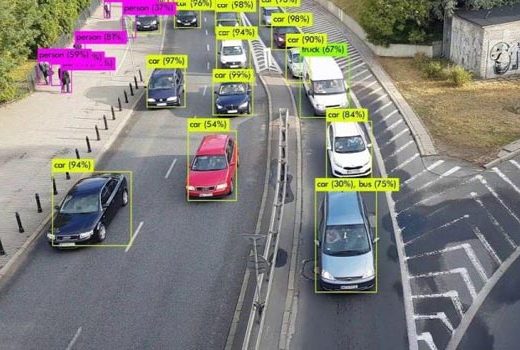
Annotation of Live Video Streams for Traffic Management and Road Planning
Annotating pre-recorded and live video stream of vehicles provided training data for machine learning models for a California based data analytics company helped managing traffic efficiently.
Read full Case Study »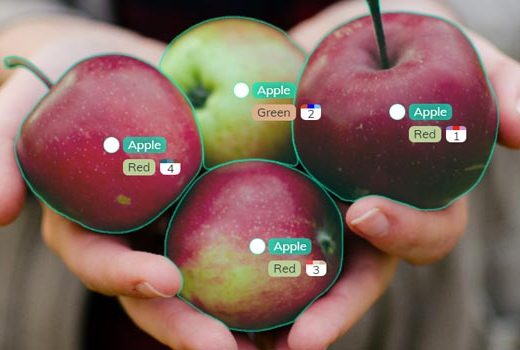
Image Annotation for Swiss Food Waste Assessment Solution Provider
The food images to be labelled and categorized so that the client could use them as training data for accurate interpretation of visual data through data annotation.
Read full Case Study »
Annotating Text from News Articles to Enhance the Performance of an AI Model
Capture, validate and verify information on upcoming or existing construction projects from multi-lingual and multi-format online publications across Europe and USA.
Read full Case Study »Our Accuracy Standards
Benefits of Outsourcing Bounding Box Annotation to HabileData

95%+ IoU – Per-Class, Measured on Every Batch
We measure IoU per class using automated geometric validation after human QA review. Every batch delivery includes a per-class IoU report. Batches with any class below the agreed threshold are re-annotated before delivery.
10,000+ Images Per Day – Fastest Annotation Throughput
Bounding box annotation is the fastest technique at scale. At standard throughput of 10,000+ images per day, a 1M-image dataset takes approximately 100 working days. Burst capacity of 50,000+ images per day is available for deadline-critical projects.
All Major Frameworks – YOLO, Detectron2, MMDetection
We deliver in the exact format required by your training framework — YOLO TXT (any version), COCO JSON, Pascal VOC XML, KITTI, nuScenes, Waymo, or custom schema. No conversion step needed before training.
AI-Assisted Pre-Labeling – 40–60% Faster on Standard Classes
We integrate Labelbox Model-Assisted Labeling and CVAT AI detection tools to pre-label images with a detection model trained on similar data. Annotators verify and correct pre-labels rather than drawing from scratch — 40–60% faster on standard class sets.
Domain-Specific Teams
Annotators are organized into domain teams with training in class-specific annotation conventions. AV bounding box annotation is handled by AV-specialist annotators who understand vehicle class hierarchies, truncation handling at image boundaries, and AV-specific sensor fusion context.
Areas of Expertise –Industries We Serve
We provide annotation services across the industries where bounding box annotation demand is growing fastest, with domain-trained annotators matched to each vertical:
What Our Client’s Say about HabileData





Bounding Box Annotation: Frequently Asked Questions
Bounding box annotation places a rectangular region (defined by x, y, width, height coordinates) around each labeled object in an image. It is the primary training data format for object detection models built with YOLO, Faster R-CNN, SSD, DETR, and other detection architectures. Bounding box annotation is used in autonomous vehicle object detection, retail product detection, security surveillance, medical imaging diagnostic AI, agricultural pest and crop detection, and any application where a model needs to locate and classify objects in images.
A tight bounding box follows the outermost visible pixels of the object – the box boundary is as close as possible to the actual object edge without cutting into it. A loose bounding box includes a margin of background pixels around the object.
The choice matters for model training because the object size statistics the model learns are determined by the bounding box dimensions. Tight boxes produce models with correctly calibrated size priors. Loose boxes inflate size estimates and can degrade confidence score calibration. At HabileData, tight fit is the default standard; if your project requires loose boxes with a defined margin, we configure that in the annotation guidelines.
Our SLA target is 95 percent or higher Intersection over Union (IoU), measured per delivery batch against a gold standard annotation set. IoU measures the overlap between the annotated bounding box and the ground truth box, expressed as a fraction of the total area covered by both. A score of 0.95 means there is 95 percent agreement between the annotation and the ground truth. This score is calculated per batch and included in the delivery documentation. Batches below the 0.95 threshold return to production.
We deliver in COCO JSON (industry standard, compatible with Detectron2, MMDetection, Ultralytics YOLO), Pascal VOC XML (per-image XML files, compatible with TensorFlow Object Detection API), YOLO .txt (normalised coordinates, one file per image, compatible with YOLOv5, YOLOv8, YOLOv9), and custom formats matching your pipeline’s schema. For video annotation, we also deliver in MOT Challenge format and JSON with track IDs for tracking benchmark evaluation.
Yes. For video datasets requiring multi-object tracking (MOT) training data, we annotate persistent track IDs across the full video sequence. Track IDs are assigned at first object appearance and maintained through occlusion, re-entry, and camera transitions according to written ID continuity rules defined before the project begins. CVAT frame interpolation is applied between manually annotated keyframes, with human review of every interpolated frame before QA. We deliver in MOT Challenge format, JSON with track IDs and frame IDs, or CVAT XML.
For datasets with rare object classes (a surveillance dataset with thousands of car instances but few motorcycle instances, for example), we apply class-stratified sampling in the QA process — rare classes receive proportionally higher QA review rates to ensure their annotation quality is at least as high as frequent classes. We also document per-class object counts and IoU scores in the delivery README so your training team can apply class-weighted loss functions with accurate count information.