
Accurate Image Annotation Services That Train Better AI Models
A computer vision model that fails in production almost always traces back to training data quality. Annotation errors compound fast. A bounding box that clips an object by 20% teaches your model the wrong boundary across every training iteration.
At HabileData, our image annotation services are built around preventing these errors through structured guidelines, domain-trained annotators, AI-assisted pre-labeling, and a three-stage quality review with inter-annotator agreement measured on every batch.
Three-stage quality review – errors caught before they compound
A bounding box that clips an object by 20% teaches your model the wrong boundary across every training iteration. Our structured guidelines, AI-assisted pre-labeling, and three-stage quality review with inter-annotator agreement measured on every batch prevent annotation errors from compounding into model failure.
300+ specialists across every labeling technique and output format
Bounding box, polygon, semantic segmentation, keypoint, polyline, 3D cuboid, and LiDAR point cloud — all delivered in COCO JSON, Pascal VOC XML, YOLO TXT, PNG mask, or custom formats. We work within your existing annotation platform, not ours.
Annotators matched to your domain context – not just the technique
Teams across healthcare, autonomous vehicles, retail, robotics, geospatial, and financial services outsource to HabileData because we match annotators to the domain context of the data. Domain-trained annotators reduce edge-case errors that generalist labelers consistently miss.
Data confidentiality built into the project – not bolted on after
All work begins under NDA with encrypted file transfer and role-restricted access on secured workstations. For sensitive data, we support on-premises delivery and air-gapped environments. Your image data confidentiality is part of the project architecture, not an afterthought.
Image Annotation Services We Offer
HabileData provides end-to-end image annotation services across every major labeling technique. Each service is delivered by domain-trained annotators with a verified 95%+ IAA standard, making your AI training data production-ready from day one.
Bounding Box Annotation
The most widely used technique in object detection and recognition. Our annotators draw precise rectangular boxes around target objects, ensuring clean, consistent training signals for models built on YOLO, Faster R-CNN, and similar architectures.
Polygon Annotation
Where bounding boxes are not precise enough, polygon annotation traces the exact boundary of each object. Ideal for irregularly shaped objects in autonomous vehicles, retail, and medical imaging datasets.
Semantic Segmentation
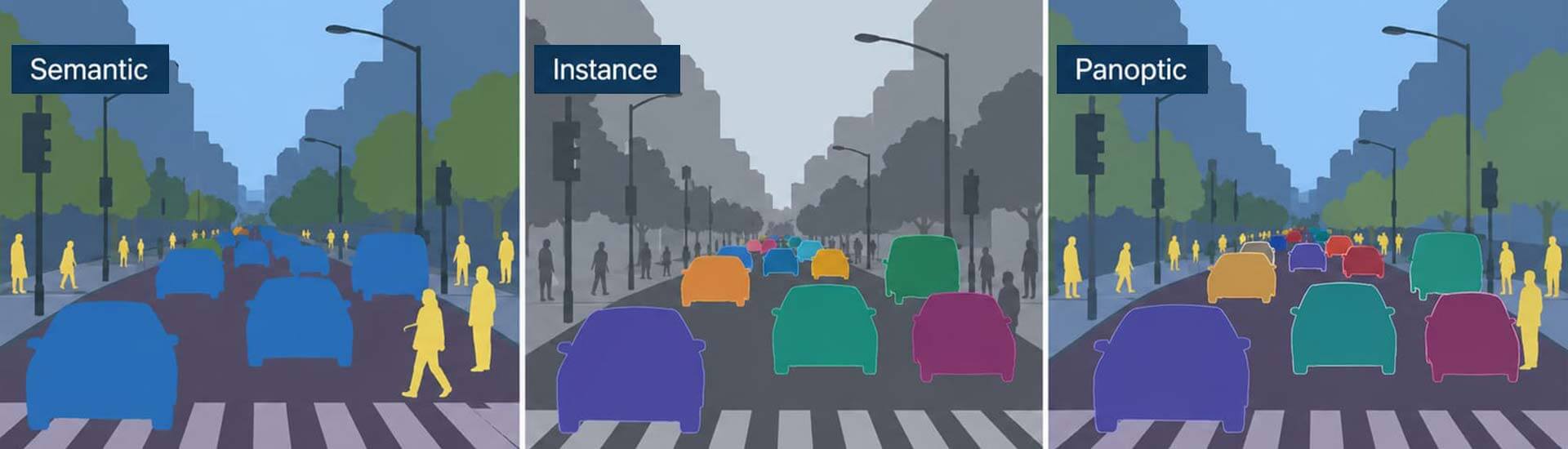
Every pixel in an image is classified and assigned to a category. Our semantic segmentation annotation supports pixel-level scene understanding for robotics, satellite imagery, and self-driving perception models.
Landmark Annotation
We place precise landmarks on human bodies, faces, hands, and objects to train pose estimation, facial recognition, and gesture detection models across healthcare, sports analytics, and security applications.
Polyline Annotation
Used primarily for lane detection, road marking, and infrastructure mapping, our polyline annotation service supports autonomous vehicle and geospatial AI models that require continuous boundary tracking.
3D Cuboid Annotation
Our annotators place accurate 3D cuboids around objects in 2D images to give depth-aware models spatial context. Widely used in warehouse automation, robotics, and autonomous driving perception pipelines.
LiDAR Point Cloud Annotation
We annotate raw LiDAR point cloud data with precise object classification, segmentation, and tracking labels. A critical service for autonomous vehicle teams building reliable real-world perception systems.
Which Image Annotation Technique Do You Need?
Use this table to match your model task to the right annotation approach, output format, and quality benchmark.
✦ Not sure which technique fits your project? Share your model task and dataset description – our team will recommend the right approach and provide a free pilot batch to validate quality before any commitment.
Image Annotation & Labeling Success Stories
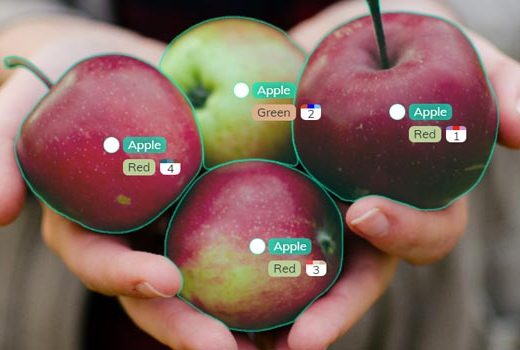
Image Annotation for Swiss Food Waste Assessment Solution Provider
The food images to be labelled and categorized so that the client could use them as training data for accurate interpretation of visual data through data annotation.
Read full Case Study »Benefits of Outsourcing Image Annotation to HabileData

Cost Efficiency – Save 60% vs. In-House
Building an in-house annotation team means absorbing recruitment, training, tool licensing, and QA management costs before a single image gets labeled. HabileData’s managed image annotation services give you 300+ trained annotators on demand at 60 to 70% lower cost than an equivalent in-house setup on a fully loaded cost comparison.
Access to Specialist Annotators
Generic annotators produce generic results. Our teams are organized into domain-specialist groups where medical imaging annotations are handled by annotators trained in radiology and pathology conventions. Domain specialization reduces edge-case errors and improves inter-annotator agreement on ambiguous classes.
Scalability from 10,000 to 100,000+ on Demand
We annotate 10,000+ images at standard daily throughput with burst capacity available for time-critical projects. Volume spikes of up to 10x can be accommodated with 48 hours’ notice, with no hiring, no onboarding, and no delay to your model release schedule.
Speed & Efficiency
We integrate SAM, Labelbox MAL, and CVAT semi-automatic annotation to pre-label images that annotators then refine. This reduces per-image annotation time by 40 to 60% on structured datasets without compromising accuracy. Human QA still validates every annotation before delivery.
95%+ IoU Accuracy on Every Batch
Quality at HabileData is measured, not assumed. Every batch includes per-class IoU scores from our QA system. If a batch does not meet the agreed threshold, it is re-annotated at no charge. Our standard thresholds are 95%+ IoU for bounding box, 93%+ for polygon, and 92%+ for semantic segmentation.
Enterprise-Grade Data Security
Image data is sensitive, and we treat it that way. All files are transferred via encrypted SFTP, processed in access-controlled environments, and deleted within the agreed retention window. We are ISO 27001-certified and GDPR-compliant, with HIPAA-aligned controls available for medical imaging projects.
Our 5-Step Image Annotation Process
Data Review & Scoping
We review your image dataset for volume, resolution, format distribution, class balance, and edge-case frequency before annotation begins.
Guideline Creation & Calibration
We write annotation guidelines specific to your dataset – class boundary rules, occlusion handling, small object thresholds.
AI-Assisted Pre-Labeling
We apply CVAT model integration or Segment Anything Model (SAM) pre-fills to reduce annotation time by 40–60%.
Three-Stage Human QA
Stage 1: Peer review of a stratified 15-20% sample per batch. Stage 2: QA specialist reviews all flagged assets. Stage 3: IAA calculated (IoU / OKS / 3D IoU).
Secure Delivery & Documentation
Dataset delivered in your required format (COCO JSON, YOLO TXT, Pascal VOC, PNG mask, or custom) via encrypted SFTP or cloud storage (S3, GCS, Azure Blob).
Image Annotation Tools and Platforms We Support
We work within your existing annotation platform or provision and configure tooling for you. Our team is trained and actively working on the following platforms.
Best for
- CVAT: Open-source teams and research
- Labelbox: Enterprise ML teams, MAL pipelines
- SuperAnnotate: Annotation + model training in one platform
- Roboflow: Computer vision teams using YOLO training
- V7 Labs (Darwin): Medical imaging and life sciences
- Scale AI: High-accuracy projects with strong QA requirements
- Segments.ai: AV and robotics 3D annotation
- Custom platforms: Enterprise clients with proprietary tooling
Our capability
- CVAT: Full project setup, SAM pre-labeling, QA, COCO/VOC/YOLO export
- Labelbox: Full ontology setup, Model-Assisted Labeling, all export formats
- SuperAnnotate: Full project config, AI-assisted workflows, QA, export
- Roboflow: Full dataset upload, annotation, augmentation, YOLO/COCO export
- V7 Labs (Darwin): Full DICOM support, medical annotation, ontology setup, JSON export
- Scale AI: Partner integration for specialist and overflow annotation
- Segments.ai: Full 3D point cloud annotation, image segmentation, AV formats
- Custom platforms: 2-hr walkthrough + training; full production within 2 business days
Areas of Expertise –Industries We Serve
We provide annotation services across the industries where bounding box annotation demand is growing fastest, with domain-trained annotators matched to each vertical:
What Our Client’s Say about HabileData





Image Annotation: Frequently Asked Questions
Image annotation in machine learning is the process of labeling objects, regions, and features within images to create structured training data for computer vision models. Annotated images teach AI models to detect, classify, and segment objects accurately. Without high-quality annotated training data, computer vision models cannot generalize reliably to real-world inputs.
The most widely used image annotation types are bounding box, polygon, semantic segmentation, instance segmentation, keypoint and landmark, polyline, 3D cuboid, and LiDAR point cloud annotation. Each technique serves a specific computer vision task. Bounding box is used for object detection, polygon for precise boundary delineation, semantic segmentation for pixel-level scene understanding, and LiDAR annotation for autonomous vehicle perception.
Image annotation cost depends on annotation type, dataset complexity, volume, and turnaround time. Outsourcing image annotation to a managed service provider like HabileData costs 60 to 70% less than building an equivalent in-house team. Contact our team for a project-specific quote based on your dataset requirements.
Image annotation and image labeling are often used interchangeably, but annotation is the broader term. Image labeling typically refers to assigning a single class label to an entire image. Image annotation covers more detailed techniques including bounding boxes, polygons, segmentation masks, and keypoints that identify specific objects and regions within an image.
A good inter-annotator agreement score for image annotation is 90% or above. HabileData maintains a 95%+ IAA standard across all project types, with per-class IoU scores measured on every batch delivery. Standard thresholds are 95%+ IoU for bounding box, 93%+ for polygon, and 92%+ for semantic segmentation.
Image annotation time depends on the annotation type, image complexity, and dataset volume. With AI-assisted pre-labeling using SAM and Labelbox MAL, HabileData reduces per-image annotation time by 40 to 60% on structured datasets. At standard throughput, we annotate 10,000+ images daily with burst capacity scaling to 100,000+ images for time-critical projects.
Outsourcing image annotation eliminates the cost and time of recruiting, training, and managing an in-house annotation team. It gives you immediate access to domain-specialist annotators, scalable capacity without hiring delays, and measurable quality standards on every batch. Companies that outsource image annotation to HabileData reduce annotation costs by 60 to 70% while maintaining production-grade accuracy.
Image annotation quality is measured using inter-annotator agreement and Intersection over Union scores. IAA measures consistency between annotators labeling the same image. IoU measures how closely an annotated region matches the ground truth boundary. HabileData generates per-class IoU scores on every batch and re-annotates any batch that falls below the agreed quality threshold at no charge.
When choosing an image annotation company, evaluate domain expertise, quality measurement standards, scalability, data security practices, and platform compatibility. Look for providers that measure IAA and IoU on every batch, offer domain-specialist annotators, and have verifiable security certifications like ISO 27001 and GDPR compliance. HabileData offers a verified sample batch within 48 hours so you can assess quality before committing to full production.
Recent Articles

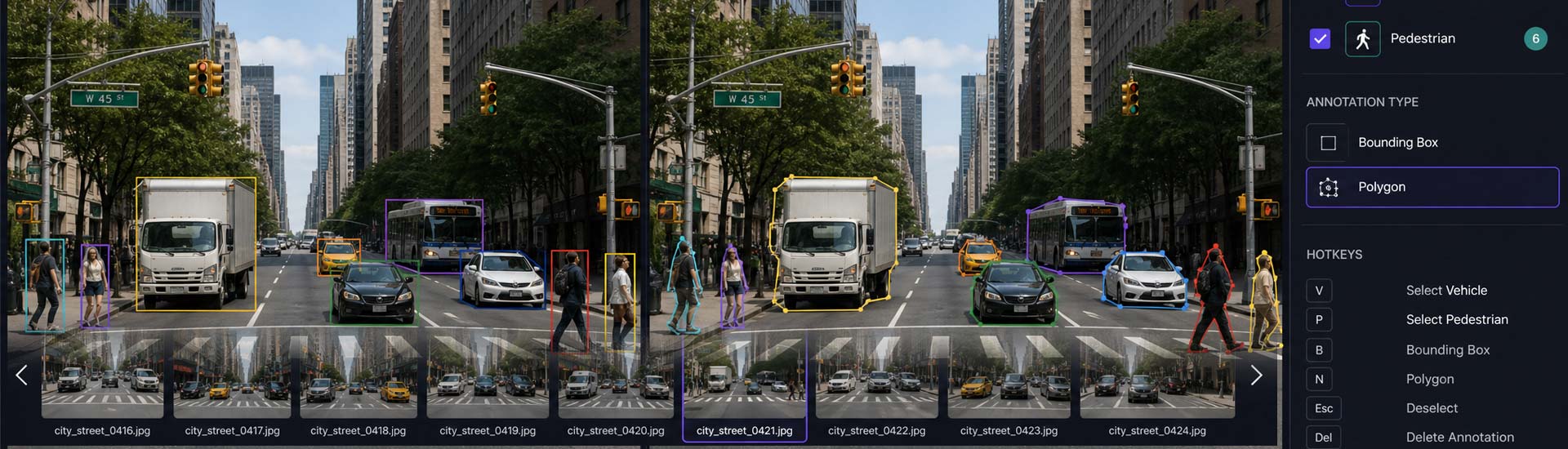
Bounding Box vs Polygon Annotation: Accuracy, Cost and Use-Case Comparison
September 15th, 2026 Biju Peter