Property document classification becomes difficult as document volumes, formats and categories increase. AI/ML can automatically identify and categorize deeds, mortgages, liens, tax records and other property documents. Human review and continuous monitoring remain important for ambiguous or changing document types.
Contents
- What Is AI document classification?
- Property document types that need classification
- How does AI classify property documents?
- AI/ML approaches to document classification
- Challenges of property document classification at scale
- Best practices for accurate AI document classification
- How to measure classification accuracy
- Build, buy, or outsource
- Conclusion
- FAQs
How do you manage property data that comes in the form of deeds, liens, mortgages, tax records, title documents, leases, appraisals if the documents are not categorized? Before you even start extracting or processing information you must know what document is.
And that is where document classification comes in.
The inflow of huge volumes of documents from different counties, title companies, lenders and other sources can get chaotic if not classified. Files are often in different formats; PDF, images, different layouts, non-standardized.
Before extracting any data, the files need to be identified accurately. Doing it manually can lead to inconsistent categorization especially when volumes increase. To combat this AI based document classification can be used that reduces manual categorization.
The job gets faster as routine tasks are handled efficiently through automation while any ambiguity goes through human review.
The article covers how AI document classification works and how it improves property document classification at scale.
What Is AI Document Classification?
AI document classification automatically categorizes documents based on their content. Using trained models, the automated classification system reads the documents and assigns them to pre-defined categories.
The categories could be deed, mortgage, lease, lien, appraisal, tax record or any such document related to property.
Classification and tagging are two different things. While classification identifies what the document is and places in the right category, tagging adds labels describing what the document contains.
Traditional methods rely on keyword searches or predefined rules to identify and categorize documents. AI/ML-based classification goes beyond these fixed rules and uses learned patterns and context to identify the document type.
Once classified the document is routed to the right workflow for further processing.
Accurate document classification is important because it prevents documents from entering the wrong workflow and reduces manual sorting. It also improves downstream data extraction by ensuring that the right extraction rules are applied to each document type.
At scale, automated classification helps process large document volumes faster and more consistently.
Property Document Types That Need Classification
Property related workflows deal with different kinds of documents. They come from different sources and jurisdictions which makes classification a challenge. Documents from these categories often contain similar terms. But they often require different processing.
Here are few examples.
Common Property Document Types for Classification
| Category | Common property documents | What gets extracted from it |
|---|---|---|
| Ownership & transfer | Deeds, warranty deeds, special warranty deeds, quitclaim deeds, corrective deeds | Grantor/grantee names, property description, recording details, transfer date |
| Financing | Mortgages, deeds of trust, assignments, MERS assignments, modifications | Borrower/lender names, loan amount, recording details, assignment information |
| Releases | Satisfactions, re-conveyances, partial releases | Released instrument, borrower/lender names, record details, release date |
| Liens & encumbrances | Tax liens, judgment liens, mechanic’s liens, lis pendens, UCC-1 fixture filings | Debtor/creditor names, lien amount, recording details, affected property |
| Title documents | Title commitments, title policies, abstracts, Schedule A, Schedule B | Ownership details, legal description, exceptions, requirements, liens and encumbrances |
| Tax & assessment | Property tax records, assessment records | Assessed value, tax amount, parcel information, tax status |
| MLS & property listings | MLS sheets, listings, sold records, comparable sales | Listing details, sale price, property characteristics, transaction information |
| Plats & surveys | Subdivision plats, survey maps, legal descriptions | Lot/block details, boundaries, dimensions, plat references |
| Foreclosure | Notice of default, trustee’s deed, sheriff’s deed, certificate of sale | Parties, property details, default/sale information, recording details |
| Probate | Letters testamentary, affidavit of heirship | Decedent/heir information, estate details, property references |
| Restrictions & property rights | Easements, rights-of-way, CC&Rs, HOA declarations | Affected property, rights/restrictions, parties, recording references |
| Supporting instruments | Powers of attorney, subordination agreements | Parties, authority/priority information, related instrument details |
Real estate data standards such as the RESO Data Dictionary help standardize property data fields and terminology across MLS systems.
How Does AI Classify Property Documents?
AI classification is a complete process where the document is first made readable particularly when dealing with scanned property records or images. The system identifies the document type based on patterns, with the prediction further evaluated using a confidence score.
Any ambiguity detected is sent for human review.
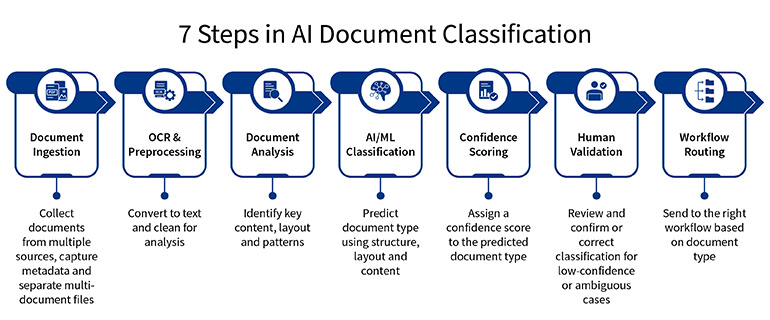
The document after confirmation is categorized and sent for the workflow. Here are the 7 steps used for AI document classification.
-
Document ingestion: This is the first stage where documents from multiple sources get collected at one place. The documents arrive from sources like public records, title companies, property databases etc. They are in formats like PDFs, images or digital documents.
Basic metadata such as file name, source and document information can also be captured at this stage. Multi-document files may be separated into individual documents before classification. After the basic checks the files are taken for classification.
-
OCR and Preprocessing: For scanned documents or images Optical Character Recognition (OCR) is used to convert the text into machine readable format. This stage often gets challenging due to poor scans, handwritten text or any other unusual layouts.
Preprocessing prepares the documents for OCR by removing noise, separating pages, and any other process that improves the quality. The documents are prepared for further classification process.
-
Document analysis and feature identification: This is the stage where analysis starts. The system starts looking for keywords, context and relationship between words. This is a complex process where the system works in multiple directions; it examines headings, structure, layout, visuals, tables and many such things to arrive at a conclusion.
-
AI/ML classification: This is the stage where the documents are categorized based on the patterns detected in the previous stages. Categorization is not done based on only keywords. A combination of structure, layout and content is analyzed by the system to decide on the category. Based on these signals, the model predicts the document type, such as a deed, mortgage, lien or release.
-
Confidence scoring: The model produces a prediction with an associated confidence/probability score, depending on the model/system.
-
Human validation: Documents with low confidence scores, ambiguous classification signals or cases requiring additional verification are routed for human review. The reviewer confirms or corrects the predicted document type before the document moves to the next workflow.
-
Routing to the right workflow: This is the final stage where the categorized documents are directed to different workflows designed for that specific document type. For example, a mortgage document is sent to a workflow designed to extract fields like name, loan amount etc. Workflow automation reduces manual routing effort by directing the identified document to the relevant property workflow.
AI/ML Approaches to Document Classification
Property documents come in different complexities. Some are very well standardized where simple rules may be sufficient while others may require complex rules. Sometimes based on the volume you may have to opt for a different strategy.
Here are some classification approaches you can use based on the complexity of the property documents.
Rules based classification: This approach uses predefined rules and keywords and is well suited for standardized and predictable documents. But this approach doesn’t work when formats and terminology differ in a big way.
For example, it can work well when documents from a particular source follow a consistent template and contain predictable labels or keywords.
Traditional machine learning: Here the machine is given examples to learn from the patterns. The model learns from many different already labeled documents to classify accurately. Common machine learning algorithms used for document classification include Naive Bayes, logistic regression, support vector machines (SVMs) and decision-tree-based models.
This approach works well when document categories are already known and sufficient labeled examples are available for each class.
NLP and deep learning: Natural Language Processing (NLP) helps analyze the language and meaning. It can understand context where there is ambiguity as different document types contain similar vocabulary.
This makes it useful for distinguishing property documents where language and context, rather than a few keywords, help identify the document type.
Multimodal/document understanding models: This approach is used when the document must be understood along with layout and visual information. The model uses information, headings, tables, formatting, all together to reach a conclusion. This approach is useful for property documents where layout, tables, forms and other visual structures help distinguish one document type from another.
Challenges of Property Document Classification at Scale
With the best of rules and approaches the classification process often gets challenging as huge volumes of documents are collected from different sources and jurisdictions.
Some of the challenges include:
Low-quality document: Very old documents are often faded and blurred while handwritten notes are difficult to decipher often with the best of technology. Sometimes even OCR struggles with poor quality documents.
Varied layouts and formats: A model trained on one format may get confused if it encounters different versions. At scale, documents may come from multiple counties and jurisdictions, each with different layouts, terminology and recording practices. PRIA notes that indexing practices and requirements can vary significantly across U.S. recording jurisdictions. The variations increase as more sources are added to the classification workflow.
Complex taxonomy: With numerous document types and sub types distinguishing closely related classes becomes complex. Rare document types make this harder because the model may encounter them less frequently than common classes such as deeds and mortgages.
Imbalanced training data: Some common documents like mortgages or deeds have relatively higher number of examples compared to uncommon document types. This creates class imbalance affecting model performance.
Volume and scalability: When document volumes increase from thousands to millions, maintaining consistent classification speed and accuracy becomes more difficult. Processing bottlenecks can develop, while the number of low-confidence documents routed for human review can also increase.
Changing document templates: Document formats are not static. Counties, lenders and other sources may change templates or introduce new versions over time. Models need to be monitored so that these changes do not gradually affect classification performance.
Similar looking document types: Different document types often contain similar terminology, which can lead to incorrect classification. Some documents are particularly difficult to distinguish because they contain similar language or serve related purposes.
Manual review workload: Every document pair the model cannot confidently distinguish may drop out of straight-through processing and require human review, increasing the manual-review workload.
Property Document Types Commonly Confused During Classification
| Document pair | Key distinction | Risk if misclassified |
|---|---|---|
| Mortgage / assignment / modification / satisfaction | Same loan, different actions or stages | Phantom open lien or released lien shown as active |
| Warranty deed / special warranty deed / quitclaim deed | Different scope of warranty | Conveyance may be interpreted incorrectly |
| Deed of trust / mortgage | Three-party vs. two-party structure | Incorrect party identification |
| Trustee’s deed / warranty deed | Foreclosure-related vs. ordinary conveyance | Foreclosure event may be missed |
| Tax lien / tax assessment | Encumbrance vs. informational record | Wrong lien status or workflow |
| Easement / right-of-way / CC&R | Different property rights or restrictions | Incorrect extraction or routing |
| Judgment lien / abstract of judgment / release | Different stages in the judgment sequence | Released lien may remain active |
Best Practices for Accurate AI Document Classification
Accurate AI document classification does not only depend on the appropriate AI model. There are many things that affect the model performance. The document taxonomy, validation process, training data, all are equally important for the performance of the model. Here we list few best practices that one must follow.
Before you train the model build a granular document taxonomy. Classification accuracy begins with taxonomy design. Clearly define the document classes and sub-classes it needs to recognize.
Just mentioning a broad category say ‘mortgage’ may not be sufficient. You must add sub-classes like original mortgage, assignment, modification, release or satisfaction.
Train AI with representative documents. Include documents from different jurisdictions and counties. The model must be trained on both clean files as well as poor quality scans. Having enough examples of sub-types helps the models train better.
Representative training data helps the model generalize better across different document types, formats and variations encountered during processing.
Use class-specific confidence thresholds. Don’t generalize a threshold; the threshold may differ by document class and business risk.
Route low-confidence and high-risk cases for human review. High-confidence predictions can be processed straight while the borderline ones can go for validation. This improves processing speed without compromising accuracy.
Measure errors at class level. Accuracy is important but don’t make it the only metric. Monitor processing time, precision, recall, F1 score and also confusion matrix. A confusion matrix is especially relevant because it can reveal patterns such as mortgage assignments repeatedly being misclassified as mortgages.
Human review should be a part of the workflow and not used as a backup only when AI fails. Reviewers can also handle poor scans, rare document classes, conflicting classification signals and other similar clashes.
And lastly always monitor production performance and model drift. The model may have performed great during initial testing, but the incoming data can have changes. New formats, jurisdictions, and document sources can change over time.
This could be the reason for retraining.
How to Measure Classification Accuracy
Your model may show high overall accuracy, but does the same accuracy sustain across all document types? A system may handle deeds and mortgages well but may not perform equally well with other complex documents. Accuracy must therefore be checked at the individual document-class level.
An important measure to track is straight-through processing (STP) rate which tells you what percentage of documents the system can classify and accept automatically without sending them for human review. The workflows at HabileData achieve an 80–90% straight-through processing rate at the defined precision threshold.
Never accept an accuracy number without context. Check whether the model was tested only on easy documents or whether difficult and rare document types were also included. Also check the confidence threshold, at what confidence level did the system automatically accept a classification? Finally, check whether the reported accuracy was measured at the individual page level or for complete documents.
When evaluating a document classification solution, ask:
- What is your accuracy on my most difficult counties and document types?
- What straight-through processing rate can you achieve at the precision level I need?
- How do you handle document types the model has never seen before?
Build, Buy, or Outsource
Organizations have three options to automate property document classification. They could either build an internal classification system, license a document AI platform or outsource the process to a service provider.
Having a system built internally requires expertise, training data, infrastructure and ongoing maintenance. But it does offer greater control overall. Licensing a platform works faster but the platform will again require configuration, integration, taxonomy mapping and monitoring. Outsourcing can be an option when internal engineering resources are limited, as the provider handles classification operations, technology and human validation.
Based on your requirement you may opt for an approach but keep in mind that document classification is not a one-time implementation. New jurisdictions get added, formats change, new document classes appear and even model performance can drift.
A phased roll-out can include:
- Define document classes and sub-classes.
- Collect representative samples across jurisdictions.
- Run the system in shadow mode alongside the existing process.
- Set confidence thresholds by document class.
- Move validated classes gradually into production.
HabileData provides pilot output within 48 hours, with full production roll-out in 2–3 weeks.
Conclusion
With property document volumes and categories increasing at a fast pace, property document classification is becoming increasingly challenging. Manual classification is time consuming and error prone. Moreover, as document volumes increase, it becomes difficult and costly to scale manual classification efficiently.
AI/ML enables classification to move beyond manual sorting. But successful classification at scale depends on more than the model: taxonomy design, representative training data, confidence thresholds, human validation and continuous monitoring are equally important.
The real value comes when classified documents are routed to the right extraction, validation and processing stage.
Human review cannot be ignored, as ambiguous cases still need to be checked by a human.
Methodology note: Operational figures cited in this article, including straight-through processing rates and implementation timelines, are based on HabileData’s document-processing workflows. Industry information and standards are supported by published sources, including PRIA, ALTA, RESO and other sources linked throughout the article.
FAQs
AI classifies property documents by analyzing text, layout, structure and context to identify the document type. OCR converts the text in scanned documents and images to machine readable format. AI identifies patterns and categorizes them into mortgage, deed, lien, release etc. Low confidence cases are routed for human review while the confirmed ones move to the workflow.
Document classification in real estate document processing is the process of identifying and categorizing property documents by type. The documents are classified into categories such as deed, mortgage, lien, lease, appraisal, tax record etc. This ensures that the document moves to the correct workflow.
Document classification identifies and categorizes the document type, while data extraction captures specific information from the document. Data extraction generally happens after document classification. For example, classification identifies a document as a mortgage, while extraction captures fields such as the loan amount, lender name and borrower name.
The accuracy of AI document classification varies depending on the document type, quality and complexity. AI can classify lower-quality property records using OCR and preprocessing to make the content machine-readable. A well-trained model can handle variations in formats and quality, while low-confidence or ambiguous cases can be routed for human review and validation.
There is no fixed number; it depends on the taxonomy and training data. A classification system can be trained to classify multiple documents like deeds, mortgages, assignments, liens, title documents etc. HabileData’s service supports 150+ property document types. New document types can also be added as the classification taxonomy and training data expand.
Yes, AI can classify handwritten and archival county records, but document quality affects performance. OCR and preprocessing help convert scanned/archival records into machine-readable text. Image cleanup/preprocessing can help with faded or noisy scans. Handwriting, damaged records, faded text and unusual layouts remain more difficult.
AI distinguishes a mortgage assignment from a mortgage by analyzing the document’s context, structure and purpose rather than relying only on common mortgage-related terms. The model looks at language, parties, document structure and contextual patterns to identify which document it is. An assignment indicates the transfer of an existing mortgage or interest from one party to another.
Straight-through processing (STP) is the percentage of documents that are classified and accepted automatically without human review. This happens when the classification meets the defined acceptance threshold at the required precision level. Low-confidence or ambiguous documents are routed for human validation.
No, AI classification does not completely replace human reviewers. AI can automatically process high-confidence classifications. Low-confidence, ambiguous, poor-quality or unusual documents can be routed for human review. Reviewers confirm or correct the predicted document type, allowing human effort to focus on exceptions and complex cases.
Document classification accuracy is measured at the individual document-class level, not only through an overall accuracy score. Metrics such as precision, recall and F1 score help evaluate performance across different classes. Results should also be considered against the document mix, confidence threshold and whether accuracy is measured at the page or document level.
Automate property document classification, extraction and validation with AI.
Explore AI Document Processing »

Jatin Patel is a Senior Manager with over 23 years of expertise in real estate documentation and legal publishing. He specializes in scaling major client accounts and driving operational excellence through strategic business transformation. By leveraging automation and deep domain knowledge, Jatin optimizes processes to enhance accuracy and efficiency. He is recognized for delivering measurable outcomes through technology adoption and a client-centric approach to execution. 🔗Connect with Jatin on LinkedIn