

Multi-county and multi-state title searches are harder because the United States has no central land records system. Over 3,000 counties each keep separate records with different indexes, offices, and digitization levels. Each state adds its own recording, probate, and title insurance laws. Every added jurisdiction multiplies research time and the number of places a defect can hide.
Contents
- What is a Property Title Search?
- Understanding Multi-County Title Searches
- Why Multi-State Title Searches Are Even More Complex
- Common Challenges During Multi-County and Multi-State Searches
- How Professional Title Researchers Handle These Searches
- Technology’s Role in Modern Title Searches
- Real-World Examples
- Risks of Incomplete Searches
- Best Practices Before Purchasing Property
- Conclusion
- Frequently Asked Questions
A property title search sounds simple. Someone checks the county records, confirms the seller owns the land, and the deal closes. For a single house in a single county, that description is close enough.
Then the property crosses a county line. Or the buyer owns land in three states. Or the seller inherited the parcel from a relative who died two states away. Suddenly you are dealing with different offices, different indexes, and different laws.
Our title research teams at HabileData run searches across more than 1,000 U.S. counties, and multi-jurisdiction files are where deals go sideways. Not because researchers are careless. Because the American land records system was never designed to talk to itself.
There are over 3,000 counties and county equivalents in the United States. Each one keeps its own land records, on its own schedule, under its own state’s rules. A search that spans two of them is not twice the work. It is often three or four times the work, with more places for a defect to hide.
The U.S. Census Bureau counts more than 3,000 counties and county equivalents in the United States. Each one keeps its own land records, on its own schedule, under its own state’s rules. A search that spans two of them is not twice the work. It is often three or four times the work, with more places for a defect to hide.
This guide explains why. It covers what a title search actually checks, why multiple counties complicate it, why multiple states complicate it more, and what buyers, investors, lenders, and title companies should do about it.
What is a Property Title Search?
A property title search is a review of public records to answer one question: can this seller legally transfer clean ownership of this property to you?
To answer it, a title examiner builds the chain of title. That is the recorded history of ownership, deed by deed, going back 30 to 60 years or more depending on state standards.
Along the way, the examiner looks for anything that could cloud the title:
- Ownership gaps or forged and defective deeds
- Mortgages and deeds of trust that were never released
- Judgment liens against current or former owners
- Unpaid property taxes and tax sale certificates
- Mechanic’s liens from contractors who were never paid
- Federal tax liens and state tax liens
- Easements that give others rights to use the land
- Restrictive covenants that limit how the property can be used
- Probate issues, such as heirs who never signed off
- Pending lawsuits, including foreclosure and divorce actions
Some of these are called encumbrances, meaning claims or restrictions that ride along with the property. Others are outright defects that can defeat ownership entirely.

A clean search supports a real estate closing and the issuance of title insurance. A problem found early can usually be fixed. A problem found after closing becomes the buyer’s expensive headache.
Understanding Multi-County Title Searches
A multi-county title search is needed whenever a single transaction touches land records in more than one county. This happens more often than people expect.
Common situations include:
- A farm or ranch that straddles a county line
- Split parcels sold together but recorded separately
- Utility corridors and pipelines crossing several counties
- Commercial developments assembled from parcels in different counties
- Large subdivisions platted near a county boundary
- A seller whose judgments or probate records sit in a different county than the land
Here is the part that surprises buyers. Counties in the same state can run their records completely differently. The law is shared. The filing cabinets are not.
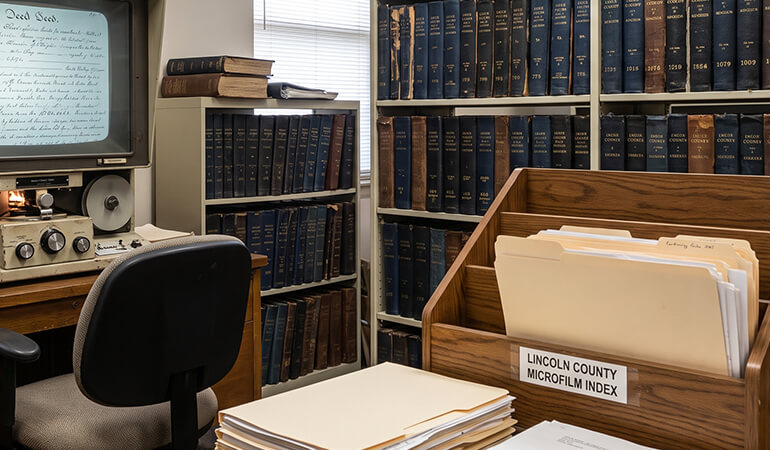
Some counties index records by grantor and grantee names. Others maintain a tract index organized by the land itself. Some have records digitized back to the 1970s. Others digitized last year, or not at all.
| Recording feature | County A (urban) | County B (rural) |
|---|---|---|
| Office name | Recorder of Deeds | County Clerk |
| Index type | Tract index, searchable online | Grantor-grantee books |
| Digital records begin | 1985 | 2015 |
| Older records | Scanned images | Microfilm and bound books |
| Recording turnaround | 1 to 2 days | 2 to 4 weeks |
| Remote access | Full online portal | In-person only |
The counties above are illustrative, but our abstractors work with pairs exactly like them inside a single state. The urban county takes an afternoon. The rural county takes a courthouse trip, a microfilm reader, and patience.
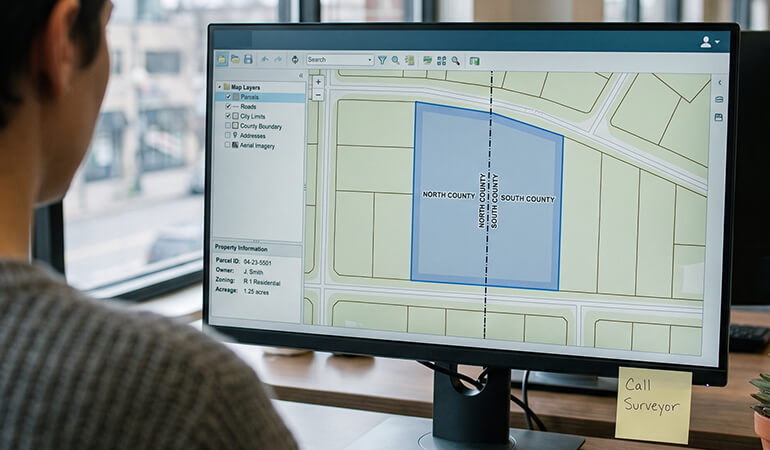
There is also the legal description problem. A parcel crossing a county line usually has a separate legal description and parcel number in each county. The deed must be recorded in both. If a past owner recorded in only one, part of the chain of title is broken.
Why Multi-State Title Searches Are Even More Complex
Cross a state line and every rule can change, not just the filing system. A multi-state title search means researching under two or more different bodies of real estate law at once.
Consider what varies from state to state:
- Recording acts. States follow race, notice, or race-notice rules, which decide who wins when two claims conflict.
- Search standards. Some states expect a 40-year search under a Marketable Title Act. Others follow 60-year or longer customs.
- Closing practice. Attorney states such as South Carolina and Georgia require a lawyer at closing. Escrow states such as California do not.
- Security instruments. Some states use mortgages. Others use deeds of trust, which foreclose differently.
- Probate law. Real property owned by an out-of-state decedent often requires ancillary probate in the state where the land sits.
- Marital rights. Nine community property states treat a spouse’s interest differently than common law states do. A few states still recognize dower-style rights.
- Tax systems. Transfer taxes, redemption periods after tax sales, and lien priorities all differ.
- Terminology. The office called a Recorder in one state is the Register of Deeds, County Clerk, or Chancery Clerk in another.
A quick example. In Iowa, private title insurance cannot be sold; buyers rely on attorney abstracts and the state’s Iowa Title Guaranty program. Move one state over and a standard ALTA title insurance policy is routine. Same country, opposite systems.
| Factor | Multi-county search (one state) | Multi-state search |
|---|---|---|
| Governing law | One set of state statutes | A different statute book per state |
| Search period | Usually consistent statewide | Can differ by decades |
| Closing format | Same statewide practice | May need an attorney in one state only |
| Title insurance | One policy often possible | Often separate policies per state |
| Probate exposure | One probate code | Ancillary probate risk |
| Cost and time | Moderate increase | Significant increase |
The practical result is that a multi-state deal is really several parallel transactions wearing one contract. Each state’s portion must independently satisfy that state’s title standards before the whole deal is safe.
Common Challenges During Multi-County and Multi-State Searches
Every jurisdiction added to a search adds new ways for the record to hide something. These are the problems examiners run into most.
Records and indexing problems:
- Missing or misfiled documents that exist but cannot be found under the expected name
- Different indexing systems, so a search strategy that works in one county fails in the next
- Recording delays, meaning a lien filed last week is not yet visible
- Name variations, such as “R.J. Whitfield,” “Robert Whitfield Jr.,” and a misspelled “Whitfeld” scattered across counties
- Parcel number changes after re-mapping, which orphan older records
- Manual records and older deeds in faded handwriting on microfilm
Boundary and survey problems:
- Boundary disputes where county line surveys disagree with old deed calls
- Survey conflicts between legal descriptions recorded in different counties
- Metes-and-bounds descriptions in one state meeting rectangular survey descriptions in another
Rights that live outside the deed:
- Easements for access, drainage, or utilities, some created decades ago
- Railroad easements and abandoned rail corridors with murky reversion rights
- Utility easements recorded only in one of the affected counties
- Mineral rights severed from the surface, common in Texas, Oklahoma, Pennsylvania, and West Virginia
- Water rights, which follow prior appropriation rules in most western states and riparian rules in the east
Jurisdictional wildcards:
- Tribal lands, where title records sit with the Bureau of Indian Affairs, not the county
- Federal lands and old federal patents, traced through Bureau of Land Management records
- Historical ownership tangles, such as unprobated estates and missing heirs
| Common title defect | Where it usually hides | Typical fix |
|---|---|---|
| Unreleased mortgage | Recorder’s index under a prior owner | Obtain and record a release or satisfaction |
| Judgment lien | The county where the debtor lived, not where the land is | Payoff and recorded release |
| Federal tax lien | Filing office tied to the taxpayer’s residence | IRS payoff or certificate of discharge |
| Missing heir interest | Probate court in another county or state | Ancillary probate or quiet title action |
| Unrecorded easement in use | Field inspection and survey, not the record | Negotiated easement agreement or exception |
| Severed mineral rights | Deeds 50+ years back in the chain | Disclosure and pricing, rarely reversible |
None of these defects is exotic. What makes multi-jurisdiction work hard is that each defect can sit in a courthouse the transaction never obviously points to.
How Professional Title Researchers Handle These Searches
Professional title research is a workflow, not a single lookup. On a multi-jurisdiction file, the workflow runs once per county, then the results are reconciled.
A typical process looks like this:
| Step | What happens | Where |
|---|---|---|
| 1. Order intake | Confirm legal descriptions, parcel numbers, and all affected counties | Survey, tax records, client documents |
| 2. Tax check | Verify assessed owner, unpaid taxes, tax sales | County tax assessor and treasurer |
| 3. Chain of title | Build ownership history for the required search period | Recorder or clerk’s office, title plant |
| 4. Name runs | Search every owner in the chain for liens and judgments | County and court indexes, in every relevant county |
| 5. Court sweep | Check probate, divorce, foreclosure, and bankruptcy filings | County, state, and federal court records |
| 6. Map review | Compare legal descriptions against GIS and survey data | County GIS, plat maps, surveyor |
| 7. Examination | An examiner reviews every document and writes the report | Title company or attorney |
| 8.Reconciliation | Cross-check findings between counties and states | Examiner, underwriter, counsel |
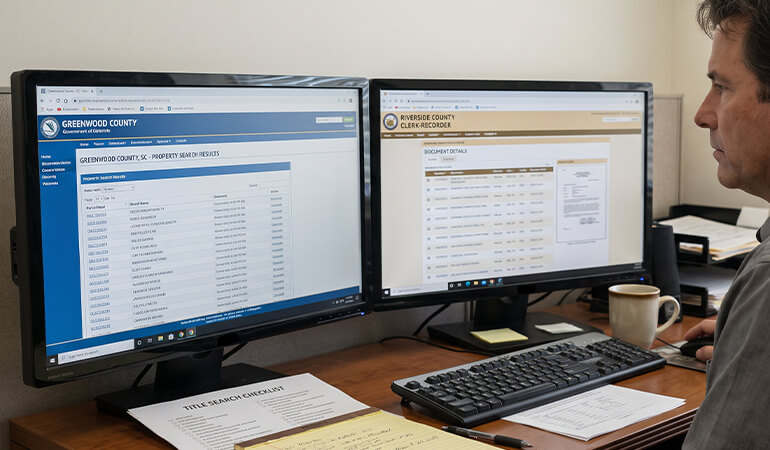
Where the records live shapes how the work gets done. In counties with strong online portals, an abstractor can pull most documents remotely. In others, someone physically visits the recorder’s office and turns pages.
In several states, especially Texas, title companies rely on title plants. A title plant is a privately maintained, geographically indexed copy of the county records, often faster and cleaner than the courthouse index itself.
The reconciliation step is where multi-jurisdiction experience matters most. The examiner has to notice that “the Whitfield tract” in County A and “Tract 14-B” in County B are the same land, and that a lien indexed in one county attaches to both.
On multi-state files, most title companies bring in local counsel or a local underwriter for each state. ALTA policy forms are broadly standard, but each state’s exceptions, endorsements, and title standards are not. Nobody credible examines fifty states from memory.
This is also why many title companies and lenders outsource title search and abstracting layer. A research partner that already covers hundreds of counties through one point of contact removes the slowest part of a multi-jurisdiction file: learning each courthouse from scratch. At HabileData, we assign researchers by state and jurisdiction complexity for exactly this reason.
Technology’s Role in Modern Title Searches
Technology has genuinely improved title work over the past two decades, and it still has hard limits. Both halves of that sentence matter.
What helps today:
- Digital archives and e-recording, so new documents post in days instead of weeks in many counties.
- OCR, which makes scanned deed books text-searchable and catches name variants a tired human might miss.
- GIS mapping and structured property data, which let examiners see parcels, county lines, and easements on one screen.
- Automated indexing and search software that flags gaps in a chain of title.
- AI-assisted document processing that pre-reads deeds and mortgages and highlights unreleased liens for a human examiner.
What technology cannot do yet:
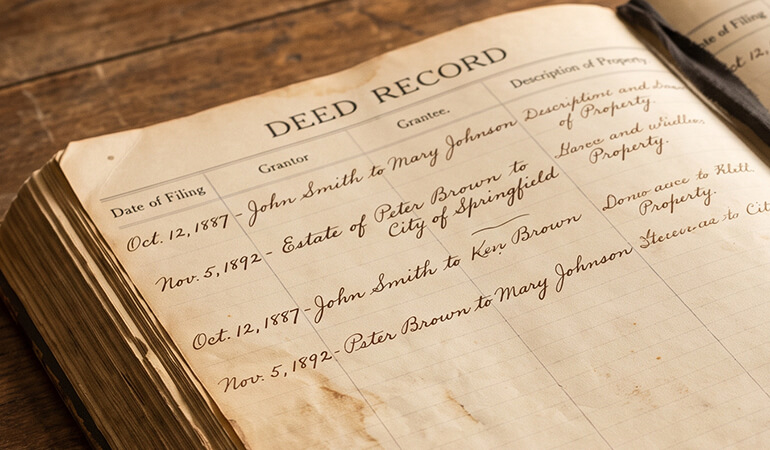
- Read what was never digitized. Thousands of counties still hold decades of records only on paper or microfilm.
- Fix bad indexing. OCR on faded 1940s handwriting produces guesses, not answers.
- Interpret law. Whether an old easement survived a tax foreclosure is a legal judgment, not a database query.
- Standardize the country. There is no national title database, and blockchain pilots have not changed that. A blockchain can store a record, but it cannot make a county’s 150 years of paper history trustworthy on its own.
The honest summary from inside the industry: technology has made good researchers faster. It has not made inexperienced ones safe, and it has not made multi-jurisdiction searches simple.
Real-World Examples
The cases below are composites drawn from common situations in title research practice. Details are generalized, but each pattern is one examiners see regularly.
1. The two-county land purchase
An investor contracted to buy 90 acres of recreational land advertised as one property. The survey showed the parcel straddling a county line, roughly 60 acres in one county and 30 in the other.
The search in the larger county was clean. The smaller county’s records showed a deed of trust from a prior owner that had been paid off but never released. Getting a recorded release from a bank that had since merged twice took five weeks. Without the second search, the buyer would have closed with a live lien on a third of the land.
2. The warehouse on the state line
A logistics company bought a distribution facility near a border town, with the building’s truck yard crossing into the neighboring state. The deal effectively became two transactions.
One state required an attorney to conduct the closing. The other did not. Transfer tax applied on one side only. Two title insurance policies were issued, each covering the acreage in its own state, with a survey endorsement tying them together. The closing took an extra month, mostly coordinating the two sets of requirements.
3. The pipeline easement nobody mentioned
A family bought rural acreage for a home site. The search in the property’s county looked clean. The abstractor, following good practice, also checked the adjoining county because the access road crossed the line.
There, indexed under a former owner’s abbreviated name, sat a 1968 pipeline easement running diagonally through the planned building site. The buyers still purchased, but they moved the house and negotiated the price down. Found after closing, that easement would have been a lawsuit instead of a discount.
4. The probate problem two states away
A seller listed farmland she had inherited from her father, who died a resident of another state. His will was probated where he lived. No ancillary probate was ever opened in the state where the farm sits.
Legally, record title had never fully passed to her there. The closing was delayed four months while an ancillary estate was opened and an executor’s deed recorded. The buyer’s lender refused to fund until the chain of title was repaired, which was the correct call.
5. The hidden out-of-state lien
A commercial borrower refinanced an office property. The borrower had previously lived and done business in another state, where a supplier had won a judgment and later domesticated it in the county where the office property sat.
The judgment was indexed under the borrower’s former business name. A single-county, current-name-only search missed it. A full name run, including prior names and the out-of-state court check, caught it. The lien was paid at closing instead of surfacing during a future sale.
Risks of Incomplete Searches
Skipping counties, shortening search periods, or ignoring out-of-state records saves money exactly once. The costs show up later, and they are rarely small.
| Missed item | Possible consequence |
|---|---|
| Unreleased lien or mortgage | Payoff demands, blocked resale, foreclosure exposure |
| Unknown easement | Lost use of part of the land, reduced value, litigation |
| Probate or heir defect | Ownership challenged years later, quiet title lawsuit |
| Unpaid taxes or tax sale | Loss of the property through tax deed |
| Boundary or description error | Owning less land than paid for, neighbor disputes |
| Severed mineral rights | Drilling or mining activity you cannot stop |
Title insurance softens some of these risks, but only for matters covered by the policy and only up to policy limits. An easement listed as an exception is the buyer’s problem forever. Land in a county that was never searched may not be covered at all.
The legal costs deserve emphasis. A quiet title action, the lawsuit used to clear disputed ownership, commonly takes months to years. During that time the property is difficult to sell, refinance, or develop.
Best Practices Before Purchasing Property
Use this checklist for any purchase that touches more than one county or state, and honestly for most rural or large-acreage purchases.
Before contract:
- Get a current survey and confirm exactly which counties the land occupies
- Pull tax records in every county to verify parcel numbers and assessed owners
- Ask the seller directly about inheritance, prior liens, mineral sales, and old easements
- Walk the land and look for pipelines, power lines, access roads, and fences that suggest unrecorded rights
During due diligence:
- Order a full title search covering every affected county, not just the largest one
- Confirm the search period meets or exceeds the standard in each state involved
- Request name runs on all sellers, including maiden names, business names, and prior addresses
- Check probate, divorce, and bankruptcy courts in every relevant jurisdiction
- For border properties, engage a title company or attorney licensed in each state
Before closing:
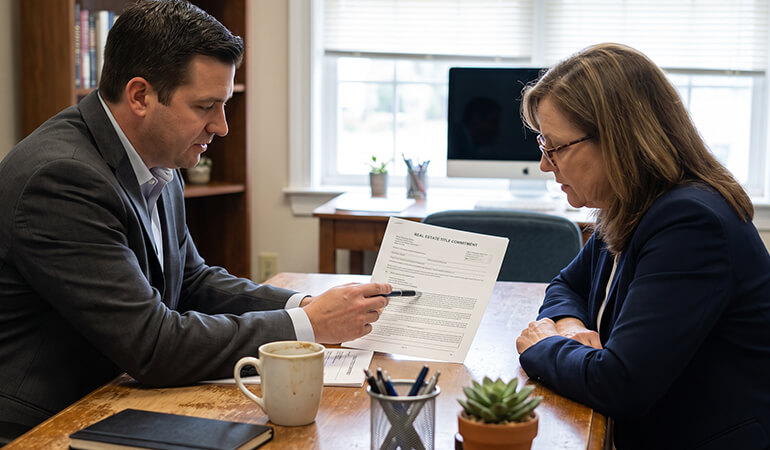
- Read the title commitment, especially Schedule B exceptions, line by line
- Ask for an explanation, in plain language, of every exception you do not understand
- Verify releases will be recorded in every county where the original lien was recorded
- Confirm the deed will be recorded in each county the property occupies
- Buy an owner’s title insurance policy, and confirm its coverage matches the full property
For title companies, lenders, and servicers handling volume:
- Standardize a multi-county checklist so no order closes on a single-county search by default
- Keep a jurisdiction matrix documenting each county’s index type, digitization depth, and turnaround
- Route high-complexity states to researchers who work those counties daily
- Consider outsourcing search and abstracting overflow, so seasonal spikes do not force shortcuts on exactly the files that need the most care
One disclaimer belongs here. This article is general information, not legal advice. For a specific transaction, especially one crossing state lines, involve a real estate attorney or licensed title professional in the affected states.
Conclusion
Multi-county and multi-state title searches are harder than they look because American land records are local by design. Every county keeps its own books. Every state writes its own rules. A property, a seller, or an estate that crosses those lines drags your transaction across them too.
The defects hiding in a second jurisdiction are ordinary: an unreleased mortgage, a pipeline easement, an unfinished probate, a domesticated judgment. What makes them dangerous is that a lazy search never looks where they live.
If your next transaction touches more than one county or state, treat the title work as a core cost of the deal, not a fee to minimize. Order the full search. Read the commitment. Ask questions until the answers make sense.
And if your team handles these files at volume, the math changes further. Every extra jurisdiction multiplies research hours, and shortcuts land on exactly the orders that can least afford them.
HabileData’s title research teams run searches, abstracts, and current-owner reports across 1,000+ U.S. counties, with dedicated specialists for high-complexity states. One point of contact, examiner-ready output, and turnaround measured in hours rather than weeks.
Frequently Asked Questions
A single-county residential search often takes a few days; our practitioner guide to title search timelines breaks this down in detail. Add a second county and expect one to three weeks, depending on how digitized each county’s records are. Rural counties with paper records take the longest.
Most title companies price by parcel and by county searched, so two counties roughly doubles the search cost. Multi-state deals add attorney fees, extra policies, and coordination time. On large transactions, that cost is small compared to the risk it removes.
Usually, yes. Title insurance is regulated state by state, and underwriters typically issue a policy per state, sometimes tied together with endorsements. Your title company will structure this; make sure combined coverage equals the full purchase price.
You can look at online county records, and it is a useful sanity check. Relying on a self-search for a purchase is risky. Indexes miss things, older records are hard to read, and legal interpretation matters. Lenders will require a professional search anyway.
The search is the investigation of the records. Title insurance is a policy that pays covered losses if the search, or the records themselves, missed something. You want both, because no search can guarantee a perfect record.
It depends on state standards. Many states with Marketable Title Acts use 40 years. Others customarily search 50 or 60 years, and some situations, like severed minerals, require going back to the original land patent.
Most liens are cured at or before closing. The seller pays the debt, the creditor signs a release, and the release is recorded. Closing is delayed only when the lien is disputed, the creditor is defunct, or the amount exceeds the sale proceeds.
No. Coverage has improved a lot, and groups like the Property Records Industry Association promote e-recording standards, but many counties still keep older records only on paper, microfilm, or bound books at the courthouse.
A title plant is a privately maintained, indexed copy of a county’s land records, organized by property rather than by name. Title companies in plant states, notably Texas, use them because they are often faster and more accurate than courthouse indexes.
In both. The deed should be recorded in every county where any part of the land lies, each time with the legal description for that county’s portion. Recording in only one county leaves the other portion’s record incomplete.
Only if the search period reaches the deed that severed them, which may be 80 or 100 years old. In mineral-heavy states, ask specifically for a mineral search. Assume nothing; severed minerals are extremely common in some regions.
Ancillary probate is a second, smaller probate opened in a state where a deceased person owned real estate but did not live. Until it happens, heirs may lack clean record title in that state, and the property cannot safely close.
It varies by state and by local custom, and it is negotiable in the contract. In many markets the buyer pays for the lender’s policy and search while the seller pays for the owner’s policy. Ask your agent what is customary locally.
Yes, and many do. Specialized research providers maintain trained teams across large numbers of counties, so a title company can order searches in unfamiliar jurisdictions through one point of contact. HabileData’s title research teams support searches across 1,000+ U.S. counties, with researchers assigned by state complexity.
Often not. Policies describe the insured land by legal description. If part of the property, or a controlling record, sits in a county nobody examined, related defects may fall outside coverage or appear as exceptions. This is exactly why complete multi-county searches matter.
Need multi-county or multi-state searches handled reliably?
Talk to our title research team »


Jatin Patel is a Senior Manager with over 23 years of expertise in real estate documentation and legal publishing. He specializes in scaling major client accounts and driving operational excellence through strategic business transformation. By leveraging automation and deep domain knowledge, Jatin optimizes processes to enhance accuracy and efficiency. He is recognized for delivering measurable outcomes through technology adoption and a client-centric approach to execution. 🔗Connect with Jatin on LinkedIn