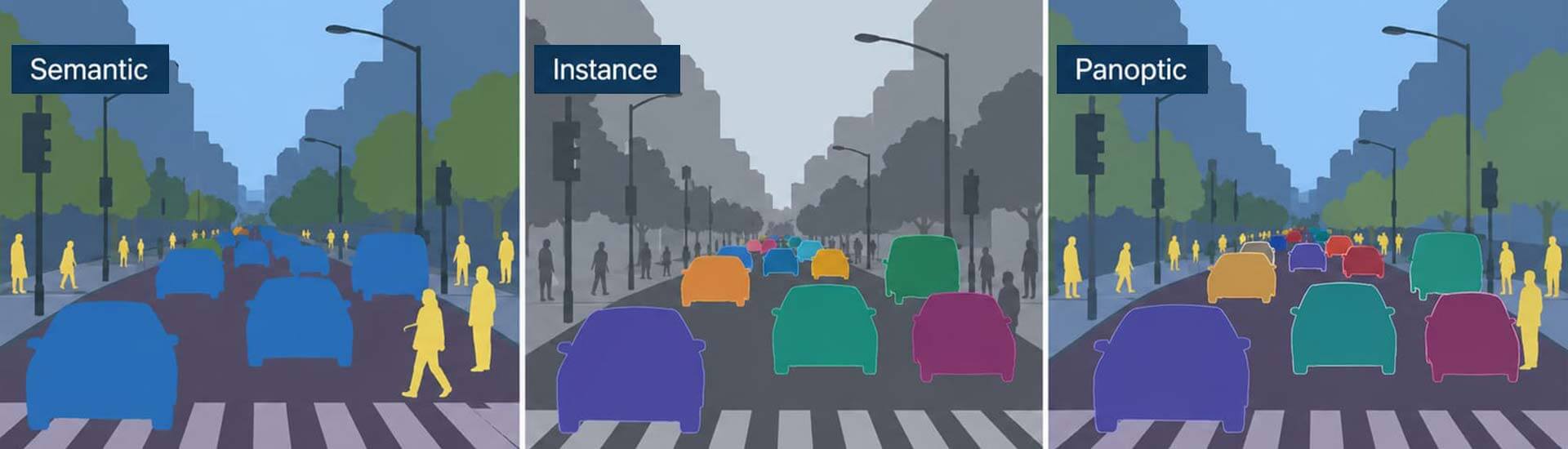
Semantic segmentation labels every pixel by class. Instance separates individual objects. Panoptic does both. The costly part is that panoptic converts down to either with a script, while semantic can never be upgraded to instance without relabeling. Costs, metrics, and how to choose correctly.
Table of Contents
- Semantic vs Instance vs Panoptic Segmentation: Quick Answer
- Things vs Stuff: The Basis of All Image Segmentation Types
- What Is Semantic Segmentation in Computer Vision?
- Instance Segmentation vs Semantic Segmentation: Key Differences
- Panoptic Segmentation Explained: Complete Scene Understanding
- Semantic vs Instance vs Panoptic: Side-by-Side Comparison
- Why Segmentation Downgrades Are Free but Upgrades Are Not
- Segmentation Annotation Cost and Timelines Compared
- mIoU vs Mask AP vs Panoptic Quality: Which Metric to Use
- Common Mistakes in Segmentation Annotation Projects
- How to Choose the Right Segmentation Type for Your Model
- Segmentation Annotation Tools: CVAT, Labelbox, V7, Roboflow
- The Bottom Line on Choosing a Segmentation Type
- Semantic vs Instance vs Panoptic Segmentation: FAQs
The worst version of this decision I have watched play out went like this. A retail analytics team ordered semantic segmentation on roughly 90,000 shelf images. Clean masks, good boundaries, delivered on time. Six weeks later their product owner asked how many facings of each SKU were on the shelf.
Semantic masks cannot answer that. Every bottle of the same product had merged into one continuous region of “bottle” pixels. You can measure the area. You cannot count the bottles.
They had to relabel. Not correct, not touch up. Relabel, from the original images, because the information they needed had never been recorded in the first place.
That is the part the comparison articles skip. Most of them will tell you semantic labels pixels by class, instance separates objects, and panoptic does both. All true, and none of it tells you what you actually need to know, which is what each one costs to produce and how much of it you can get back later if you choose wrong.
Semantic vs Instance vs Panoptic Segmentation: Quick Answer
Semantic segmentation labels every pixel with a class, so all cars are just “car”. Instance segmentation separates individual objects, so you get car_1 and car_2, but it usually ignores background regions like sky and road. Panoptic segmentation does both at once: every pixel gets a class, and every countable object also gets its own ID.
Things vs Stuff: The Basis of All Image Segmentation Types
Alexander Kirillov and his co-authors formalized panoptic segmentation in a 2019 CVPR paper, and the useful thing they gave the field was not the task. It was the vocabulary. Stuff means regions of similar semantic value that carry no distinct instance identity: sky, pavement, ground. Things are the countable objects: cars, people, trees.
Once you hold that split in your head the three types stop being a list to memorize. Semantic labels everything and counts nothing. Instance counts the things and ignores the stuff. Panoptic does both.
Everything else in this article follows from that one distinction, including the cost differences, which surprise people more than they should. If you are further back than this and still weighing segmentation against boxes and keypoints generally, the image annotation types overview is the better starting point.
What Is Semantic Segmentation in Computer Vision?
An annotator working a semantic task has one job per pixel. Pick a class, fill the region. There is no decision about where one car ends and the next begins, because that question does not exist in the schema. Two overlapping cars are one blob of car pixels and that is correct output.
This makes semantic the fastest of the three and, misleadingly, the one where quality is hardest to read off a headline number.
Here is why. Mean IoU averages across classes, and large regions are easy. A road surface covers a third of a driving frame and is bounded by high-contrast edges. Sky is easier still. Those classes score in the high nineties almost by default, and they can carry an mIoU number while the classes you actually care about are quietly falling apart.
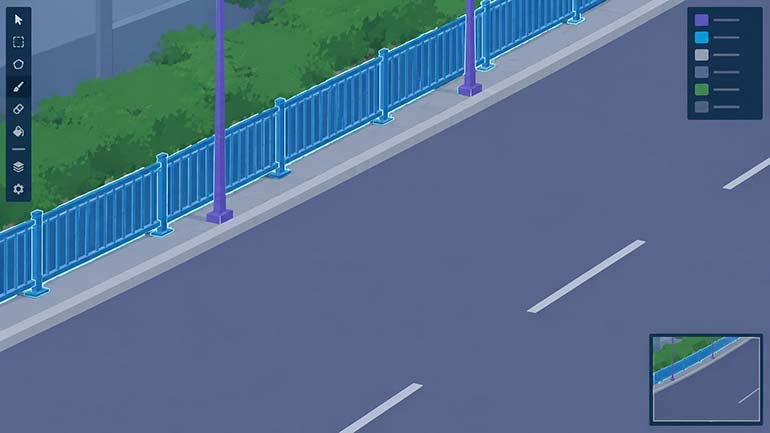
Thin structures are where it shows. Poles, fences, cables, wing mirrors, catheter tubing. A one-pixel-wide fence rail contributes almost nothing to overall pixel accuracy and everything to whether your model can see a fence. On our segmentation work we gate separately on boundary pixel accuracy, 95% or better on the one-pixel boundary zone, and on small objects under 32 square pixels at 88% or better, precisely because the headline mIoU will not tell you when those have collapsed. Our overall SLA target is 0.84+ mIoU per delivery batch, but nobody should accept a batch on that number alone.
Semantic is the right call for drivable surface analysis, land use classification from satellite tiles, tissue type mapping, and anything where coverage of a region matters more than the identity of individual objects in it.
Instance Segmentation vs Semantic Segmentation: Key Differences
Instance segmentation adds one question to every object, and it is a question with no automatically correct answer: is this one thing or two things?
Most of an instance annotator’s time goes into occlusion. A pedestrian walks behind a parked van and reappears on the other side. Two visible regions, one person, or two people? A shopping trolley in front of a shelf splits three product facings into six visible fragments. Does a car that is 90% hidden get an instance at all, or does it fall below your visibility floor?
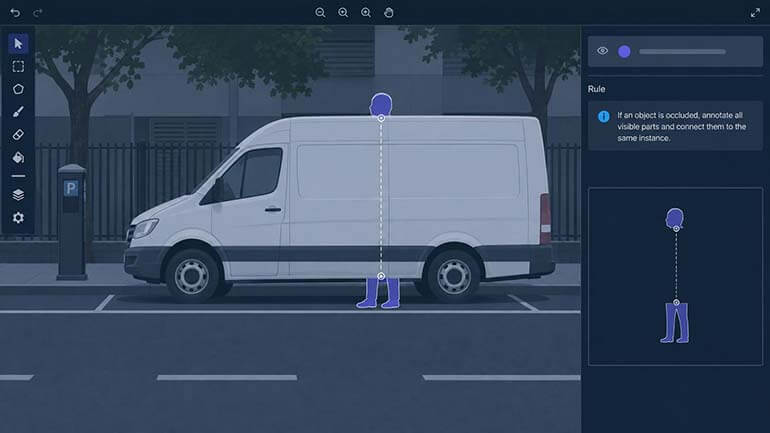
None of that is answerable by looking harder at the image. It is answerable only by a written rule that somebody made before annotation started. When ten annotators work without those rules, you get ten different instance counts on the same frame, and your model trains on the disagreement.
This is why I keep saying that segmentation consistency is an engineering problem rather than a talent problem. The talent is in drawing the boundary. The consistency comes from the occlusion protocol, the minimum visible area threshold, and the fragment merging rule, all written down and calibrated on the client’s own data before production starts.
Instance segmentation earns its cost when you need to count, track, or act on individuals. Crowd counting. Multi-object tracking datasets. Surgical instrument detection. Shelf facing counts, as that retail team learned the expensive way.
One correction to something the ranking articles get wrong: instance segmentation is not a superset of semantic segmentation. It labels things and leaves stuff unlabeled. If you need to know what the road surface is, instance masks will not tell you.
Panoptic Segmentation Explained: Complete Scene Understanding
Panoptic asks for both label types on the same image with a hard constraint attached. Each pixel gets exactly one class and one instance label, and no pixel may carry more than one of either.
That non-overlap rule sounds like a technicality. In the annotation tool it is the main event. Semantic and instance layers produced independently will always conflict somewhere, usually along thing-stuff borders, and every conflicted pixel has to be resolved to a single owner. Where exactly does the car end and the road begin, in the shadow underneath it? Somebody has to decide, consistently, across every frame in the dataset.
Panoptic is what autonomous vehicle perception and robot navigation genuinely need, because those systems have to reason about drivable space and individual obstacles in the same coordinate frame. It is also the most annotation-intensive output we produce, and I would not recommend it to a team that only needs one half of it.
Semantic vs Instance vs Panoptic: Side-by-Side Comparison
| Key Points | Semantic | Instance | Panoptic |
|---|---|---|---|
| Stuff classes (sky, road) | Labeled | Not labeled | Labeled |
| Things separated by ID | No | Yes | Yes |
| Can you count objects | No | Yes | Yes |
| Overlapping masks allowed | N/A | Yes, in most schemas | No, one label per pixel |
| Primary acceptance metric | mIoU | Mask AP | PQ |
| Relative labeling effort | Baseline | Higher | Highest |
| Typical output format | PNG mask + color map | COCO JSON | COCO panoptic JSON |
| Best fit | Land use, drivable surface, tissue mapping | Counting, tracking, instrument detection | AV perception, robot navigation |
Why Segmentation Downgrades Are Free but Upgrades Are Not
This is the part I wish someone had told that retail team.
Panoptic labels convert down to either of the other two for the cost of a script. Drop the instance IDs and you have semantic masks. Drop the stuff classes and you have instance masks. Ten minutes of work, no annotator involved.
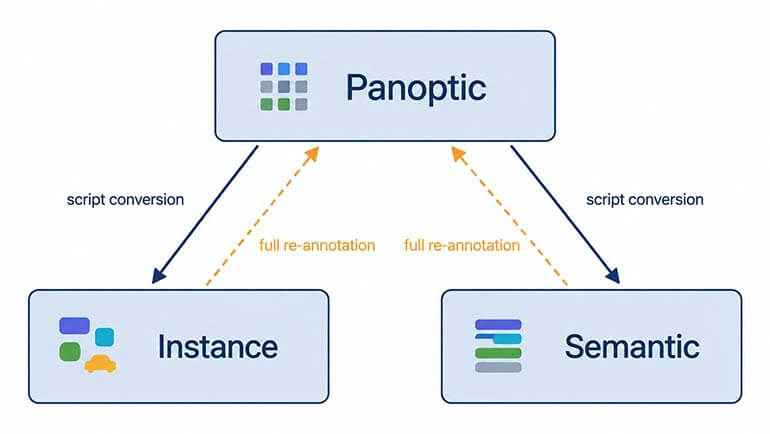
Going the other direction is not a conversion. It is a rebuild.
You cannot derive instance IDs from a semantic mask, because the information was never captured. A connected region of car pixels might be one car or four overlapping ones, and the merge already happened. And you cannot derive a full semantic map from instance labels either, because nobody ever labeled the sky.
So the question to ask at scoping time is not “what does the current model need.” It is “what is the probability that something downstream needs counting within the life of this dataset.” If that probability is meaningful, the marginal cost of annotating panoptic now is almost always smaller than relabeling the same images later, and you also avoid the version-skew mess of a dataset labeled two different ways in two different quarters.
Where I would still say no: single-purpose datasets with a defined shelf life, and any project where the client genuinely only has stuff classes. Nobody needs instance IDs on soil type.
Segmentation Annotation Cost and Timelines Compared
For standard semantic segmentation on 10,000 images with a five to eight class ontology and no fine-detail classes, we scope 12 to 18 business days with a team of 20 annotators. That window covers calibration, a pilot batch, full production, and a three-stage review, which is why it reads slower than a raw drawing-speed estimate. Anyone quoting you pure throughput has left the QA out. Our sustained throughput on segmentation work runs 2,000 to 5,000 images a day depending on scene complexity.
Instance work on the same images takes longer, and the multiplier is driven almost entirely by object density rather than by image count. A 25-class urban driving scene with 40 visible vehicles costs vastly more per frame than a 25-class scene with three. When we quote instance or panoptic, the first thing we ask for is a sample so we can count objects per frame, because images per day is close to meaningless as a unit here. If you need actual rate benchmarks rather than relative effort, the per-image and per-object pricing breakdown covers those separately.
Panoptic sits highest, and the extra time is not in drawing. It is in conflict resolution along thing-stuff boundaries and in the QA pass that verifies the one-label-per-pixel constraint actually holds.
Model-assisted pre-labeling changes the arithmetic, but unevenly, and this is where a lot of cost estimates go wrong. SAM and similar tools give us 60 to 80% time reduction on clearly bounded objects and roughly 40 to 60% across a mixed dataset. On tumor margins, agricultural field edges, and thin structures, the assist is close to zero and can be negative once you count correction time. A model that produces a plausible wrong boundary costs more to fix than an empty canvas costs to fill.
mIoU vs Mask AP vs Panoptic Quality: Which Metric to Use
Each segmentation type is graded by a metric that fails in its own particular way, and if you only track the headline number you will be surprised late.
mIoU on semantic output averages per class, so it is dominated by whichever classes have generous pixel counts. Discussed above. Look at the per-class breakdown, always. It is the same trap IoU, precision, and recall set on bounding boxes, one dimension up.
Mask AP on instance output rewards correct detection and reasonable overlap, but it does not care about the pixels between your objects. A dataset can post good mask AP with genuinely unusable stuff coverage, because it was never measuring that.
Panoptic Quality is the one people misread most often. PQ is the product of two terms. Segmentation quality is the average IoU across matched segments. Recognition quality is an F1-style term over true positives, false positives, and false negatives. Matching requires IoU above 0.5, and under the non-overlap rule that threshold guarantees at most one predicted segment can match each ground truth segment.
Here is the practical consequence. Every segment counts once, whatever its size. A missed pedestrian 40 meters down the road is worth exactly as much as the entire sky region. PQ is therefore brutal on datasets that are strong on large stuff and weak on small things, which is the exact profile of an under-resourced panoptic annotation job. If you are buying panoptic labels, ask for PQ broken into SQ and RQ separately. A high SQ with a sagging RQ means the boundaries are fine and segments are being missed or invented, which is a completely different fix from loose boundaries.
The full definition and the current COCO panoptic evaluation code are on the COCO dataset site, and the original paper is arXiv:1801.00868.
Common Mistakes in Segmentation Annotation Projects
The same handful of mistakes come up in scoping calls, year after year.
The expensive one is ordering semantic when the road-map contains the word “count”. That is the retail case at the top of this article, and it is avoidable by asking a single question a quarter earlier than most teams ask it.
The wasteful one runs the other way. Land use classification, crop type mapping, tissue classification: none of these need instance IDs, and I have talked more than one team down from panoptic on a satellite project. Nobody needs to know which patch of soil is soil_7.
Then there is the assumption that instance labels include background. They do not. Teams find out when some downstream module wants terrain and the labels have nothing to say about it.
Two more, quickly. Accepting delivery on one averaged number, which I have gone on about enough already. And writing the class ontology before anyone has looked at the hard frames.
That last one is worth a sentence more. Ontologies drafted from a slide deck fall apart on the first occluded crowd. We pull the awkward frames first now and write boundary rules against those, on the theory that a rule surviving the worst 5% of your images will survive the other 95%.
How to Choose the Right Segmentation Type for Your Model
Does anything downstream need to count, track, or address individual objects? If yes, semantic is out.
Does anything need to reason about background regions, drivable surface, terrain, or tissue? If yes, instance on its own is out.
Answer yes to both and you need panoptic. Answer yes to only one and take the cheaper option, but go back and sit with the first question for a minute longer than feels necessary, because that is where the expensive mistake hides.
There is a fourth question that sits behind all of them: is this dataset likely to outlive the model you are training right now? Most do. If yours will, weight the decision toward panoptic even where today’s model has no use for half of it.
Segmentation Annotation Tools: CVAT, Labelbox, V7, Roboflow
We work in CVAT, Labelbox, V7 Darwin, and Roboflow depending on the project, and usually inside whatever the client already runs rather than moving them. The honest position is that tool choice matters much less than people expect. Every one of these can produce good segmentation output and every one will produce inconsistent output without a written boundary protocol behind it. Format support is the real differentiator: V7 for DICOM work, Segments.ai for 3D, CVAT for interpolation on video sequences where temporal boundary drift needs its own QA pass.
The Bottom Line on Choosing a Segmentation Type
Semantic, instance, and panoptic are not three points on a quality scale where panoptic is the good one. They record different information, and the one you want is determined by what your system has to do with the output.
The asymmetry is what should drive the decision. Downgrading a panoptic dataset is a script. Upgrading a semantic one is paying twice for the same images.
Get the ontology and the occlusion rules written before anyone opens the annotation tool, gate delivery on per-class numbers rather than an average, and be honest at scoping time about what the road-map contains six months out.
Everything above works whoever labels the data. Run it in-house if you have the annotators, or hand the scoping question to someone who has already priced these three side by side on real datasets.
If you would rather not run it yourself, semantic, instance, and panoptic segmentation is what we do, and I would start with a pilot batch on your own images so you can check the per-class numbers instead of taking mine on trust.s
Semantic vs Instance vs Panoptic Segmentation: FAQs
Semantic labels every pixel with a class but merges objects of the same class. Instance separates individual objects but typically leaves background unlabeled. Panoptic does both, with the constraint that each pixel carries exactly one class and one instance label.
The question does not have an answer, because the three are graded on different metrics that are not comparable. A 0.90 mIoU semantic dataset and a 0.65 PQ panoptic dataset can both be excellent. Compare within a type, never across.
The non-overlap rule. Semantic and instance layers conflict along thing-stuff boundaries, and every conflicting pixel needs a consistent resolution rule. That conflict resolution, plus the QA pass that verifies it held, is where most of the extra effort goes.
No. Once objects of the same class merge into a single region, the instance boundaries are gone from the data. You would be relabeling the images from scratch. Panoptic converts down to both of the others, which is why it is worth considering for datasets with a long life.
When nothing in your pipeline needs background regions. Surgical instrument detection, product counting on a plain background, and cell counting in microscopy all fit. You are paying for the stuff classes if you order panoptic and never read them.
Match it to the type: mIoU with a per-class breakdown for semantic, mask AP for instance, PQ split into SQ and RQ for panoptic. Add a separate gate for small objects and boundary pixels, because averaged metrics hide failures on thin structures.
No. Pre-labeling helps most on clearly bounded objects and least on ambiguous boundaries like tumor margins and field edges. It also does nothing for the instance-count decisions in occluded scenes, which is where a lot of instance and panoptic effort actually goes.
Check our numbers on your own images first.
Request a Free Pilot »


Biju Peter is a Senior Project Manager with 22+ years in the BPM industry, specializing in large-scale data operations and annotation-driven projects. He brings deep expertise in data processing, web research, scraping, and multi-modal annotation across image, text, audio, and video domains. He has successfully led 200+ projects, managed large teams, and delivered scalable, high-quality solutions for global AI and machine learning initiatives for clients across the globe. 🔗Connect with Biju on LinkedIn