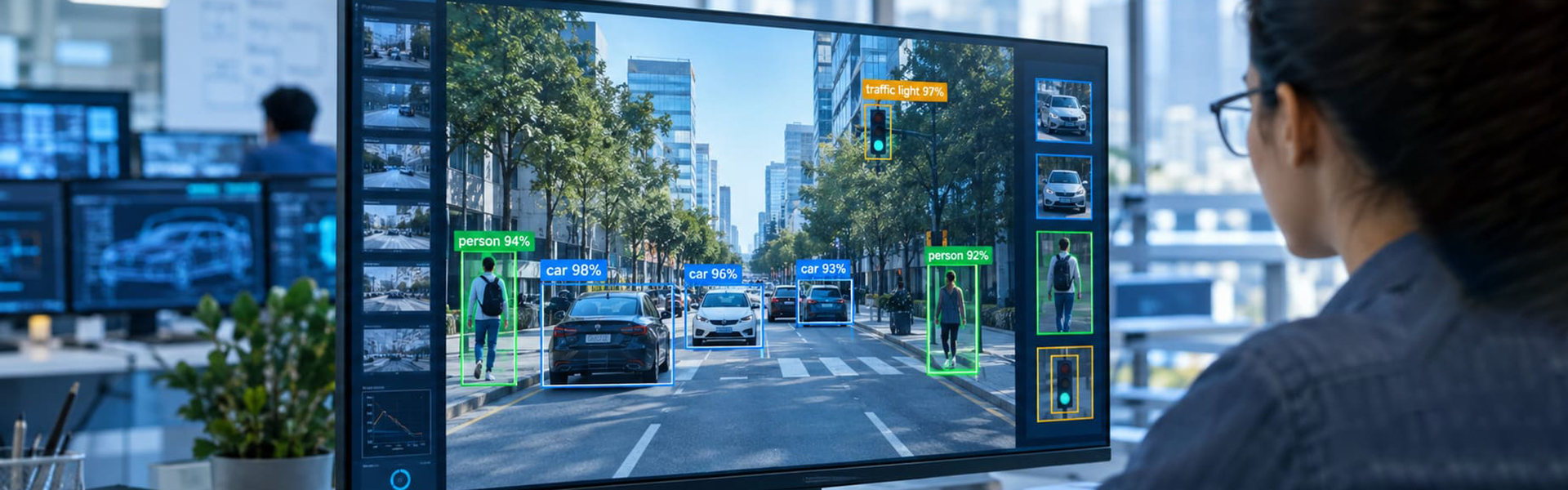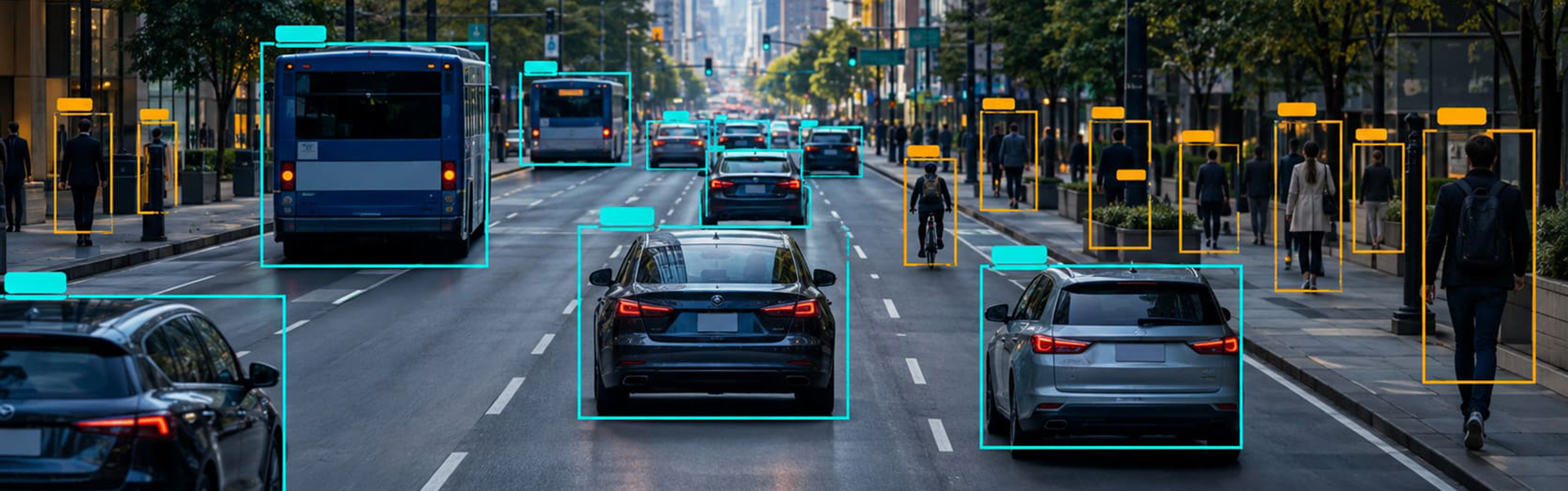
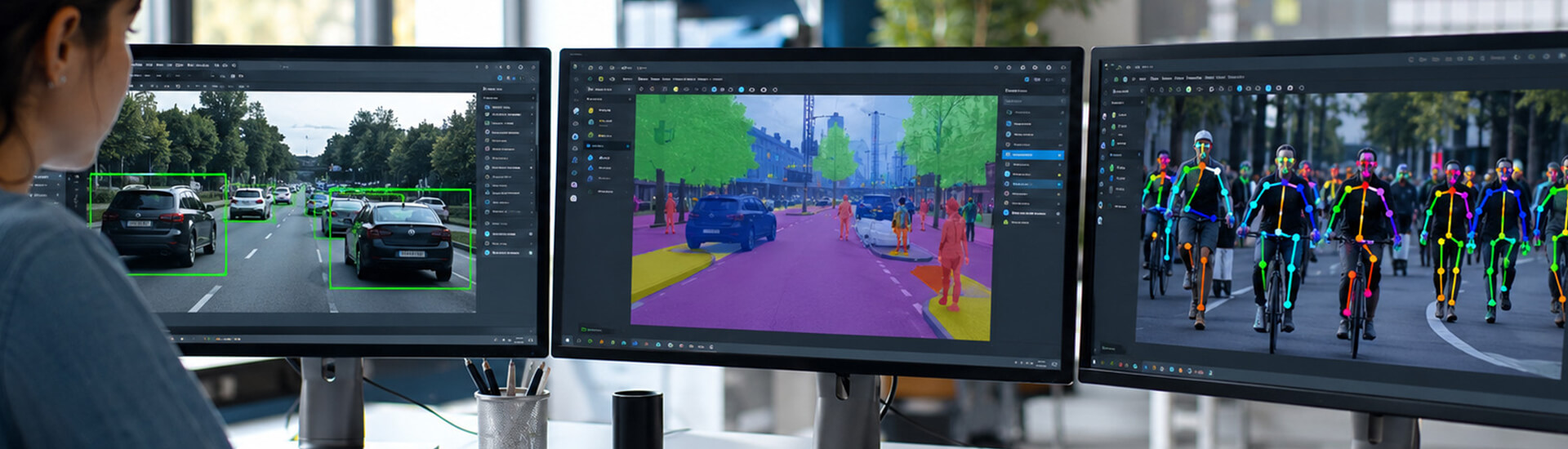
Image annotation costs in 2026: bounding boxes $0.03–$0.12 per object, segmentation $0.20–$1.50 per image, keypoints $0.05–$0.30, hourly $6–$18 offshore and $20–$60 onshore. Pricing shifts with complexity, volume, and QA depth. Pre-annotation and clear guidelines cut spend without hurting label quality.
Contents
- How Much Does Image Annotation Cost in 2026? (Quick Answer)
- What Is Image Annotation Pricing?
- The 3 Image Annotation Pricing Models Explained
- Image Annotation Pricing Benchmarks by Task Type (2026)
- What Drives Image Annotation Costs Up or Down?
- Hidden Annotation Costs Most Buyers Miss
- In-House vs Outsourced Annotation: Cost Comparison
- How to Reduce Image Annotation Costs Without Hurting Quality
- How HabileData Prices Annotation Projects
- Getting the Right Annotation Quote: Final Takeaways
- Image Annotation Pricing FAQs
Most buyers I talk to don’t struggle to find annotation vendors. They struggle to tell whether a quote is fair.
One vendor says three cents a box. Another says fourteen. A third insists on hourly billing and won’t commit to a per-unit rate at all. None of them are lying. They’re just pricing different things.
That gap matters more than people expect. Annotation is usually the largest line item in a supervised training pipeline. Label quality sets the ceiling on model accuracy.
Underspend and you get noisy labels that cap your F1 score no matter how good your architecture is. Overspend and you’ve burned budget you needed for iteration.
This isn’t hypothetical. A study led by MIT researchers found that ten of the most-cited ML benchmarks, including ImageNet, carry at least 3.3% label errors on average. Correcting those errors reshuffled which models performed best.
So the real skill isn’t finding the cheapest vendor. It’s knowing what a task should cost, so you can read a quote and see where the money goes.
This post lays out what image annotation actually costs in 2026, based on real outsourcing markets rather than sticker prices. Numbers are in USD, and every range comes with its assumptions.
How Much Does Image Annotation Cost in 2026? (Quick Answer)
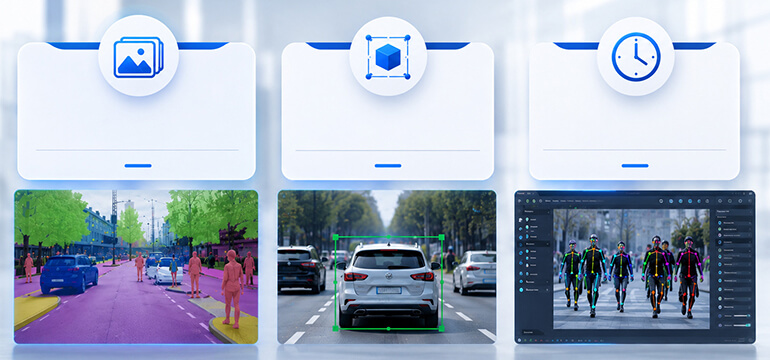
For most projects, bounding boxes run $0.03–$0.12 per object, keypoint annotation $0.05–$0.30 per object, and pixel-level segmentation $0.20–$1.50 per image. Hourly rates sit around $6–$18 offshore (India, the Philippines) and $20–$60 onshore in the US. Volume, complexity, and QA depth move you within those bands.
What Is Image Annotation Pricing?
Image annotation pricing is how a vendor converts labeling labor into a billable number. That number mostly comes down to what you’re labeling and how carefully, with volume adjusting the rate on top.
Costs vary widely because “annotation” spans everything from one class label on a photo to hundreds of pixel-accurate polygons on a street scene.
A rough scribble box and a medical segmentation mask both count as annotation. They’re an order of magnitude apart in effort. So any headline “cost per image” figure without context is close to meaningless.
Pricing usually attaches to one of three units: the image, the object, or the hour. Picking the wrong unit for your task is a common way buyers overpay.
Before comparing quotes, it helps to understand the different types of image annotation and which unit each one naturally maps to.
The 3 Image Annotation Pricing Models Explained
1. Per-Image Pricing: When You Pay by the Image
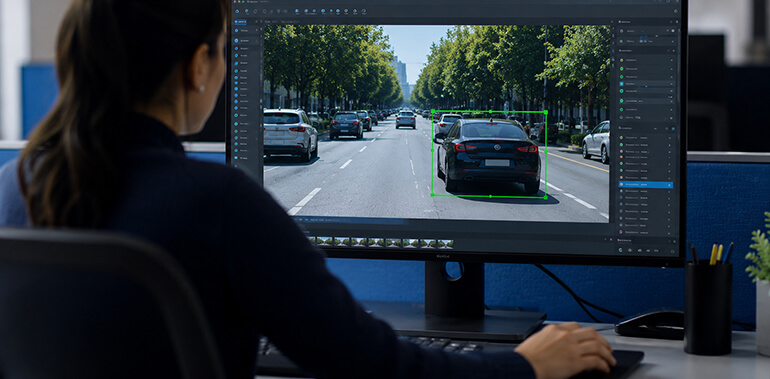
Per-image pricing charges a flat rate for each image, no matter how many things are in it. It works well when effort per image is predictable: whole-image classification, single-mask semantic segmentation, or scene-level tagging.
The trap is variance. If some images hold two objects and others hold forty, a flat rate either overcharges the sparse ones or bankrupts the vendor on dense ones.
Good vendors handle this by tiering images by density before quoting. So ask how they bucket your data.
Realistic range: $0.05–$0.25 for simple classification or tagging, and $0.20–$1.50 for semantic or instance segmentation. Medical or satellite frames run higher, since one can take ten minutes.
2. Per-Object Pricing: When You Pay by the Label
Per-object pricing charges per labeled instance, which fits bounding boxes and keypoints. You pay for what you get, and the vendor isn’t punished for dense scenes.
Density is the swing factor. A box in a clean, well-separated scene costs less than one in a crowded frame with occlusion, motion blur, or tiny far-field objects.
Autonomous driving data is the classic expensive case: hundreds of overlapping boxes, strict edge tolerances, and heavy QA.
The scale is real too. The widely used KITTI driving benchmark holds more than 200,000 3D object annotations in cluttered scenes, showing how object counts, not image counts, drive cost here.
If that’s your domain, our bounding box annotation services show how object density plays out on autonomous-driving data.
Realistic range: $0.03–$0.12 per bounding box, and $0.05–$0.30 per keypoint, depending on points per skeleton and placement tolerance.
3. Hourly Pricing: When You Pay by the Hour
Hourly pricing bills for annotator time, not output. It fits when the task is fuzzy, exploratory, or shifting week to week, when guidelines aren’t stable, or when the work needs judgment a per-unit rate can’t capture.
Hourly gets expensive fast when throughput is low. At forty labels an hour and $12, your effective cost is thirty cents per label, often above a per-object contract.
Use hourly for the messy early phase. Then switch to per-unit once the task stabilizes.
Image Annotation Pricing Benchmarks by Task Type (2026)
| Task type | Pricing model | Realistic cost range | Notes |
|---|---|---|---|
| Bounding box | Per object | $0.03–$0.12 per box | Lower end at high volume and low density; higher for occluded or small objects. |
| Polygon segmentation | Per object / per image | $0.10–$0.80 per polygon | Vertex count drives cost; tight boundaries cost more. |
| Semantic segmentation | Per image | $0.20–$1.50 per image | Full-scene pixel labeling; complex urban scenes at the top. |
| Instance segmentation | Per object | $0.15–$1.00 per object | Combines detection and masking; overlap and occlusion raise cost. |
| Keypoint annotation | Per object | $0.05–$0.30 per object | Depends on points per skeleton and placement tolerance. |
| Cuboid / 3D box | Per object | $0.10–$0.50 per object | Common in LiDAR and driving data; requires depth reasoning. |
| OCR labeling | Per image / per field | $0.02–$0.20 per field | Transcription plus bounding; handwriting and multi-language cost more. |
Treat these as offshore-blended starting points. Onshore US delivery usually runs two to four times higher for the same task.
That tracks with wage data: the US Bureau of Labor Statistics put the median US hourly wage at $23.80 in May 2024, well above offshore annotation rates.
For how these tasks map to model types, our image annotation guide covers which annotation styles feed which model types.
Not sure which task type your project needs?
Talk to an annotation specialist »What Drives Image Annotation Costs Up or Down?
Six things move a quote more than anything else.
Complexity is the obvious one. A loose box around a car is cheap. A pixel-accurate mask around hair or foliage is not. Effort scales with the precision your model needs, so don’t pay for tolerance you won’t use.
That effort is easy to underestimate. The COCO dataset, a standard segmentation benchmark, took tens of thousands of annotator hours across its 2.5 million labeled instances.
Tooling matters more than buyers expect. Open-source tools like CVAT keep licensing at zero but push cost into setup and management.
Commercial platforms like Labelbox or V7 add per-seat or per-label fees, often a cent to a nickel per label, in exchange for automation and stronger QA.
QA depth is where budgets quietly balloon. A single annotator pass is cheapest. A second review pass adds roughly 20–40% to labor.
Consensus schemes, where three people label the same item and you take the majority, can more than double the cost. Safety-critical data usually needs it anyway.
Workforce skill sets a floor. General annotators handle everyday objects fine. But medical, legal, and satellite work needs specialists whose rates run well above the offshore baseline.
Volume cuts the other way. A 5,000-image pilot pays a premium. A standing contract for millions of labels a month unlocks the low end of every range above, and sometimes dips below it.
Turnaround is the last lever. Standard SLAs are already baked into quoted rates. Compress the timeline and you pay a rush premium, often 25–50%, because the vendor pulls in extra headcount or runs night shifts.
Hidden Annotation Costs Most Buyers Miss
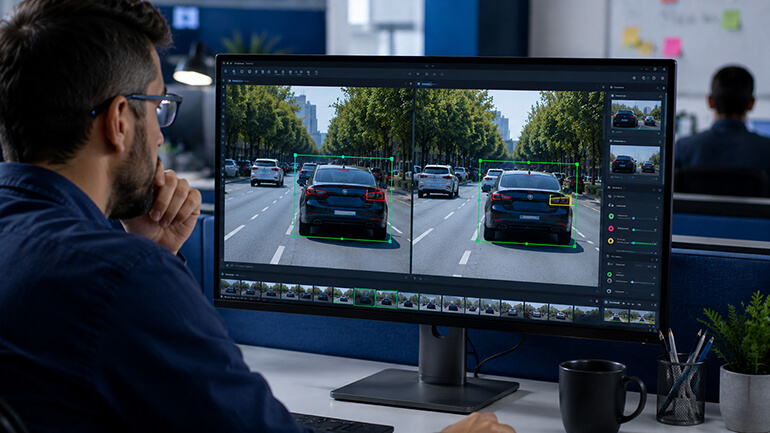
The per-unit rate is rarely the whole bill. A few line items reliably surprise first-time buyers.
QA rework is the big one. When guidelines are ambiguous or acceptance criteria shift mid-project, re-labeling can add 15–30% on top of the original cost.
This is usually the buyer’s fault, not the vendor’s, and it’s avoidable with a tight spec. Our image annotation guide covers how to structure guidelines before volume ramps.
Project management overhead is real too. Someone manages the team, runs calibration sessions, and handles edge-case escalations. Vendors either fold this into a higher rate or bill it separately, so ask which.
Then there’s tool licensing on commercial platforms, plus dataset inconsistencies that force partial redos when your source data is messier than the sample you sent.
Iteration cycles catch almost everyone. You rarely get the label schema right on the first pass, and each revision is a partial re-annotation.
In-House vs Outsourced Annotation: Cost Comparison
| Factor | In-house | Outsourcing |
|---|---|---|
| Cost per 1,000 boxes | $150–$400 fully loaded | $40–$120 offshore |
| Ramp-up cost | Hiring, training, tooling: weeks to months | Days; vendor already staffed |
| Scalability | Limited by headcount you can hire | Elastic; scale up or down per batch |
| Time to first labels | 4–8 weeks | 3–7 days |
| QA infrastructure | You build it | Included in the vendor’s process |
| Best for | Sensitive data, tight IP, permanent core needs | Variable volume, fast scaling, non-core work |
In-house makes sense when data can’t leave your building, or when annotation is genuinely core to your product.
For most teams scaling a training set, outsourcing wins on cost and speed. That holds until volume is high and steady enough to justify a permanent internal team.
Many teams run a hybrid: a small in-house group owns the schema and QA standards, while an outsourced annotation partner handles bulk throughput.
How to Reduce Image Annotation Costs Without Hurting Quality
You can cut spend without cutting quality if you attack the right levers.
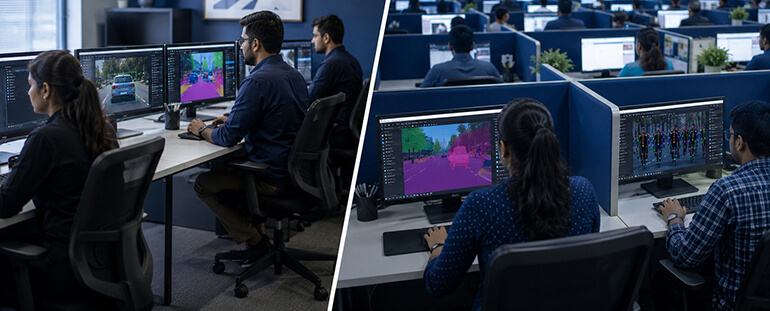
Pre-annotation is the highest-leverage move. Run an existing model over your data, generate rough labels, and have humans correct rather than draw from scratch.
Correction is two to five times faster than labeling cold, and the savings compound at scale.
This is the same human-in-the-loop pattern behind Meta’s Segment Anything project, whose data engine used the model to assist annotators and produced over a billion masks.
Write labeling guidelines before you start, not after the first batch comes back wrong. Ambiguous specs are the single biggest source of rework.
Include edge cases, show positive and negative examples, and lock the spec before volume ramps.
Batch similar images so annotators stay in a rhythm instead of context-switching. And match QA to risk: full consensus on a recommendation dataset is overkill, while a single pass on pedestrian detection is reckless.
One more lever people forget: prune your dataset before labeling. Not every image earns its annotation cost.
Deduplicating near-identical frames and dropping low-information images can shrink a labeling bill by double digits before a single box is drawn.
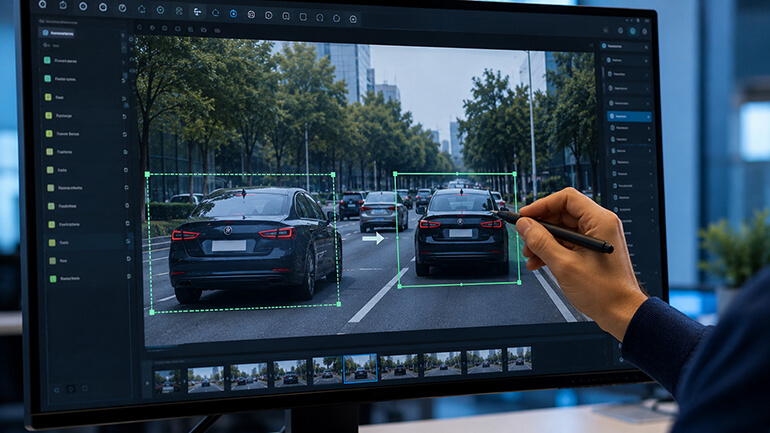
Want to see how much pre-annotation could save on your dataset?
Book a cost-reduction assessment »How HabileData Prices Annotation Projects
HabileData approaches annotation as an operations problem, not a headcount problem. The work runs on defined QA frameworks with configurable review passes.
So you pay for the accuracy your model needs, rather than a flat premium on everything.
Teams scale with your batches. Domain-trained annotators handle the specialized cases, retail, healthcare imaging, geospatial, where general labelers fall short.
The starting point is usually a conversation about your accuracy target and volume, then a quote built around it.
Getting the Right Annotation Quote: Final Takeaways
The cheapest quote and the best value are rarely the same number. A three-cent box that returns at 85% accuracy costs you more in retraining and model failures than a well-QA’d box at twice the price.
Price the accuracy you need, not the label.
If you’re scoping a dataset and want a realistic quote against your actual complexity and volume, request a consultation and we’ll build one around your requirements.
Ready for a real number based on your task type, volume and accuracy target instead of a range?
Get a custom annotation quote »Image Annotation Pricing FAQs
Whole-image classification and simple tagging are cheapest, often under $0.05 per image, because they need one decision per frame. Cost climbs as you move toward per-object boxes and pixel-level masks.
Semantic and instance segmentation need pixel-accurate boundaries, which take far longer than a box. A complex urban scene can take several minutes, which is why per-image rates reach $1.50 and beyond.
Only when the task is unstable or exploratory. Once guidelines are locked and throughput is predictable, per-unit pricing is almost always cheaper and easier to budget.
They estimate seconds-per-label from a sample batch, apply their loaded labor rate, then add QA passes, platform costs, and management overhead. Volume and SLA adjust the final number.
Yes, substantially. A small pilot pays a premium. A steady contract for millions of labels a month unlocks the bottom of every range, because the vendor can plan staffing around guaranteed throughput.
Well-run projects target 95%+ label accuracy with multi-pass QA. Single-pass work runs lower and suits non-critical use cases. Match the target to how much a wrong label costs your model.
Offshore delivers the same quality for most tasks at a fraction of the cost. Onshore is worth the premium mainly for data that can’t leave the country, or work needing regulated-domain expertise.
A scoped pilot of a few thousand images usually turns around in under a week. Full production volume depends on batch size and QA depth, but a good vendor gives you a throughput-per-day figure up front.



Biju Peter is a Senior Project Manager with 22+ years in the BPM industry, specializing in large-scale data operations and annotation-driven projects. He brings deep expertise in data processing, web research, scraping, and multi-modal annotation across image, text, audio, and video domains. He has successfully led 200+ projects, managed large teams, and delivered scalable, high-quality solutions for global AI and machine learning initiatives for clients across the globe. 🔗Connect with Biju on LinkedIn