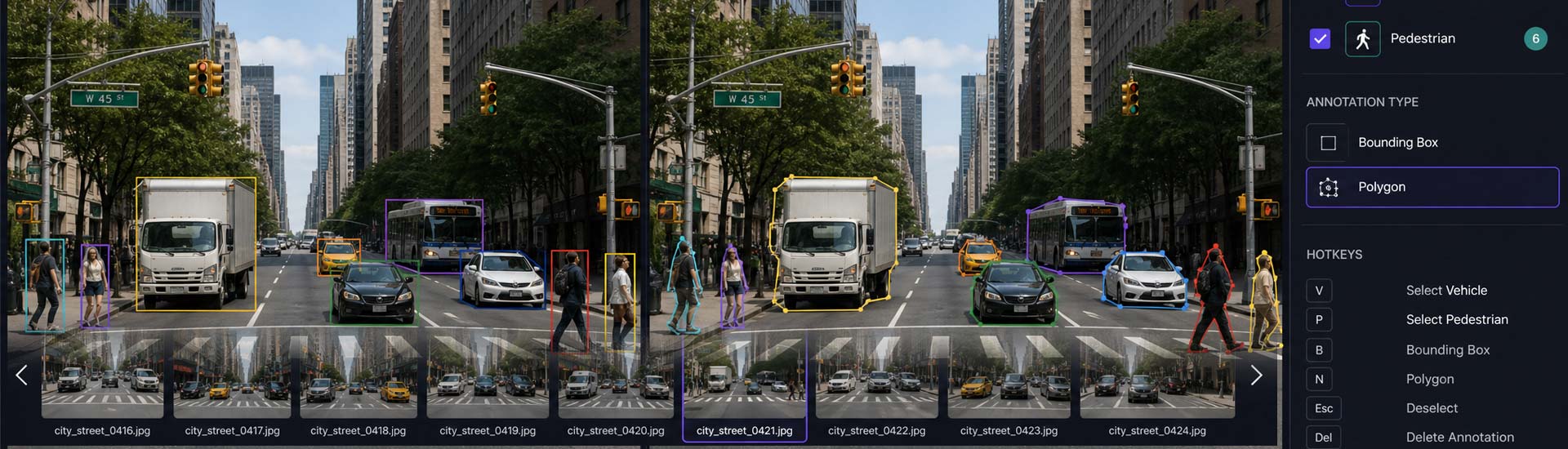

Choose a data annotation company by evaluating six things: documented quality assurance processes, workforce model and domain expertise, security certifications such as ISO 27001 and SOC 2, transparent pricing, proven scalability, and results from a paid pilot project. Score 2 to 3 shortlisted vendors against identical criteria before signing a contract.
Contents
Your model is only as good as its labels. Researchers at MIT found label errors in ten widely used test sets, including an estimated 6% of ImageNet validation labels (Northcutt et al., 2021). Datasets built under deadline pressure carry more.
That is why picking a data annotation company needs real care. A bad choice fails quietly: teams I have worked with have re-labeled 30 to 40% of a delivered dataset (a figure from my projects, not a published statistic). A data labeling company with weak controls adds a breach risk on top.
Comparing vendors is hard because every provider of data annotation services claims 99% accuracy, enterprise security, and domain experts. The gaps only show up when you know what to ask. So score every vendor on the same 21 checkpoints below, and the choice stops being a coin flip.
Quick answer: How do you choose a data annotation company?
Choose a data annotation company by evaluating six things: documented quality assurance processes, workforce model and domain expertise, security certifications such as ISO 27001 and SOC 2, transparent pricing, proven scalability, and results from a paid pilot project. Score 2 to 3 shortlisted vendors against identical criteria before signing a contract.
Types of Data Annotation Providers Compared
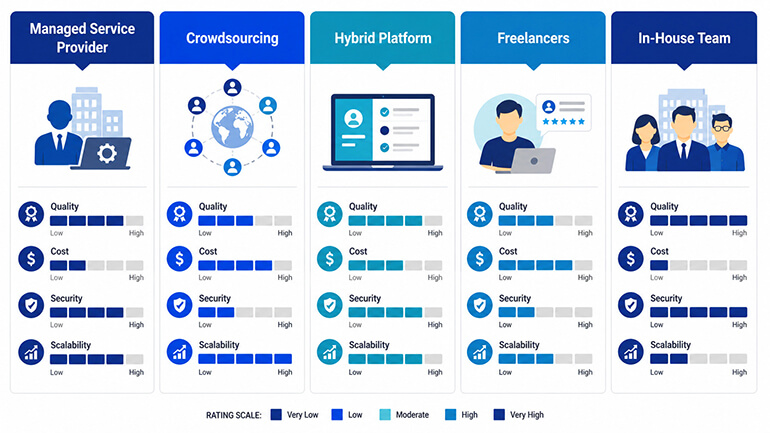
There are five ways to get data labeled; the right one depends on data sensitivity, quality bar, budget, and how long the need lasts. A managed service provider (MSP) runs trained, employed teams and owns quality. A crowdsourcing platform hands small tasks to unnamed workers. A hybrid sells labeling software plus a workforce. Freelancers you hire directly. In-house means your own staff.
| Provider type | Quality | Cost | Security | Scalability | Best fit |
|---|---|---|---|---|---|
| Managed service provider | High, with accountable QA | Mid to high | Strong; certifications, NDAs, controlled facilities | High | Complex or sensitive data, strict quality bars |
| Crowdsourcing platform | Variable | Low per label | Weak; anonymous workers | Very high for simple tasks | Simple, high-volume, non-sensitive tasks |
| Platform + workforce hybrid | Mid to high | Mid to high | Moderate to strong | High | Tooling and labor from one contract |
| Freelancers | Depends on the individual | Low to mid | Weak; hard to enforce | Low | Small pilots, niche expert tasks |
| In-house team | Highest domain fit | Highest fully loaded | Strongest | Low; slow to scale | Core IP data, continuous needs, regulated domains |
Notice the trade-off: crowdsourcing is cheap because nobody vets the workers; in-house is costly because you carry hiring, training, and idle time. Most teams using this checklist are choosing between MSPs and hybrids.
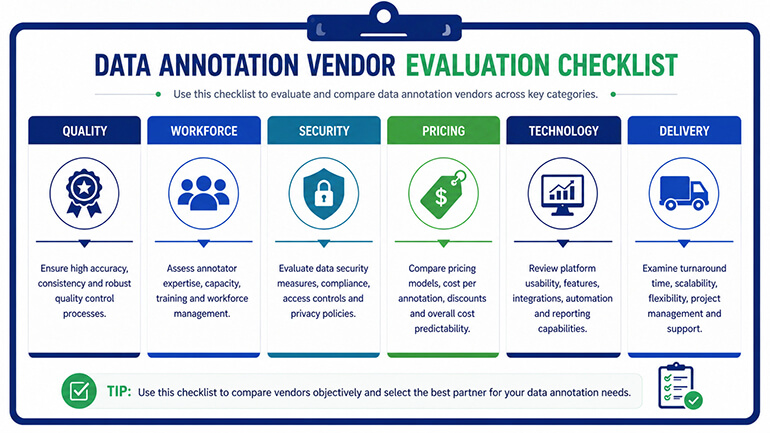
The 21-Point Vendor Evaluation Checklist
Score each vendor 0 to 2 per point (0 = fails, 1 = partial, 2 = strong). The totals usually make the decision obvious.
Quality and accuracy (points 1-5)
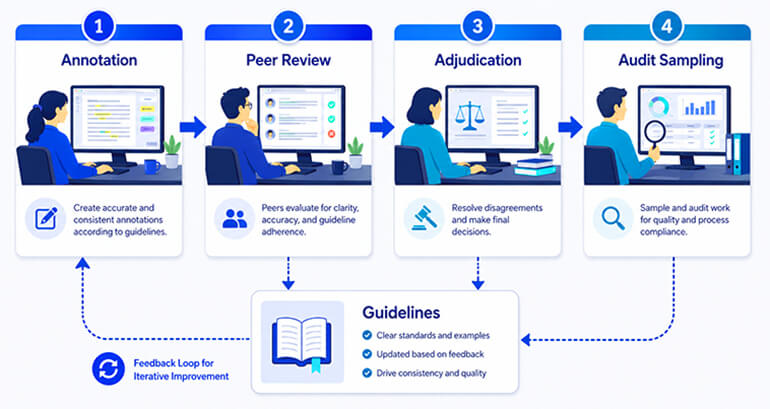
1. Documented QA process. Quality that lives in one manager’s head does not survive turnover. Good: a written multi-stage workflow (annotation, review, adjudication, audit sampling) with defined reviewer ratios. Ask: “Can you send your standard QA workflow document?”
2. Quality metrics reported. Look for accuracy against a gold standard, F1 for detection tasks, and inter-annotator agreement (IAA): how often two annotators independently give the same answer. Low IAA means unclear guidelines and noisy labels. Good: IAA reported per batch, unprompted. Ask: “What IAA did you hit on your last project like ours?”
3. Guideline development and calibration. Most label errors come from unclear guidelines, not careless annotators. Good: guidelines as a versioned, living document, plus calibration rounds where annotators label the same samples and resolve disagreements. Ask: “What agreement threshold must annotators hit in calibration before production starts?”
4. Edge case handling. Real data is full of items the guidelines miss: half-hidden objects, sarcastic text, borderline findings. Good: a formal escalation path where rulings flow back into the guidelines. Bad: annotators quietly guess. Ask: “Show me an edge case that changed your guidelines mid-project.”
5. Rework and error-correction policy. Get the acceptance threshold, measurement method, and remedy in writing. Good: free rework of failing batches. Vendors confident in their annotation quality assurance put this in the SLA without a fight. Ask: “If a batch falls below the agreed threshold, who pays?”
Workforce and expertise (points 6-9)
6. Workforce model and vetting. Employees, long-term contractors, or an anonymous crowd? This one answer predicts quality, security, and consistency. Good: a stable, screened workforce, and a straight answer on subcontracting. Ask: “Are the people labeling my data your employees? If not, who employs them?”
7. Domain expertise for your vertical. Anyone can draw a bounding box; judging whether a lesion is a finding takes domain knowledge. Good: named past projects in your field and access to specialists where needed. Ask: “What went wrong on your most similar past project?” The answer tells you plenty.
8. Training and on-boarding. Good: structured on-boarding on your guidelines, practice batches scored against a gold standard, and a qualification bar annotators must pass. “They move to other projects if they fail” beats “everyone passes eventually.” Ask: “How do you verify an annotator is ready for production data?”
9. Annotator retention and consistency. High churn eats quality; every new person re-learns your edge cases. Good: turnover under roughly 20 to 30% a year and a dedicated core team for your project’s length. Ask: “What was your turnover last year, and does my team stay?”
Security and compliance (points 10-13)
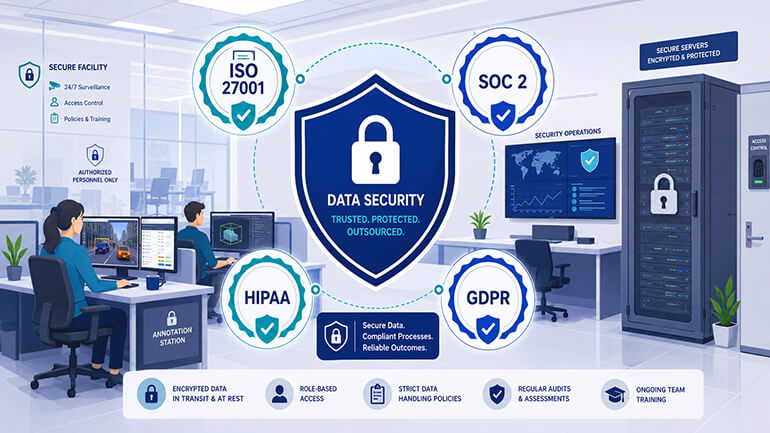
10. Certifications. ISO 27001 certifies an information security management system; a SOC 2 report is an auditor’s assessment of controls; HIPAA covers US health data; GDPR covers EU personal data. Good: current documents under NDA, not logos. Ask: “Can you share your ISO 27001 certificate and latest SOC 2 Type II report?”
11. Data handling infrastructure. Certifications describe a system on paper; infrastructure stops someone copying your data. Good: role-based access, VPN or virtual desktop setups that keep data off local machines, per-user logging, signed NDAs the vendor can produce. Ask: “Where does my data physically live during annotation, and who can touch it?”
12. IP ownership and confidentiality. The contract should plainly assign all annotations to you and bar the vendor from reusing your data or labels, including for their own models. Good: clean IP assignment plus certified deletion at project end. Ask: “Do you ever reuse client data in any form?”
13. Data residency and subcontracting. Residency matters legally (GDPR restricts transfers out of the EU) and contractually. Good: named storage regions and no subcontracting without your written approval. Ask: “In which countries will my data be processed, and by whom?”
Pricing and commercial terms (points 14-16)
14. Pricing model fit. Common annotation pricing models: per label, per hour, per project, and dedicated-team (FTE). Per-label suits predictable tasks; hourly or FTE suits evolving work. Good: the vendor explains why their model fits your task and shows the rate math. Ask: “What would this cost under your other models?”
15. Included vs billed extra. QA, project management, tool licenses, and rework sometimes appear as extra line items after signing. Good: an itemized quote with rework of vendor-caused errors free. This is where cheap quotes go to die. Ask: “Which items on this quote could rise after we sign?”
16. Contract flexibility and exit. Annotation needs swing as your model evolves. Good: monthly or quarterly volume changes, exit on 30 to 60 days’ notice, and handover of all data, guidelines, and QA records. Ask: “If our volume halves in month four, what happens?”
Technology and tooling (points 17-18)
17. Platform capabilities. Good: the vendor works in your labeling tool when required, supports API integration, and is honest about where model-assisted labeling (a model pre-labels, humans fix) actually cuts cost. Ask: “Can your team work inside our platform, and how would data flow between systems?”
18. Reporting and visibility. If you can only inspect work at delivery, problems pile up in silence for weeks. Good: a live dashboard, or at least a weekly report with throughput, per-batch quality, and IAA trends. Ask: “Show me the actual report a client like us receives.”
Delivery and communication (points 19-21)
19. Turnaround, capacity, and SLA. An annotation SLA should tie delivery time and quality thresholds to remedies like service credits or free rework. Good: numbers (“10,000 images per week at 97% accepted accuracy”), not adjectives (“fast”). Ask: “If we double throughput for a month, how long is ramp-up, and what does the SLA owe us if you miss?”
20. Communication cadence and dedicated PM. Annotation projects throw off constant guideline questions; slow answers stall the pipeline. Good: a named project manager, same-business-day answers, weekly written check-ins. Ask: “Who exactly will I talk to each week?”
21. Pilot and reference checks. Everything above is what vendors say; pilots and references are what they do. Good: enthusiasm for a paid pilot with measurable acceptance criteria, and references you pick from a list. Ask: “Can we run a paid two-week pilot, and can I speak to two similar clients?”
Download the 21-Point Vendor Evaluation Checklist (Free PDF)
Print it, score each vendor, and compare them side by side in one afternoon.
How to Run a Vendor Pilot Project the Right Way
A good pilot is a controlled experiment: the same data, frozen guidelines, and pre-agreed acceptance criteria across 2 to 3 vendors.
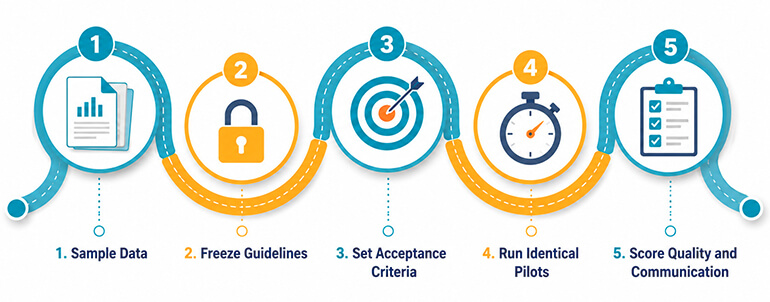
- Step 1: Build a representative sample. Pull 500 to 2,000 items that mirror production data, ugly parts included. A pilot on your cleanest data measures nothing.
- Step 2: Freeze the guidelines. Change rules mid-pilot and results stop being comparable. Log vendor questions instead; those questions are data about the vendor.
- Step 3: Set acceptance criteria in advance. Write down the accuracy threshold, the gold set you will measure against, the turnaround target, and the IAA floor.
- Step 4: Give every vendor the identical package. Same data, guidelines, deadline, and private gold set. Pay for it: a paid annotation pilot project gets the vendor’s real team; a free one often gets their sales-support team.
- Step 5: Score quality and communication, not just price. Grade labels against the gold set, but also grade how sharp the questions were and how honest the self-assessment. The vendor that flags its own errors first is the one you want at scale.
Two weeks is usually enough.
Red Flags That Should Disqualify a Vendor
Some vendor behaviors are not weaknesses to weigh; they are exits from the process:
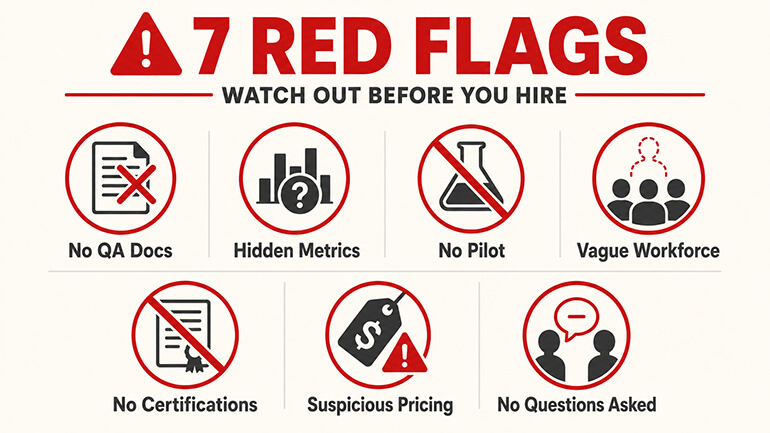
- No documented QA process.
- Refusal to share quality metrics. A vendor that measures quality is proud of the numbers.
- Unwillingness to run a paid pilot. There is no legitimate reason to refuse one.
- Vague answers on workforce or subcontracting. Often polite cover for unnamed, unvetted subcontractors.
- Certifications as logos, not documents.
- Prices far below market. Someone absorbs that gap: your quality, your security, or an invoice full of extras.
- No hard questions during scoping. A serious data annotation vendor digs into your edge cases and acceptance criteria before quoting. One that says yes to everything has not understood the work.
Soft spots elsewhere on the checklist can be worked around. These seven cannot.
Cost vs. Quality: How to Compare Vendor Quotes Fairly
Compare vendors on total cost per accepted label, not sticker price per label. One vendor prices per bounding box, another per hour, a third per annotator per month, so turn every quote into “cost to deliver X accepted labels”. For typical rates by task type, see our guide to data annotation cost and pricing benchmarks.
Then add what never appears on quotes:
| Cost component | Cheap vendor | Quality vendor |
|---|---|---|
| Per-label price | Low | Moderate |
| QA and PM fees | Often billed extra | Usually included |
| Rework of failed batches | You pay | Vendor pays, per SLA |
| Your team’s oversight time | High | Low |
After each pilot, divide the vendor’s total cost, including your team’s review hours, by the labels that passed acceptance. That number is the fairest basis I know of for data labeling outsourcing decisions, and a sticker price 30% lower routinely loses by it.
Real-World Examples
The startup that skipped the pilot. A computer vision startup sent 200,000 images to the lowest bidder at full volume. Class boundaries shifted between batches, a second vendor re-labeled roughly 40% of the dataset, and the “cheap” project cost about 1.6x the mid-priced quote they had rejected.
The pilot that flipped the ranking. A geospatial firm piloted three vendors on one shared set of aerial images. The cheapest scored 91% against the gold set; the mid-priced vendor scored 97% with sharper questions and won. Well-run pilots produce that result all the time, and it matches what we see in production work like this image annotation case study for a Swiss food waste assessment company, where guideline calibration mattered more than raw price.
Video raises the stakes because errors spread across thousands of frames. In one video annotation project for traffic management and road planning, frame-level checks were the difference between usable and unusable training data. A pilot exposes that; a sales call never will.
Conclusion
Choosing a data annotation company stops being guesswork once you make it a scored process: 21 checkpoints, identical questions to every vendor, a paid pilot on real data. Disqualify on security and QA basics first, pilot 2 to 3 survivors, then compare cost per accepted label.
Want it printable? Grab the free PDF checklist above and score your shortlist this week. Or if you would rather talk it through with people who run these projects daily, talk to our annotation experts. Bring your hardest edge cases.
Frequently Asked Questions
Simple image classification runs a few cents per label; expert medical or legal annotation can cost several dollars per item. Treat benchmarks as indicative.
A disciplined RFP for data annotation, from send-out to signed contract, takes 6 to 10 weeks: two for the RFP round, two to three for pilots, the rest for scoring and legal.
Simple classification often reaches agreement above 0.8 (using measures like Cohen’s kappa); genuinely subjective tasks may sit near 0.6. What matters is that the vendor measures it, reports it, and improves it.
Judge the controls, not the map. An offshore vendor with ISO 27001 and strong references beats a local vendor without them. Time zone overlap and residency law are the location factors that matter.
Throughput commitments, an accuracy threshold with a defined measurement method, response times for guideline questions, and remedies when targets are missed.
You should, always, even when the vendor helps write them. Guidelines encode your product’s judgment calls; losing them at contract end means starting over with the next AI training data company.
The fastest way to judge any annotation vendor is a paid pilot on your real data.
Start a Pilot Project »


Biju Peter is a Senior Project Manager with 22+ years in the BPM industry, specializing in large-scale data operations and annotation-driven projects. He brings deep expertise in data processing, web research, scraping, and multi-modal annotation across image, text, audio, and video domains. He has successfully led 200+ projects, managed large teams, and delivered scalable, high-quality solutions for global AI and machine learning initiatives for clients across the globe. 🔗Connect with Biju on LinkedIn