

Finding the right commercial real estate data platform can feel overwhelming with a lot of many options available. To make the decision easier, we’ve compared and analyzed the industry’s top databases and highlighted their pros and cons.
Contents
What separates successful commercial real estate investors from everyone else? In many cases, it’s access to the right data.
The modern-day commercial real estate market thrives on data. Whether you are a broker, lender, investor, or PropTech startup, you need to have the proper data to make your decision.
No matter whether you are seeking off-market deals, studying the investment trends in the market, or trying to assess risks associated with certain projects, having access to the right database can make a difference.
According to Statista, the global commercial real estate market surpassed $38 trillion in 2025, with North America accounting for more than $13 trillion of that value. As one of the world’s largest commercial real estate markets, the U.S. increasingly relies on accurate property and market data to support investment, lending, and development decisions at scale.
And, there are a lot of options when it comes to finding the best database and real estate data source, including CRE data providers and property data platforms.
Let us consider the best fits for your business needs, running through the comparison.
How We Evaluated These Commercial Real Estate Data Sources
Not all commercial real estate databases offer the same value. Some focus on ownership data and lead generation, while others lean into analytics and market research.
To make this list, we graded each platform based on what matters most to investors, brokers, lenders, and analytics teams. We considered:
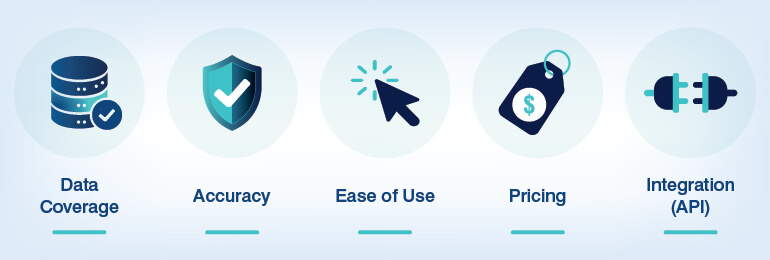
- Data coverage & depth: breadth of property and transaction data, ownership insights, and overall market coverage across asset classes and geographies.
- Data accuracy & freshness: reliability of data accuracy, verification quality, transaction depth, and how frequently information is updated.
- Ease of use & UI: platform usability, search experience, navigation, and overall workflow efficiency for different user types.
- Pricing & value: cost relative to features offered, return on investment, and overall market adoption and trust.
- Integration & API access: availability of CRM and third-party integrations, API support, and ease of exporting or connecting data into existing workflows.
These factors help measure the overall quality of a platform. They also highlight its ability to deliver reliable commercial property data, real estate market intelligence, and commercial real estate analytics.
A recent REALTOR® Technology Survey found that 66% of professionals adopt tools such as property data platforms, CRM software, AI analytics, GIS mapping, and market intelligence platforms to save time, while 64% use them to improve client experience.
Together, they provide faster access to property insights, ownership records, market trends, and investment opportunities. High-quality data helps teams work more efficiently, make informed decisions, and deliver greater value to clients.
Now that you understand the criteria behind our rankings, let’s take a closer look at the commercial real estate databases that stood out in our evaluation.
The 10 Best Commercial Real Estate Databases & Data Sources Compared
Every commercial real estate database has its own strengths and areas of specialization.
Some focus on property ownership and prospecting, while others excel at transaction intelligence, market analytics, valuation, or debt data.
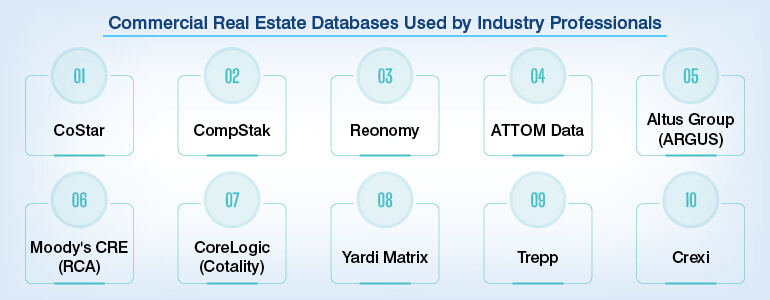
Below, we’ll take a closer look at the leading platforms and the types of users they serve best.
1. CoStar
CoStar is one of the most widely used commercial real estate databases in the industry. It provides property records, ownership details, leasing activity, tenant information, and market research across multiple asset classes.
It covers major commercial markets and is often considered a core research tool for professionals in the industry.
The platform is known for its depth and consistency. Many brokers and investors use it to understand local market conditions and track property listings.
It also allows users to analyze ownership structures and compare similar properties within a specific area. Because of its strong research backbone, it is commonly used in brokerage, investment analysis, lending, and market reporting workflows.
How It Works: CoStar combines public records with in-house research. It also relies on broker relationships, tenant surveys, and analyst verification. This process helps keep property data updated and accurate across markets.
Pros
- Extensive commercial property database
- Strong market analytics and research capabilities
- Regularly updated property and ownership records
- Comprehensive coverage across major U.S. markets
- Useful tools for investors, brokers, and lenders
Cons
- Premium pricing may be expensive for smaller firms
- Some features have a learning curve for new users
- Subscription plans can require long-term commitments
Pricing: CoStar uses custom enterprise pricing. Costs vary based on user requirements, market coverage, and selected products.
Best For: Institutional investors, commercial brokers, real estate analysts, lenders, and large CRE firms that need detailed market intelligence and property data
Who Should NOT Use This: Independent investors, small brokerages, or users seeking an affordable lead-generation tool may find CoStar’s pricing and feature set more extensive than necessary.
2. CompStak
CompStak specializes in commercial real estate lease and sales comparables. It focuses on verified transaction data rather than general property listings.
The platform is widely used by brokers, appraisers, investors, and analysts who need reliable comp data for valuation and underwriting work.
Its main value comes from helping users understand real-world deal pricing. This includes lease rates, sales prices, tenant information, and property-level transaction details.
Because the data is sourced directly from industry professionals, it is often used as a benchmark in financial modeling and market analysis. However, its usefulness depends heavily on market participation and data contribution levels.
How It Works: CompStak uses a crowdsourced model. Brokers and real estate professionals contribute lease and sales comps. These submissions are verified before being added to the platform. This helps improve accuracy and reliability over time.
Pros
- Strong database of lease and sales comparables
- Verified transaction data from industry contributors
- Useful for underwriting and valuation analysis
- Covers multiple commercial property types
Cons
- Coverage varies by market
- Limited functionality beyond comparables data
- Data access can depend on contribution levels
Pricing: Pricing is subscription-based. It varies depending on data access level, market coverage, and user type.
Best For: Brokers, appraisers, investors, and analysts seeking reliable commercial real estate comps.
Who Should NOT Use This: It is not suitable for users who need ownership data, off-market leads, or full property intelligence platforms.
3. Reonomy
Reonomy is a commercial real estate data platform focused on property ownership and off-market deal discovery.
It is widely used by investors, brokers, and acquisition teams who want to identify property owners and find potential sales opportunities before they hit the market.
The platform brings together ownership records, mortgage data, transaction history, and contact information in one place. This makes it easier to build targeted prospecting lists. It is especially useful for users who rely on direct outreach to source deals.
Reonomy is less focused on deep market analytics and more focused on identifying opportunities and decision-makers behind properties.
Pros
- Excellent owner and contact data
- Strong off-market property search capabilities
- Easy-to-use property filters
- Nationwide property coverage
Cons
- Contact information may not always be current
- Less focused on advanced market analytics
- Premium features require higher-tier plans
Pricing: Reonomy offers tiered subscription plans. Pricing depends on features, data access, and team size.
Best For: Real estate investors, wholesalers, and acquisition teams looking for off-market opportunities.
Who Should NOT Use This: It is not ideal for users who need advanced market research, valuation tools, or institutional-level analytics.
4. ATTOM Data
ATTOM Data is one of the largest property data providers in the United States. It offers access to property records, tax information, mortgage data, and neighborhood-level insights.
It is widely used by proptech companies, lenders, insurers, and data-driven real estate firms
The platform stands out for its scale and data depth. It includes not only basic property details but also risk indicators such as flood zones, environmental hazards, and local market trends. This makes it useful for both investment analysis and risk modeling.
ATTOM is primarily designed for organizations that need structured data at scale rather than users searching individual listings.
How It Works: ATTOM collects data from thousands of public and proprietary sources. It standardizes and cleans this data before delivering it through APIs and bulk data feeds. This allows companies to integrate it into applications and analytics systems.
Pros
- Extensive nationwide property database
- Robust API offerings
- Includes risk, neighborhood, and market data
- Suitable for enterprise applications
Cons
- Can be complex for non-technical users
- API integration may require development resources
- Pricing can be costly for large datasets
Pricing: Pricing is based on data volume, API usage, and licensing requirements. It is typically structured for enterprise customers
Best For: Data-driven real estate companies, proptech firms, lenders, and enterprises requiring large-scale property data.
Who Should NOT Use This: Data-driven real estate companies, proptech firms, lenders, and enterprises requiring large-scale property data.
5. Altus Group (ARGUS)
ARGUS, developed by Altus Group, is a leading commercial real estate valuation and cash flow modeling platform.
It is widely used by institutional investors, asset managers, and valuation professionals. The platform focuses on financial performance rather than property discovery.
ARGUS helps users understand how a property performs over time. It models rental income, expenses, lease structures, and exit assumptions.
This makes it especially useful for complex commercial assets such as office buildings, retail centers, and large investment portfolios. Instead of helping users find deals, it helps them evaluate whether a deal makes financial sense.
How It Works: Users input property financial data, lease terms, and assumptions. ARGUS then builds detailed cash flow models and valuation scenarios. These outputs help support acquisition, disposition, and portfolio decisions.
Pros
- Industry-leading valuation and cash flow modeling tools
- Strong portfolio analysis capabilities
- Widely accepted by institutional investors
- Supports complex commercial assets
Cons
- Steep learning curve for new users
- More focused on analytics than property sourcing
- Premium pricing
Pricing: ARGUS uses enterprise licensing. Pricing depends on modules, number of users, and organizational requirements.
Best For: Institutional investors, asset managers, and valuation professionals.
Who Should NOT Use This: It is not suitable for users looking for property listings, off-market deals, or basic CRE search tools.
6. Moody’s CRE (RCA)
Moody’s CRE, formerly known as Real Capital Analytics (RCA), is a commercial real estate data platform focused on investment transactions.
It tracks property sales, capital flows, and buyer activity across global markets.
The platform is mainly used to understand investment trends rather than search for properties.
Users can see who is buying assets, what types of properties are attracting capital, and how pricing is evolving across regions. This makes it a strong tool for institutional research and market intelligence
How It Works: Moody’s CRE collects transaction data from public records, financial filings, and research teams. This data is then analyzed and organized into structured investment insights.
Pros
- Comprehensive investment transaction database
- Strong market intelligence and reporting
- Global commercial real estate coverage
- Trusted by institutional investors
Cons
- Primarily focused on investment activity
- Less useful for property prospecting
- Higher pricing compared to some alternatives
Pricing: Pricing is based on institutional data access and research requirements. It is typically customized for each organization
Best For: Institutional investors, investment managers, and market researchers.
Who Should NOT Use This: It is not suitable for brokers or investors focused on off-market deal sourcing or property discovery.
7. CoreLogic (Cotality)
CoreLogic, now known as Cotality, provides property, mortgage, and risk intelligence used across the real estate, lending, and insurance industries.
Its datasets include ownership records, mortgage information, property characteristics, valuation insights, and compliance-related data. The platform is widely trusted by financial institutions and organizations that rely on accurate property data to support business decisions.
One of Cotality’s strengths is its focus on risk and mortgage intelligence. In addition to property records, the platform offers data related to natural hazards, insurance exposure, and regulatory compliance.
While investors can benefit from the data, the platform is primarily designed for enterprise users rather than deal sourcing or prospecting.
How It Works: Cotality aggregates property, mortgage, and risk data from public records, financial institutions, government agencies, and proprietary sources. It then delivers that information through data products, analytics tools, and enterprise solutions.
Pros
- Extensive mortgage and property datasets
- Strong risk and compliance capabilities
- Trusted by lenders and insurers
- Broad national coverage
Cons
- Less focused on investment sourcing
- Enterprise-oriented platform
- Pricing may be prohibitive for small businesses
Pricing: Pricing is customized based on data access, product selection, and organizational needs.
Best For: Lenders, insurers, risk managers, and compliance teams.
Who Should NOT Use This: It is not the best choice for investors or brokers looking for off-market opportunities, ownership outreach, or property prospecting tools.
8. Yardi Matrix
Yardi Matrix is a commercial real estate data platform known for its strong coverage of multifamily properties. It also provides information on office, industrial, self-storage, and student housing assets.
The platform offers ownership details, rent data, occupancy metrics, loan information, and market reports that help users evaluate specific properties and broader market trends.
The platform is especially popular among apartment investors and developers. Its detailed multifamily data makes it useful for underwriting, market research, and competitive analysis.
In addition to property information, Yardi Matrix publishes market reports and forecasts that help users understand local supply and demand conditions. The interface is relatively easy to navigate, making it accessible to both experienced professionals and newer users.
How It Works: Yardi Matrix combines public records, ownership research, surveys, and direct outreach to property operators. This information is verified and organized into a searchable database.
Pros
- Excellent multifamily property coverage
- Detailed ownership and occupancy data
- Valuable market reports and forecasts
- Easy-to-navigate interface
Cons
- Limited coverage in some niche property sectors
- Certain datasets require separate subscriptions
- Less focused on off-market sourcing
Pricing: Subscription pricing varies based on asset classes, datasets, and research products selected.
Best For: Multifamily investors, apartment developers, and analysts who need detailed rent, occupancy, and ownership data.
Who Should NOT Use This: It may not be the right fit for users who need broad coverage across every commercial property type or those focused primarily on prospecting.
9. Trepp
Trepp is a leading provider of commercial mortgage-backed securities (CMBS) and commercial lending data. The platform is widely used by lenders, debt investors, and credit professionals who need visibility into loan performance and debt market activity.
Unlike traditional property databases, Trepp focuses on the financing side of commercial real estate. Users can analyze loan-level performance, monitor delinquency trends, evaluate credit risk, and track market activity within the CMBS sector.
These insights help institutions make more informed lending, investment, and risk management decisions. Its specialized focus has made it a trusted resource among professionals involved in commercial real estate finance.
How It Works: Trepp collects loan and securitization data from issuers, servicers, public filings, and industry participants. The data is standardized and enhanced with analytics tools that help users evaluate risk and market conditions.
Pros
- Leading source for CMBS and loan data
- Strong risk and credit analysis tools
- Detailed debt market insights
- Trusted by lenders and institutional investors
Cons
- Limited property-level sourcing capabilities
- Specialized focus may not suit all users
- Premium pricing structure
Pricing: It is customized based on data access, analytics requirements, and the number of users.
Best For: Lenders, debt investors, credit analysts, and structured finance professionals
Who Should NOT Use This: It is not ideal for brokers, property investors, or users looking for ownership data and deal sourcing tools.
10. Crexi
Crexi integrates commercial property listings along with databases, marketing, and market intelligence tools. Over the past few years, this tool has been gaining popularity rapidly and is often considered an easier version compared to some enterprise CRE databases.
The ability to list properties, do market research on properties, look at ownership records, and interact with buyers or sellers can be done via one single platform.
The most important benefit of Crexi is that this tool is very user-friendly. In addition to having a free service version, Crexi also allows for subscription packages for both enterprises and individual users.
Even though Crexi lacks depth compared to its competitors, it keeps improving its research and analytical potential. The simplicity and affordability of this platform are two aspects which made it widely-used in CRE.
How It Works: Crexi integrates broker listings, public records, ownership info, and proprietary market datasets.
Pros
- User-friendly platform
- Strong commercial property marketplace
- Growing data and analytics capabilities
- Offers both free and paid features
Cons
- Data depth may not match larger enterprise platforms
- Coverage can vary by market
- Advanced features require premium plans
Pricing: Free basic access available. Paid plans and premium features are available on request.
Best For: Commercial brokers, investors, and smaller firms looking for an affordable CRE data platform.
Who Should NOT Use This: It may not be the best fit for large institutions that require advanced valuation tools, extensive market research, or highly specialized datasets.
We’ve covered the strengths, limitations, and ideal use cases of each platform. Next, let’s compare them side by side to see how they stack up across the most important categories.
Commercial Real Estate Database Comparison
While each platform serves the commercial real estate industry, their capabilities vary significantly. Some specialize in ownership intelligence and prospecting, while others focus on market analytics, transaction data, valuation modeling, or debt-market insights.
The table below compares the core capabilities of the leading CRE data platforms.
| Platform | Primary Focus | Ownership Data | Transaction Data | Lease Comps | Market Analytics | API/Data Integration | Financial Modeling |
|---|---|---|---|---|---|---|---|
| CoStar | Property Intelligence & Market Research | High | High | High | High | Medium | Low |
| CompStak | Lease & Sales Comparables | Low | High | High | Medium | Low | None |
| Reonomy | Ownership Intelligence & Prospecting | High | Medium | None | Low | Medium | None |
| ATTOM Data | Property Data & APIs | High | High | None | Medium | High | None |
| ARGUS (Altus Group) | Valuation & Cash Flow Analysis | None | Low | None | High | Medium | High |
| Moody’s CRE (RCA) | Investment Sales & Capital Markets | Low | High | None | High | Medium | Low |
| CoreLogic (Cotality) | Property, Mortgage & Risk Data | High | High | None | High | High | None |
| Yardi Matrix | Multifamily & Commercial Property Data | High | Medium | Low | High | Medium | Low |
| Trepp | Debt & CMBS Analytics | Low | High | None | High | Medium | None |
| Crexi | Listings & Deal Sourcing | Medium | Medium | Low | Low | Low | None |
The comparison makes it easier to identify where each platform excels. The next step is understanding which solution aligns best with your specific business goals and data requirements.
Need accurate, structured property data piped into your platform or CRM?
Talk to our CRE data experts »How to Choose the Right Commercial Real Estate Database?
The best commercial real estate database depends on what you’re trying to accomplish. Some platforms are built for market research and investment analysis, while others are better for finding property owners, sourcing deals, or accessing transaction data. Here’s a quick guide based on your role:
1. For Institutional Investors
Look for platforms with strong market analytics, transaction history, and valuation tools. CoStar, Moody’s CRE, and ARGUS are popular choices for analyzing investments and managing large portfolios.
2. For Commercial Real Estate Brokers
If your focus is prospecting, managing real estate listings, and comparables, platforms like CoStar, CompStak, and Crexi can help you find opportunities and support client deals.
3. For Real Estate Analytics Companies
Data depth and integration capabilities matter most. ATTOM Data, CoreLogic, and CoStar offer extensive datasets that can power research, analytics, and reporting tools.
4. For PropTech Companies
Choose platforms with robust APIs and scalable data access. ATTOM Data and CoreLogic are commonly used to build real estate applications and data-driven products.
5. For Lenders
Lenders benefit from property, mortgage, risk, and loan performance data. CoreLogic, ATTOM Data, and Trepp provide valuable insights for underwriting and risk assessment.
With a clearer picture of what each platform offers, let’s wrap up with the key takeaways and considerations to keep in mind before making your decision.
Conclusion
There isn’t a one-size-fits-all commercial real estate database. The right platform depends on whether you need market intelligence, property ownership data, transaction comparables, valuation tools, or debt analytics.
While CoStar remains one of the most comprehensive solutions, specialized platforms like CompStak, Reonomy, ARGUS, Trepp, and ATTOM Data may be a better fit depending on your goals.
Evaluating your data needs, budget, and workflow requirements will help you choose the platform that delivers the most value for your business.
FAQs
There are numerous CRE databases in the USA, each providing some unique benefits. While CoStar has long been acknowledged as an industry standard with rich data about properties and the marketplace, other databases like Reonomy, CompStak, and Yardi Matrix may become more relevant depending on what exactly you need (ownership, lease comps, etc.)
CoStar provides one of the most complete databases on the market and allows users to find the most up-to-date information related to their area of focus. Yet, CoStar is too pricey for smaller brokerages to consider purchasing. That’s why many small brokers prefer cheaper solutions like Crexi and Reonomy.
The leading free CRE platform on the market today is Crexi. Besides having an extensive property listings database, it also provides free market info. Moreover, public records and local government websites can be excellent sources of free data about commercial properties.
CompStak is one of the most popular databases that offers lease comp data. The database comprises of verified data that is compiled by professionals in the CRE industry. It is often used by real estate brokers, appraisers, and investors in valuation and underwriting.
One of the best CRE databases for multifamily investors is Yardi Matrix. It includes ownership details, rent trends, occupancy details, and market reports.
Get reliable, decision-ready commercial real estate data.
Request a free consultation today. »


Jatin Patel is a Senior Manager with over 23 years of expertise in real estate documentation and legal publishing. He specializes in scaling major client accounts and driving operational excellence through strategic business transformation. By leveraging automation and deep domain knowledge, Jatin optimizes processes to enhance accuracy and efficiency. He is recognized for delivering measurable outcomes through technology adoption and a client-centric approach to execution. 🔗Connect with Jatin on LinkedIn