

Delays in real estate closings often trace back to title issues. This blog explains the difference between the chain of title and the abstract of title, their roles in verifying ownership and identifying encumbrances, common title defects, and the impact of automation.
Table of Contents
- What Is Chain of Title?
- How Chain of Title Records Are Built?
- How Title Examiners Review the Chain of Title?
- What Can Break a Chain of Title?
- What Is Abstract of Title?
- Abstract of Title vs. Title Report vs. Title Commitment
- Chain of Title vs. Abstract of Title: What’s the Difference?
- Why Both Matter During a Title Search?
- Common Title Defects and How They Are Resolved
- Where AI and Automation Actually Fit in Title Work?
- Common Misconceptions About Chain of Title and Abstract of Title
- The Bottom Line
What actually happens when a closing gets delayed because of a “title issue”?
Most of the time, it comes down to something hidden in the property’s recorded history. It could be a break somewhere in the chain of title, an unreleased lien, or a document that raises questions about ownership.
These issues matter because every real estate transaction depends on confidence that the seller has the legal right to transfer ownership and that no unresolved claims are standing in the way.
That confidence doesn’t come easily. According to the American Land Title Association (ALTA), title professionals spend an average of 22 hours resolving title issues for a standard transaction and 45 hours for more complex transactions before closing.
Two terms come up repeatedly during this process: chain of title and abstract of title.
The chain of title is the timeline of who has owned a property. The abstract of title is the fuller written record: it includes that ownership timeline plus other things on file, like liens, easements, and judgments, that could affect the property. In short, the chain is part of the abstract, and the abstract covers more ground.
To understand how they work together, let’s look at each one separately.
What Is Chain of Title?

The chain of title is the chronological record of ownership transfers for a property. It shows how ownership moved from one party to another, starting with the earliest available record and continuing through the current owner.
Think of it as the property’s ownership timeline.
If a property moved from Owner A to Owner B, and later from Owner B to Owner C, the chain of title documents for each transfer and confirms that every link connects properly.
Each link represents a recorded conveyance, usually through a deed. The chain shows the relationship between the grantor, the person transferring ownership, and the grantee, the person receiving ownership. For the chain to be reliable, every transfer must connect clearly to the next one.
A simple example:
Maria → James → Priya → Daniel
shows a continuous ownership history.
But:
Maria → James → [Missing Link] → Daniel
creates a gap that requires investigation.
A missing link does not always stop a transaction, but it does require additional research and, in many cases, corrective action before closing.
How Chain of Title Records Are Built?
The chain of title does not exist as a single document stored in one place.
It is built from public land records maintained by county recorder offices and other recording authorities. These records are typically indexed by grantor and grantee names, requiring title professionals to locate and review individual documents to reconstruct ownership history.
This is where land record digitization plays an important role.
Recorded documents need to be captured, classified, indexed, and organized, so ownership transfers can be identified and reviewed accurately. Turning scattered county records into searchable digital information helps title teams work more efficiently.
How Title Examiners Review the Chain of Title?
Title examiners do more than follow names from one deed to another.
They review each transfer to determine whether ownership passed properly and whether any issues could affect the current owner’s ability to convey the property.
Some of the questions examiners consider include:
- Was the deed properly executed?
- Did the grantor have the legal authority to transfer ownership?
- Was the document recorded correctly?
- Does ownership flow continuously to the current owner?
- Are there unexplained gaps that require further investigation?
Not every inconsistency creates a title defect.
A minor spelling difference or missing middle initial is not treated the same way as an unrecorded deed or an invalid transfer. The examiner’s role is to separate harmless issues from problems that could affect marketability.
What Can Break a Chain of Title?
Several issues can interrupt the ownership history of a property.
Common causes include:
- Unrecorded deeds: A transfer may have occurred but never been properly recorded.
- Defective conveyances: A deed may contain errors, lack proper execution, or fail to meet legal requirements. Thorough property deed processing helps catch gaps like these early, before they surface at closing.
- Forgery or fraud: A fraudulent signature or unauthorized transfer can create ownership questions. Concerns about fraudulent transfers continue to grow. According to the National Association of REALTORS®’ 2025 Deed & Title Fraud Survey, 63% of surveyed REALTOR® association leaders reported awareness of deed or title fraud in their markets over the past year, a figure that rises to 92% in the Northeast.
- Probate gaps: Ownership may become unclear if heirs do not complete the required transfer process.
- Recording errors: Indexing or recording mistakes can make ownership connections difficult to verify.
These are the issues title professionals look for before they become closing problems.
What Is Abstract of Title?
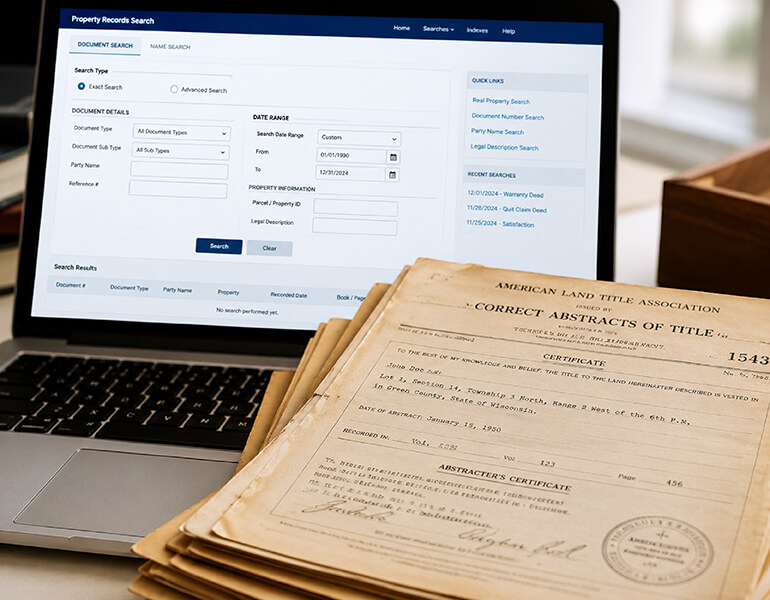
The abstract of title is a written summary of a property’s recorded history. While the chain of title focuses specifically on ownership transfers, the abstract provides a broader view of everything in the public record that could affect the property’s legal status.
Think of it as a report that brings together the documents and recorded matters identified during the title search.
An abstract of title typically includes:
- The chain of ownership
- Recorded deeds
- Mortgages
- Liens
- Easements
- Judgments
- Tax matters
- Releases and satisfactions
Other recorded documents affecting ownership rights
If the chain of title answers:
“Who owned this property and how did ownership move over time?”
The abstract of title answers:
“What else exists in the public record that could affect ownership or marketability?”
That distinction matters because ownership history and title condition are not the same thing.
A property can have a complete ownership history and still have unresolved issues attached to it. An unpaid lien, unreleased mortgage, or recorded easement may not break the chain, but it can still affect the transaction.
Abstract of Title vs. Title Report vs. Title Commitment
These terms are often confused because they all relate to title information, but they serve different purposes.
The abstract of title is the historical record. It summarizes the property’s ownership history and other recorded matters that may affect title.
A title report provides a summary of title search findings, including ownership information and known issues.
A title commitment is issued by a title insurance company and outlines the requirements that must be satisfied before issuing a title insurance policy, along with exceptions that may not be covered.
In simple terms:
- The abstract tells you what exists in the property’s history.
- The title report summarizes what the search found.
- The title commitment explains what needs to be addressed before insurance is issued.
Chain of Title vs. Abstract of Title: What’s the Difference?
Now that we’ve looked at each separately, the distinction becomes much clearer.
The chain of title and abstract of title work together, but they are not interchangeable.
The chain focuses on ownership continuity. However, the abstract provides a broader title picture.
One tracks the journey of ownership. The other captures recorded matters that could affect that ownership.
| Factor | Chain of Title | Abstract of Title |
|---|---|---|
| What it is | The chronological sequence of property ownership transfers | A written summary of the property’s complete recorded history |
| Main focus | Ownership continuity | Overall title condition |
| Includes | Deeds and ownership transfers | Deeds, liens, mortgages, easements, judgments, taxes, releases, and other recorded matters |
| Purpose | Confirm that ownership passed correctly | Identify issues that may affect ownership or marketability |
| Created from | Recorded conveyance documents | A broader review of public records |
| Primary users | Title examiners, attorneys, researchers | Buyers, lenders, insurers, title companies, and production teams |
Part of the confusion is that these terms are often used loosely, even within the industry, some treat them as interchangeable, others describe one as simply a subset of the other. The clearest way to hold the distinction: the chain of title is the ownership sequence, and the abstract of title is the broader record that documents that sequence alongside every other recorded matter affecting the property. The chain lives inside the abstract, but the abstract is more than the chain.
Why Both Matter During a Title Search?
If the abstract already includes the chain of title, why do professionals look at both?
Because they answer different questions.
The chain of title confirms that ownership moved correctly from one party to the next and helps identify gaps, breaks, or questionable transfers. The abstract goes further, identifying other recorded interests – liens, easements, judgments, or unpaid obligations – that the chain alone wouldn’t reveal.
For example, imagine a property that transferred successfully over several decades:
Maria → James → Priya → Current Owner
From an ownership perspective, everything looks correct. But the abstract reveals an unreleased mortgage from a previous owner. The chain is intact, but the title still has an issue that must be resolved before closing.
A clean chain confirms ownership. A complete abstract helps determine whether that ownership can transfer without unresolved risks.
Because the chain and abstract answer different questions, thorough title search services examine both, confirming ownership continuity while surfacing any recorded interest that could affect marketability.
Common Title Defects and How They Are Resolved
A title defect does not always mean a transaction cannot move forward.
In many cases, issues can be resolved through curative work that corrects the record, clears outstanding matters, or provides additional documentation.
Common title defects include:
- Missing or unrecorded deeds: A transfer may have occurred but was never properly reflected in public records. Resolution may involve locating missing documents or recording corrective deeds.
- Errors in prior deeds: Incorrect names, legal descriptions, or execution issues may require corrective deeds or other documentation.
- Probate gaps: If ownership was transferred through inheritance but the required estate process was not completed, probate documents or affidavits may be needed to establish ownership.
- Unreleased liens or mortgages: A paid obligation may remain in the record if a release or satisfaction was never filed.
- Ownership disputes: Competing claims, boundary disputes, or adverse possession issues may require legal action, including a quiet title proceeding.
The earlier these issues are identified, the more options teams have to resolve them before closing.
Not sure if your title is clean?
Where AI and Automation Actually Fit in Title Work?
Automation is changing how title teams handle large volumes of property records, but it is not replacing the expertise behind title examination.
The biggest impact is in areas like record retrieval, document classification, data extraction, and ownership history organization.
On the chain of title side, automation can help teams:
- Retrieve records faster
- Classify documents
- Extract key data points
- Organize ownership history
- Flag potential gaps for examiner review
Instead of manually reviewing thousands of pages of county records, title teams can use technology to organize information faster and bring critical documents to an examiner’s attention.
For abstracts of title, intelligent document processing (IDP) can extract details from unstructured records, including:
- Grantor and grantee names
- Recording dates
- Document types
- Lien information
- Mortgage details
- Easement references
This speeds up abstract preparation and reduces manual data entry.
But automation still has limits. It can identify patterns, extract information, and organize records, but it cannot replace the judgment required to evaluate marketability, determine curative actions, or assess title risks.
Those decisions still require experienced title professionals. Automation speeds up title work, while examiners provide the judgment that technology can’t. That’s how HabileData helps title teams work faster without compromising accuracy.
Common Misconceptions About Chain of Title and Abstract of Title
- “A clean chain of title means the title is clear.” Not necessarily. A complete chain confirms that ownership transferred properly. It does not mean the property is free from other claims or interests. A property can have a complete ownership history and still have liens, judgments, easements, or other recorded issues.
- “Title insurance replaces the need for title examination.” It does not. Title insurance protects against covered losses, but it does not replace the search and examination process used to identify potential issues before closing.
- “Automation has replaced title examiners.” Not even close. Automation helps teams process records faster, but evaluating documents, resolving defects, and making marketability decisions still require experienced examiners.
The Bottom Line
The chain of title and the abstract of title are closely connected, but they answer different questions. The chain of title tracks who owned the property and how ownership transferred over time.
The abstract of title documents that history along with recorded matters that may affect the property’s legal status. Understanding this distinction matters because title issues can impact closing timelines, underwriting decisions, lender confidence, and claims risk.
The future of title production is not automation replacing expertise. It is technology improving efficiency while experienced professionals provide the judgment needed to make accurate title decisions.
Ready to make title research easier?



Jatin Patel is a Senior Manager with over 23 years of expertise in real estate documentation and legal publishing. He specializes in scaling major client accounts and driving operational excellence through strategic business transformation. By leveraging automation and deep domain knowledge, Jatin optimizes processes to enhance accuracy and efficiency. He is recognized for delivering measurable outcomes through technology adoption and a client-centric approach to execution. 🔗Connect with Jatin on LinkedIn