
Title search turnaround varies by county infrastructure, product type, and file complexity. This 2026 guide gives state and county-level TAT benchmarks, bottleneck analysis, and operational strategies for setting realistic SLAs.
Contents
- What Title Search Turnaround Time Actually Measures
- How County Infrastructure Affects Title Search Turnaround Time
- What Causes Title Search Delays: Technical and Operational Factors
- Title Search Turnaround Benchmarks: State, County, and Product
- Where Title Search TAT Bottlenecks Happen
- How AI Reduces Title Search Turnaround Time
- The Bottom Line on Title Search Turnaround
- Methodology and Data Notes
- Frequently Asked Questions About Title Search Turnaround Time
A title search in the United States can take anywhere from four hours to fourteen business days. Three factors decide the range, how digitized the county records are, what type of search product is ordered, and how complex the file is.
A current owner search in a fully digitized metro county can complete within a single business day. A two-owner search in a manual rural county can take two weeks or more. This guide breaks down the ranges by state, county type, and product, with bottleneck analysis and operational strategies.
Key findings at a glance
- Standard transactions: 22 hours on average (ALTA, 2024)
- Difficult transactions: 45 hours on average. 36% of all transactions fall into this category (ALTA, 2024)
- Fully digitized metro counties: 4 hours to 2 business days
- Semi-digitized counties: 2 to 5 business days
- Manual rural counties: 5 to 14 business days
- Multi-county orders: Set by the slowest county in the chain
- Attorney-state closings: Add calendar time beyond the search itself
What Title Search Turnaround Time Actually Measures
Turnaround Time, or TAT, is the metric used to measure efficiency at every stage of title production, from order intake through commitment delivery.
Lenders use TAT to signal whether closing dates will hold. Title companies use it to show operational capacity to scale and SLA compliance.
Underwriters use TAT to inform pacing decisions across the commitment pipeline. The metric matters across every stakeholder in the closing process.
Despite its importance, TAT in title production remains elusive under real conditions. Outside internal systems, you will only find generalized approximations.
Title search situations turn case-specific constantly. Externally, turnaround keeps varying by state, by county, by product type, and by individual file.
Generalizations mask the real range. TAT can vary between four hours and four days for the same product, ordered from two different counties at the same time.
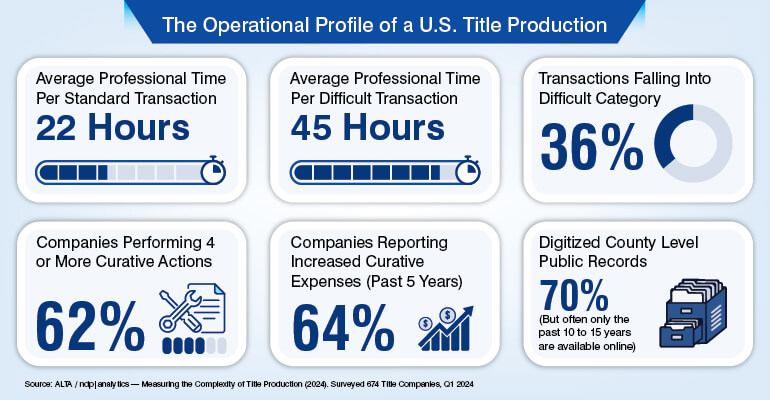
An ALTA-commissioned study by ndp|analytics surveyed 674 title insurance companies in Q1 2024. The findings set the industry baseline this guide builds on.
Title professionals spend about 22 hours on a standard transaction and 45 hours on difficult ones. 36% of all transactions belong to the difficult category.
That is the ground truth. Practitioner experience across 1,000+ U.S. counties match it. What works is benchmarking by county access tier and product type, not by average.
One clarification matters before going further: any comparison of TAT lacks meaning if it is not mapped against product type and county infrastructure.
The TAT discussed here is the time from order intake to the output package being delivered to the examiner or underwriter. Examiner and underwriter review time is beyond scope.
How County Infrastructure Affects Title Search Turnaround Time
Title search turnaround boils down to two problems: county access and infrastructure, and data operations.
The 3,600+ county recorder offices across the United States operate independently. No national standard governs access, indexing, or digitization of records.
According to PRIA, the Property Records Industry Association, the standards body for property records, eRecording adoption has grown steadily but unevenly across U.S. counties.
Diane Tomb, then-CEO of ALTA, noted in the 2024 ALTA study that only 70% of public records at the county level are digitized.
She also observed that often, only the past 10 to 15 years of records are available online. Older records sit in deed books, on microfilms, or require manual requests.
This scenario leaves you with three operational tiers of baseline retrieval time. Each tier behaves differently and requires a different workflow strategy.

Fully digitized counties
Here you find API or portal access, searchable images of documents, and online grantor-grantee indices. Automated retrieval is possible.
Big metro counties like Maricopa County (AZ), Cook County (IL), and Los Angeles County (CA) sit in this tier.
Take Maricopa County as an example. The county claims that 91% of its documents have been digitally recorded, with a database of over 50 million searchable documents.
Even with this level of digitization, you still face a routine 48-hour lag before newly recorded instruments make it to the search index.
Semi-digitized counties
In these counties, you need a split workflow because turnaround is unpredictable. Most have only partial online access.
Older records remain in deed books, on microfilms, or require a manual request. The digital index typically holds 10 to 20 years of records at most.
A full search often needs a fax request for the older part of the title chain, a title plant pull, or a courthouse visit.
While the digital search can finish within hours, the manual part can stretch significantly depending on courthouse access hours and staffing.
Manual counties
Rural counties across Appalachia, the northern Plains, and parts of the Deep South still offer only manual access and records.
Any work requiring manual access can take 3 to 7 workdays. Paper indices and bound deed books must be searched by hand.
Even with this three-tier baseline, your work does not get simpler. The problem of compounding remains.
Any order requiring access to multiple counties inherits the TAT of the slowest county. The file waits for the slowest link.
In a two-county order, you might get documents from one county within two hours but wait five days for documents from the other.
If you have ever waited three days for a fax response from a rural recorder while a semi-digitized neighboring county returned the same record within hours, you have lived this in practice.
What Causes Title Search Delays: Technical and Operational Factors
Once you understand that county infrastructure is largely beyond your control, two sets of variables remain.
Technical factors govern how fast you locate documents and retrieve data. Operational factors govern how fast that work moves through your pipeline.

Technical factors
The biggest two are scan ability of documents and discovering data. Both decide how fast retrieval actually happens.
In discoverability, the primary factor is indexing quality. A mis-indexed grantor name or instrument type will throw off any standard search.
Alternate search and locate can add hours to days. Each layer of investigation extends the timeline.
The next biggest factor is image quality and scan readability. Low-pixel images, faint stamps, and illegible cursive all stump generic OCR.
These records need interpretation by human experts. Manual reading and re-keying add time to every affected file.
The hidden but most frustrating hit comes from “digitized” claims that carry incomplete data. Many digital indices hold only 10 to 15 years of records.
For older records, manual retrieval is unavoidable. The reality often differs from what the county portal advertises.
Data standardization is another technical factor. MISMO, the Mortgage Industry Standards Maintenance Organization, and PRIA are jointly developing title and closing data standards. Both bodies recently published ALTA title and settlement datasets in candidate recommendation status to enable consistent digital exchange across the industry.
Operational factors
In title production, human experts remain the quality gateway. Title officers, examiners, and underwriters all play this role.
Expert availability, individual capacity, and individual capability all influence how fast work moves through the pipeline.
Even with all documents in hand, abstraction complexity remains. Trust language, estate transfers, and multi-party conveyances all add cycle time.
Properties with multiple rapid transfers are especially complex. Each layer of the chain needs careful review.
Workload fluctuations matter too. During spring and summer peaks, both title companies and counties are overwhelmed with orders.
Accessibility is no longer the issue. Your position in the queue is what determines turnaround.
The ALTA study found that 62% of title companies run at least four curative actions per transaction. 64% reported a jump in curative expenses over the past five years.
Along with these, multi-county overhead matters. You factor in jurisdiction-switching costs and the additional retrieval steps each portal adds.
TAT changes with every change in portal, fee structure, and indexing convention. Curative work timelines are usually outside your control.
Whether resolving unreleased mortgages, missing heir affidavits, matching judgments, or resolving gap deeds, each curative item runs on its own clock.
Title Search Turnaround Benchmarks: State, County, and Product
By state and region
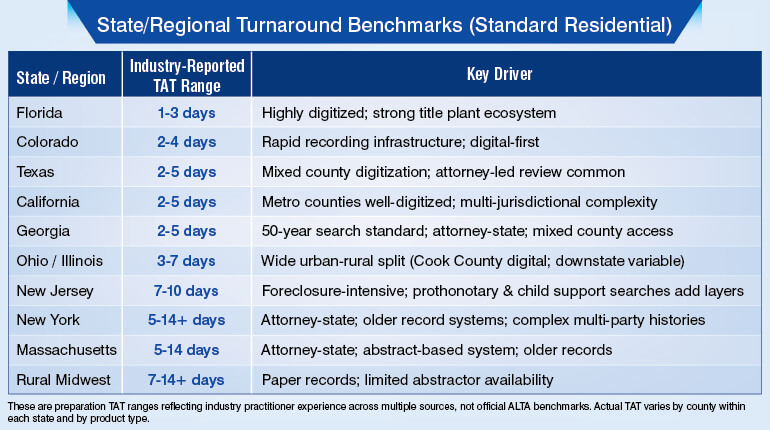
State-level TAT has a different equation. Three basic denominators apply across every state.
First is the digitization level of counties in that state. Second is the recording practices of the state itself.
Third is the closing requirement if it is an attorney-state. Each variable affects how the state-level benchmark performs.
In attorney-states, a licensed attorney must be involved in closing or title opinion. This stretches calendar time even when the actual title search completes quickly.
The NAIC state insurance laws survey shows that in-state operation requirements and whether attorneys can also serve as title agents varies across states.
Georgia needs special mention. The State Bar’s Title Standards mandate a 50-year search for marketable title. The Marketable Title Act also mandates 40 years as a minimum.
By county type
State-level benchmarks are unreliable when analyzing the root cause of TAT. The real reasons for variability sit at the county level.
States like Georgia can have fully digitized metro counties (Fulton, Gwinnett) alongside rural counties with manual paper-record access.
| County Type | Retrieval Time | Total Preparation TAT |
|---|---|---|
| Fully digitized (metro) | Hours to 1 day | 4 hours to 2 business days |
| Semi-digitized (suburban/mid-size) | 1 to 3 days | 2 to 5 business days |
| Manual (rural) | 3 to 7+ days | 5 to 14+ business days |
By title search product
Product type and county type must be considered together. A current owner search behaves very differently in a digitized versus manual county.
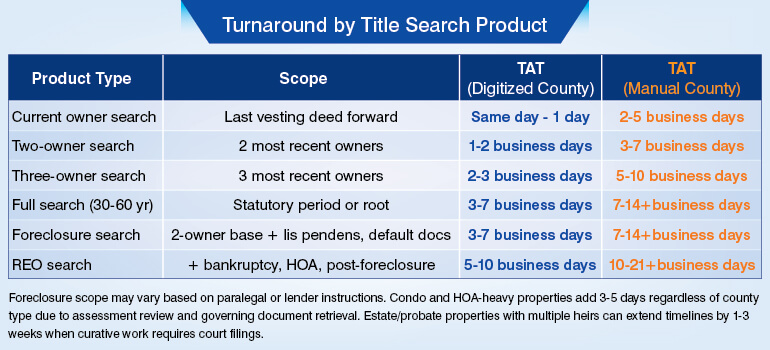
Days may be added depending on governing document retrieval and assessment reviews where required.
Any condo or HOA-heavy property can add 3 to 5 days to the process regardless of the county.
Where court filings are needed, for example in estate and probate properties with heirs, curative work can take 1 to 3 weeks.
Where Title Search TAT Bottlenecks Happen
Five bottlenecks cause the routine turnaround variability seen across title operations. Each one affects different stages of the workflow.
Fragmented records
A single file often requires collecting data from the county recorder, tax assessor, clerk of court, building department, and municipal utility office.
Sequential retrieval is required because each source has its own access method and response time. Parallel processing is rarely possible.
Mis-indexed documents
If any document is filed under a wrong category or name, a standard search will not find it. The error stays invisible until a downstream gap surfaces.
A full day can be lost on investigation and resolution once the gap is discovered. Recovery work takes time the workflow did not budget for
Poor scan quality
Title operations frequently encounter document images that are illegible or degraded. Manual reading by experts and re-keying of data becomes necessary.
One unreadable instrument can add hours to examiner time. The cost compounds across files that share the same source county.
Manual routes
Any manual step involving third-party processes and responses is essentially beyond your control as the title company.
These include courthouse visits, fax requests, or phone calls followed by a wait for response. Each one adds unpredictable cycle time.
Curative work loops
This bottleneck cannot be compressed with automation. Curative work depends entirely on third-party responses.
Common cases include exception resolution: gap affidavits, probate issues, missing releases. Each one runs on its own external clock.
Taken together, these bottlenecks have a compounding effect downstream. Lender SLAs will not flex deadlines because of county infrastructure issues.
Examiners struggle when files do not arrive in a steady flow but in bursts. Underwriters get forced to rush reviews when preparation takes too long.
If you are benchmarking your own operation against these ranges, ask three questions: what is your TAT by county tier, by product type, and by examiner availability?
That breakdown will tell you where in your workflow the recoverable time lives. The answer is rarely where most operations managers assume it is.
How AI Reduces Title Search Turnaround Time
AI can shoulder the automatable, time-consuming stages of title search preparation. The compressible work has expanded substantially in the past two years.
These stages include document retrieval orchestration, document classification, field-level extraction, chain assembly, and exception flagging.
Industry adoption confirms the direction. According to HousingWire reporting on Qualia’s 2025 State of AI in Title & Escrow report, more than 90% of title and escrow professionals have adopted generative AI in at least one form. 86% feel neutral to very optimistic about technology.

Where AI has the most impact
AI can ingest data from county portals and title plants. Domain-trained models can already classify 150+ document types.
Jurisdiction-specific extraction can capture party names, recording dates, and legal descriptions with confidence scoring. The work scales without proportional headcount.
AI can also assemble the title chain by timeline, detect gaps in documentation, and route low-confidence items to human experts.
Only selected issues come across for manual review. Examiner workload concentrates on judgment calls, not mechanical extraction.
Where AI has limited impact
AI will not speed up a courthouse fax or a runner’s drive to a rural recorder’s office. Some delays remain physical and procedural.
But AI can compress time and standardize workflows for every other stage. The recoverable time sits in preparation, not in third party-dependent steps.
The time taken between document arrival and commitment-ready output can drop from hours to minutes. That is the operational lever.
What AI enables operationally
AI enables real-time SLA tracking. You can drill down by county, product type, and examiner to see where delays began.
This lets you reallocate capacity before backlogs build up. Operations managers gain visibility they did not have before.
This is exactly what AI-powered title search support services are built to deliver compressed preparation time, standardized outputs across mixed-infrastructure counties, and real-time SLA visibility for operations managers.
The Bottom Line on Title Search Turnaround
Title search turnaround cannot be represented by a single number. It is the result of a matrix of variables.
Operational capacity, file complexity, county infrastructure, and product scope all interact. Each one moves independently.
To control TAT, you manage each dimension separately and case by case. True industry averages do not exist yet.
More examiners can absorb queue volume and run curative actions in parallel. Headcount helps overall TAT but not per-file TAT.
Increasing examiner headcount cannot solve per-file issues sitting in individual county infrastructure and third-party response windows.
Headcount also cannot simplify the inherent complexity of a 50-year chain. Some work is irreducibly human and judgment driven.
The most efficient title companies do not ask about average TAT. They ask three different questions instead.
What is your TAT by county access tier? What is your TAT by product type? Where in the workflow can you recover lost time?
The answers inform capacity decisions for operations managers. Targeted intervention beats blanket headcount expansion every time.
Given current reality, the county scenario will not change overnight. Manual counties will stay manual for at least decades.
What you can do is tighten and shorten the preparation stages that sit between document retrieval and examiner review.
Methodology and Data Notes
The TAT ranges in the state, county type, and product tables are derived from cross-referencing practitioner-reported data and operational experience.
Operational experience reflects title search preparation support across 1,000+ U.S. counties. Industry data is drawn from ALTA, PRIA, and MISMO published sources.
This article is published by HabileData, a provider of AI-powered title search services for U.S. title companies, supporting examination preparation, document classification, and chain assembly across 3,000+ county formats. Corrections and methodology questions are welcome.
Frequently Asked Questions About Title Search Turnaround Time
A standard residential title search takes between 4 hours and 14 business days. Three factors decide the range; county digitization, search product type, and file complexity. In fully digitized metro counties, a current owner search can complete within 4 hours to 2 business days. In manual rural counties, the same product may take 5 to 14 business days.
ALTA’s 2024 industry data found that standard transactions average 22 hours of work. Difficult transactions, which account for 36% of all transactions, average 45 hours.
Five bottlenecks drive most title search delays. Each one affects a different stage of the workflow. First is fragmented records across multiple county offices. Second is mis-indexed documents that do not surface in standard searches. Third is poor scan quality requiring manual interpretation. Fourth is manual retrieval routes such as courthouse visits and fax requests. Fifth is curative work loops that depend entirely on third-party response times.
Curative work affects 62% of transactions on average and can significantly extend turnaround times.
County digitization creates three distinct tiers of retrieval time. Fully digitized counties offer API or portal access with searchable indices, supporting automated retrieval within hours. Semi-digitized counties provide 10 to 20 years of online records, while older documents require manual access, stretching turnaround time to 2 to 5 business days.
Manual counties often require paper-index and deed-book searches that can take 5 to 14 business days.
Within a single state, county digitization levels, recording practices, indexing quality, and access hours vary independently. While state recording statutes remain the same, operational differences between county recorder offices create significant variation in turnaround times.
Urban counties with modern digital infrastructure generally process searches faster than rural counties that rely on paper records.
Attorney-state closings add calendar time beyond the title search itself because a licensed attorney must participate in the closing process or title opinion. However, the title search may be completed within the same timeframe as in a non-attorney state.
The overall transaction timeline is often extended to accommodate attorney review and approval requirements.
According to ALTA industry data, standard transactions average about 22 hours of work, while difficult transactions average approximately 45 hours. Roughly 36% of title transactions fall into the difficult category.
Difficult files often involve curative actions, estate or probate transfers, gap deeds, missing releases, or complex chains of title that require additional research and resolution.
Curative work is the process of resolving title defects identified during examination. Common examples include obtaining missing release documents, correcting gap deeds, securing heir affidavits, and matching judgments to the correct party.
Simple curative work may take 1 to 3 business days, while complex probate or quiet title matters can take several weeks depending on third-party response times.
Different title search products require different levels of investigation. A current owner search verifies the latest deed and liens, making it the fastest option. Two-owner and full title searches require deeper chain-of-title research and additional verification.
Commitment-grade searches also include tax, judgment, and lien research across multiple offices, increasing turnaround times.
AI can accelerate document retrieval, classification, data extraction, and chain assembly tasks. These improvements reduce preparation time and help title professionals process files more efficiently.
However, AI cannot eliminate delays caused by courthouse visits, manual county processes, lender requirements, court actions, or other third-party dependencies.
A realistic service-level agreement depends on county coverage, search type, and file complexity. For fully digitized metro counties and current owner searches, a 24 to 48-hour SLA is often achievable.
For mixed-county portfolios, two-owner searches, or searches involving manual jurisdictions, realistic turnaround times typically range from 3 to 14 business days.
Ready to benchmark your TAT by county tier and product type?
Talk to our experts »


Snehal Joshi , Head of Business Process Management at HabileData, leads a 500-member team of data professionals, having successfully delivered 500+ projects across B2B data aggregation, real estate, ecommerce, and manufacturing. His expertise spans data hygiene strategy, workflow automation, database management, and process optimization - making him a trusted voice on data quality and operational excellence for enterprises worldwide. 🔗Connect with Snehal on LinkedIn