
Title officers can cut commitment prep time without adding headcount. The fix is straightforward: standardize how files come in, pull documents from more than one source, sort and label them before review, and use AI only where it actually helps in each of the four phases of title examination.
Contents
- How Much Time Does Each Phase of the Typical Title Commitment Process Take?
- Top Bottlenecks Causing Friction during the Preparation Period of Title Searches
- The Three Workflow Levers That Compress Turnaround Time
- How Best to Use Automation/AI Within Your Title Examination Workflow
- KPIs that Support Continuous Improvement
- Real-world Impact of Workflow Optimization
- The Bottom Line
Title officers are under stress due to an imbalance of volume growth vs. budget cuts. There is a lot of pressure on title officers right now. Order volume continues to grow. Client Service Level Agreements (SLAs) continue to become tighter. Yet, hiring budgets remain static. As such, the math does not work out unless the workflow changes.
On average, title commitment preparation requires 3–5 business days in metro areas under normal circumstances. However, as of 2025, county backlogs increased 19%. Therefore, even simple searches may exceed their SLA windows. A closing delay costs borrowers $35-$60 in fees for extending their rate lock. Delayed title searches cost an additional $500-$1000 in average closing friction per file.
This article will describe ways for title officers, operations managers, and title company owners to shrink the commitment preparation timeframe without employing any staff via standardization, better distribution of tasks, and selective application of automation.
How Much Time Does Each Phase of the Typical Title Commitment Process Take?
The typical title commitment process in the United States includes four phases. Understanding what happens in each phase can help you see the roadblocks which exist within this traditional workflow.
| Phase | Key Activities | Typical Time |
|---|---|---|
| Intake & Order Setup | APN verification, legal description check, search scope definition | 30 min – 2 hrs |
| Document Retrieval | County records, deeds, mortgages, liens, tax records, judgments | 1 – 4 hrs (days in backlogged counties) |
| Document Review | Chain of title analysis, lien/encumbrance review, exception drafting | 2 – 6 hrs |
| Commitment Prep | Schedule A/B assembly, underwriter review, issuance | 1 – 3 hrs |
Title examinations are relatively simple when properly executed. Therefore, a well-managed title examination facility utilising a basic method of operation could easily conduct a residential title examination within one business day. In practice, most title examinations require three to five working days to complete; not because title examiners operate slowly, but simply as a result of the friction caused by the handoffs associated with transferring responsibility in the traditional workflow.
Top Bottlenecks Causing Friction during the Preparation Period of Title Searches
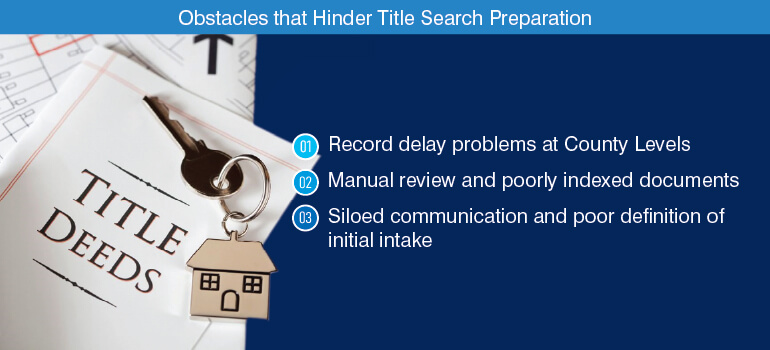
1. Record Delay Problems at County Levels
Title commitments generate activity in approximately 3,600 different recording offices throughout the United States. Since there are no two identical recording office systems, some recording offices provide totally electronic records, whereas other recording offices require physically visiting the courthouse to obtain access to historical deeds or probate information. When a county uses both electronic and paper filing methods, title examiner workflows must use multiple interfaces simply to assemble a complete chain of title history.
2. Manual Review and Poorly Indexed Documents
Although documents may be obtained quickly enough, manual reviews are typically the greatest source of wasted time. Searching for misindexed documents and undisclosed deaths can cause an examiner to wander into a 3-hour long rabbit hole. According to one Alabama title abstractor, an examiner can spend three hours investigating the wrong individual prior to realizing he/she is deceased – after which point, they must begin again with the heirs.
3. Siloed Communication and Poor Definition of Initial Intake
Badly defined initial intake (for example, ambiguous legal descriptions or unverified Assessor Parcel Numbers) results in poorly scoped searches and often requires restarting searches. Siloed communication between the examiner, abstractor, and underwriter also creates problems such as lost emails, unclear instructions, and delayed communications that compound delay at each transfer of responsibility.
The Three Workflow Levers That Compress Turnaround Time
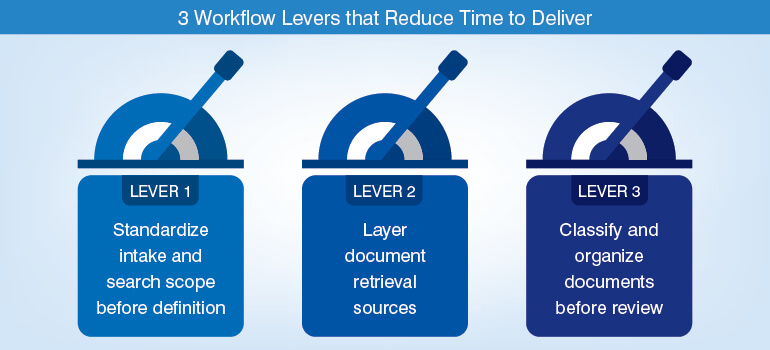
Lever #1: Standardize Intake and Search Scope before Definition
Some amount of rework may be avoided. Create a checklist for initial intake that will clearly identify and verify full legal description and APN, ownership status (death, trust, etc.), confirm search types, confirm jurisdictions that require multi-county searches – all before creating orders. Teams operating in an operational capacity that report quantifiable reduction of mid-examination restarts have utilized a standardize intake checklist.
Lever #2: Layer Document Retrieval Sources
Do not solely depend upon a single county resource. Utilizing multiple county resources along with title plants and third-party data vendors provides examiners with access to documents from the fastest possible sources. Combining a verified list of vendors used for accessing county resources with databases containing title plant information related to searches based upon legal description can dramatically shorten document retrieval times for most routine residential orders
Lever #3: Classify & Organize Documents Before Review
Document piles consisting of unorganized documents force examiners to mentally sort documents prior to beginning examinations. Developing a system of organized document classification by instrument type, recordation date, grantor/ grantor prior to review can reduce examiner review time by 20-30% for complicated searches, regardless of whether this is done with or without new technology investments.
How Best to Use Automation/AI Within Your Title Examination Workflow
Title automation solutions in operations has evolved far beyond mere digitization.
- Structured data extraction: Artificial Intelligence (AI) tools extracting ownership information, legal descriptions, recording dates, lien amounts, parcel IDs from unstructured documents, thereby eliminate manual transcription. These offer the highest-value opportunities for AI data extraction and automation.
- Automated Lien Discovery: Simultaneous multi-database scanning for judgments, unpaid taxes and contractors liens against federal bankruptcy records, county tax rolls and court judgement indexes;
- Human-in-the-Loop (HITL) Validation: Routing high-confidence extracted information directly through while sending only low-confidence/ high-risk information to examiners for review, thus allowing examiners’ expertise to focus only on what truly matters.
These benefits are quantifiable: automation increases productivity and customer satisfaction by reducing errors by up to 70%. For title operations, that equates to fewer missed liens, fewer errors made in recording details and fewer exceptions that arise during the final stages of the commitment process that ultimately blowup a commitment.
| Workflow Stage | Manual Approach | Automated | Time Savings |
|---|---|---|---|
| Document retrieval | Single-source county searches | Multi-source parallel retrieval | 40–60% |
| Classification | Manual sorting by examiner | AI instrument categorization | 50–70% |
| Data extraction | Manual transcription | Structured AI extraction | 60–80% |
| Lien discovery | Sequential DB checks | Simultaneous multi-DB scan | 50–65% |
| Exception review | Full manual review | AI flagging + HITL queue | 30–50% |
KPIs that Support Continuous Improvement
Measuring something is essential to optimizing it. All top-performing title companies track these KPIs on an ongoing basis (at least) once a week.
| KPI | What It Measures | Target |
|---|---|---|
| Average Turnaround Time | End-to-end commitment prep per file | < 24 hrs residential; < 72 hrs commercial |
| Accuracy Rate | Commitments issued without post-issuance corrections | > 98% |
| Rework Rate | Files requiring restart or significant revision | < 5% |
| First-Pass Commitment Rate | Commitments without revisions after underwriter review | > 95% |
| Exception Resolution Time | Hours from exception identified to resolution | Target 4–8 hrs by type |
Real-world Impact of Workflow Optimization
As many can attest; the result of workflow optimizations can be measured. For example, AFX Research is a national title assessment company that provides 75% of current owner searches in less than 1 business day nationwide, at over 3600 recording venues through the use of both automation and expert researcher networks. Companies using AI-assisted document classification also see an additional 40-70 % reduction in manual processing time per file.
By 2025, 92 percent of executives within document intensive industries will have implemented AI enabled automation into their workflows. With each county establishing API accessible record feeds, document retrieval will move from hours to minutes for increasing percentage of US transactions. Those title operations building AI readiness today will be structurally better off tomorrow when these capabilities mature.
The Bottom Line
Preparing title commitments faster does not happen from working harder inside a broken process. It happens when you rebuild the process: standardized intake, layered retrievals, structure document organization and AI-driven document processing, around efficiency and accuracy. Title officers who will outrun competition are not waiting to hire more employees. They’re optimizing the operation they already have.



Snehal Joshi , Head of Business Process Management at HabileData, leads a 500-member team of data professionals, having successfully delivered 500+ projects across B2B data aggregation, real estate, ecommerce, and manufacturing. His expertise spans data hygiene strategy, workflow automation, database management, and process optimization - making him a trusted voice on data quality and operational excellence for enterprises worldwide. 🔗Connect with Snehal on LinkedIn