

Title companies struggle to pace up their manual title processing slowed down due to fragmented data. Leveraging AI, automates document extraction and review, resulting in improved speed and accuracy. Ultimately, we can say that human supervised AI models boost efficiency and scalability, helping Title companies with faster commitment preparation.
Contents
- All You Need to Know About Commitment Preparation Process
- Problems Impacting Title Search Timelines
- Root Causes of Delays in U.S. Title Search Workflows
- Operational Challenges Faced by the Property Examiners
- Top Reasons Why AI Adoption is Accelerating In Title Companies
- Core Technologies Powering AI in Title Search
- AI-Powered Title Workflow for Commitment Preparation
- Human Validation in Title Search
- Advantage Points of AI on Commitment Preparation
- Manual vs Automated Title Search Workflows
- Business Impact and the Future of AI for Title Companies
- Conclusion
Did you know that about 36% of title files are complex and require extensive curative work, according to ALTA (American Land Title Association research)?
It negatively impacts closing timelines and increases operational costs significantly for real estate transactions.
Title commitment preparation, the manual and fragmented process, is impacted the most due to these challenges. Growing transaction volumes add up to the issue of traditional workflows that are already struggling to keep up with modern day real estate data dynamics.
This is making a lot of title companies rely heavily on AI models to improve efficiency, and hence the turnaround time of their commitment preparation process. Let’s check out step-by-step as to how the title commitment preparation process works.
All You Need to Know About Commitment Preparation Process
The commitment preparation process is an approach used by the title companies to validate property ownership, identify liens, or encumbrances, and create a report before closing.
It involves searching history, reviewing real estate documents list, and assessing risks to ensure an accurate property title.
The commitment preparation process begins with a basic title search across US counties, where examiners gather records for the verification of property and liens.
Next comes, document categorization and listing, followed by data extraction and review. Investigator study deeds, mortgages, and tax records as part of the abstraction services workflow to identify risks.
At the final stage, all judgements are compiled into a title commitment report. These steps are generally slowed due to missed or incorrect county level information and manual effort.
While the process seems structured, several bottlenecks are in practice. Let’s jump into a closer look at where the delays occur.
Problems Impacting Title Search Timelines
Several operational inefficiencies significantly affect title search turnaround time, especially in traditional workflows.
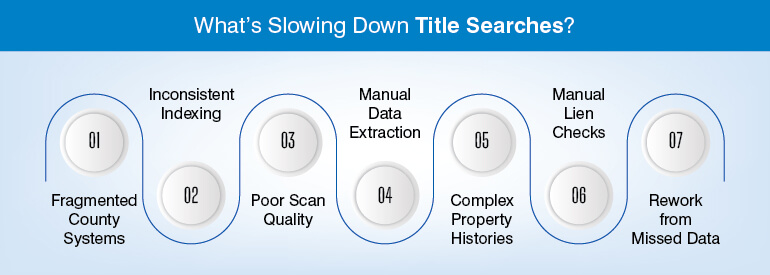
1. Shattered County Record System
Different systems across counties complicate the title search records in the USA. This requires examiners to navigate through multiple platforms.
2. Inconsistent Indexing
Repeated variations in naming history and indexing reduce efficiency in property ownership evidence notes. In our experience across U.S. counties, inconsistent grantor–grantee indexing takes up a lot of manual review time.
3. Poor Scan Quality and Incorrect Formats
Manual review of the scanned files is forced due to lack of proper OCR and incorrect formats.
4. Manual Data Extraction & Review
Human-driven processes slow down the automated title search process and in-fact increases dependency on skilled investigators.
5. Complicated Property History
Property that has long transaction chains and several ownership changes requires deeper investigation within the workflow.
6. Manual Lien & Encumbrance Check
Identifying manual liens and encumbrances without proper tools and technology increases risk and efforts.
7. Rework Due to Missed information
Errors leads to repeated investigation and unnecessarily delay faster commitment procession.
All of the above are the major factors of systematic issues. Let’s dive deeper into the reasons to make the process better.
Eliminate manual inefficiencies in title workflows
Schedule a free consultation! »Root Causes of Delays in U.S. Title Search Workflows
The delays in US title workflow automation grows from key systematic challenges:
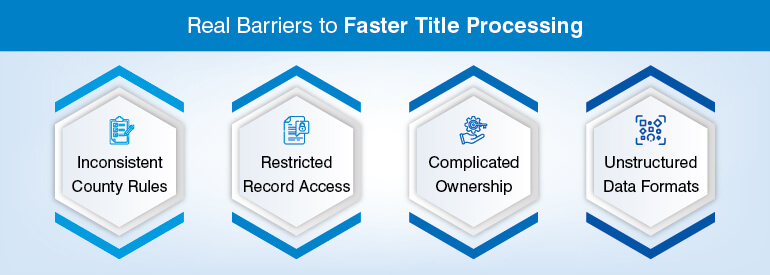
1. Jurisdictional Variability in Recording Practices
The jurisdiction varies county-wise, so do the operations. The process drastically complicates the title search process across US counties and makes scalability a challenge.
2. Data Accessibility Challenges
Locked data behind paid websites is one of the biggest issues for title search companies. AI technology and automated systems try to extract the data, and they may fail to find the information due to this gated wall.
3. Complex Property Scenarios
Inherited property, multi-owner or frequently switched owners is an another concern which results in more human efforts for deep investigation, complicating the whole process.
4. No Standardization in Document Formats and Metadata
Unorganized documents restrict the effectiveness of AI-driven workflows. AI systems find it harder to understand the categories and list of documents that are not normalized.
The above are the hurdles that clearly prove why your commitment preparation process is slowed down. NLP Tools for intelligent real estate document data extraction improve efficiency and accuracy.
The property examiners also face everyday challenges that significantly impact efficiency. Let’s explore to avoid them at an early stage.
Operational Challenges Faced by the Property Examiners
An accurate commitment preparation can be ensured by title examiners. Yet they face particular challenges. Let’s go through some of them below:
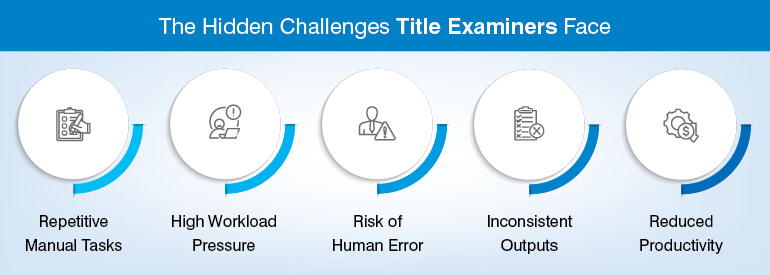
1. Time Consuming Tasks
Title examiners spend a lot of time running through each document one by one manually. The process is tiring and leaves less time for other important decision-making tasks.
However, AI helps speed up document review by automatically extracting and highlighting key information, reducing manual effort.
2. High Workload with Limited Scalability
As per the demand, the investigators often get loads of files for verification at the same time. It becomes difficult to handle everything altogether and drive the requirement to add more people, raising the costs.
We’ve seen skilled examiners handle only 8-12 complex files per day manually, which AI-assisted workflows can improve without adding more staff.
3. High Risk of Human Error
Manual work increases the chance of missing something important, such as legal claims, unpaid loans, or in case of restrictions. Even a small mistake can lead to huge financial and legal trouble in the future.
To address this, AI reduces errors through consistent validation and early flagging of missing or risky information.
4. Uneven Results & Lack of Consistency
Examiners apply different methods to validate documents and verify liens and encumbrances. Different judgements due to uneven quality across files may cause a couple of rechecks, and ultimately confusion.
This is where AI brings value by ensuring standardized processing and more consistent results across files.
5. Complexity in Cases
In most of the cases, property records are not really clear and need extra effort to be fixed. These processes take more time and lead to overall processing delays.
In such cases, AI helps simplify complex property records by organizing data and identifying key issues faster.
All the above challenges may sometimes hamper the speed of the work; errors may increase, and file rechecks need to be done. Complexity affects both speed and data quality of a property, and this directly leads to unhappy clients.
To What Extent Does Title Search Turnaround Time Drive These Problems
The above operational challenges make the title search process much slower than it should be. A major reason is manual work due to which, the examiners have to go through each document which takes a lot of time.
The challenge increases with restricted data access and complexity. On top of that, sometimes the documents are not properly organized, so more time needs to be invested just to figure out how to sort them.
High workloads also add to the delay. When examiners have too many files to handle, it creates bottlenecks, and the need to double-check details increases the overall processing time even more.
That’s why many companies are opting for AI solutions to make the process faster and more accurate.
Top Reasons Why AI Adoption is Accelerating In Title Companies
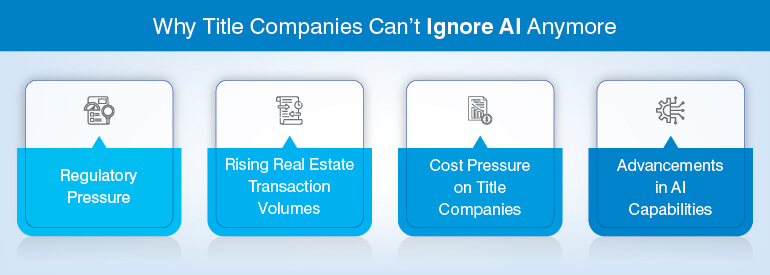
AI is becoming more popular in title companies because these companies have a lot more work now. There are plenty of property deals happening these days, so employees have to handle a large number of documents.
Doing all of this humanly takes a lot of time and can lead to mistakes. AI helps reduce this burden by doing most of the tasks faster and more accurately.
Also, companies wish to save money and avoid errors, so using AI has become extremely important. Another reason is that AI has improved a lot in recent years.
Previously, the traditional systems were not smart enough to understand documents, but now technology can help it read, understand, and standardize information from papers much better.
Hence, companies have started relying on AI for better convenience and efficiency. According to industry research reported by HousingWire, AI adoption in real estate and financial services has risen from approximately 48% to over 70% in just a few years.
Core Technologies Powering AI in Title Search
Several technologies work together in an AI-driven title workflow. We have compiled them below for you.
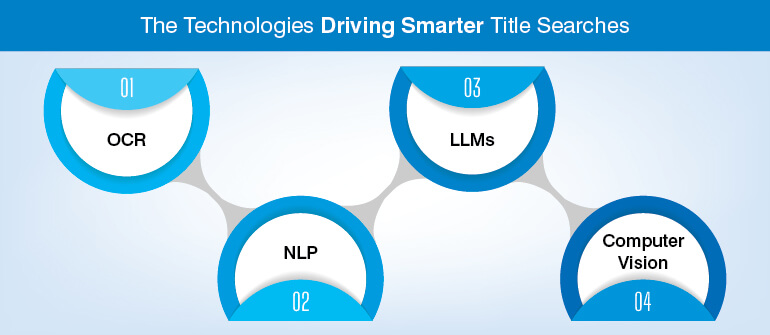
1. Optical Character Recognition (OCR)
Character recognition is an important method to read paper documents and convert them into computer text. For example, you are uploading an image of text on paper, and the system is able to extract the text from it. Isn’t it easy for humans?
You can now search and store data easily with the help of OCR.
2. Natural Language Processing (NLP)
Natural language processing is a technology to understand human language. Now, smart systems can read documents and figure out important data like ownership, property history, dates, and other documents.
AI quickly detects the important parts, instead of the human workforce reading the whole page carefully. In title workflows, this helps accurately separate similar legal terms like a mortgage satisfaction and a partial release, which can significantly affect ownership records.
3. Large Language Model (LLM)
Large language models are intelligent AI systems that understand long and complex text. In title work, they help explain complicated legal documents in simpler words.
They can also point out missing or unclear information which can significantly decrease manual efforts. For example, LLMs can read complex subordination agreements and flag lien priority issues, which would normally need an experienced examiner to review.
4. Computer Vision for Document Parsing
Computer vision helps in verifying documents like the human eye. It easily observes stamps, signatures, tables, and different sections in a document.
Everytime, the details are not available on papers, they may be uploaded somewhere online, and AI ensures the commitment preparation does not miss any information.
AI-Powered Title Workflow for Commitment Preparation
A modern automated title search process includes:
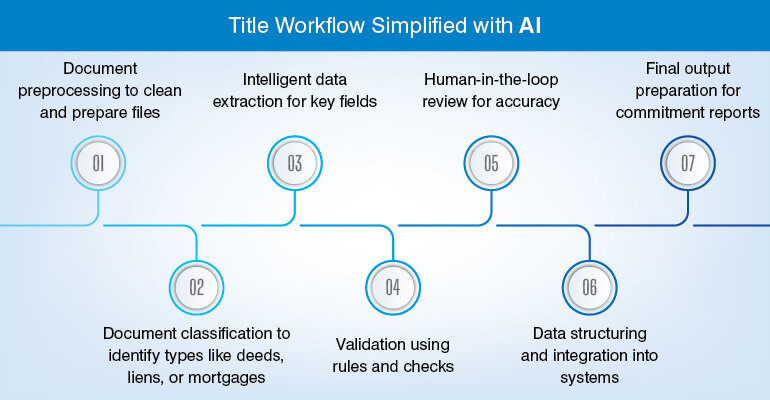
This US title workflow automation helps reduce manual effort and improves consistency.
One of the most impactful applications of AI in this workflow is data extraction. Here’s what AI can capture.
Use of AI to Extract Key Data Points
AI systems can automatically pull important details such as:
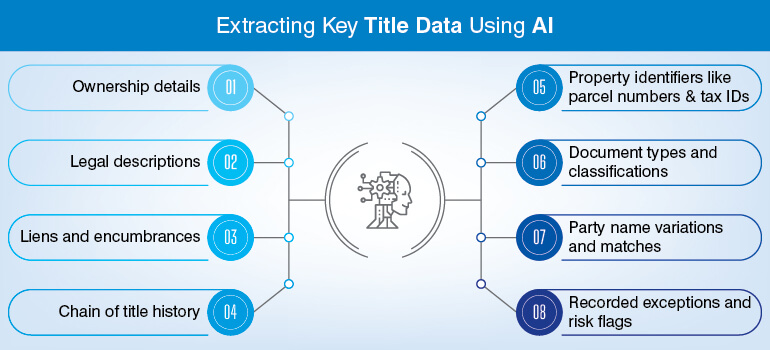
This improves property ownership verification and speeds up the title commitment preparation process. While automation plays an important role, human validation is still essential to ensure accuracy.
Human Validation in Title Search
Human review is an important step even after automation. Across high-volume title work, AI often flags many documents for human review due to low confidence. This happens most in inherited property chains and records with missing information.
AI systems extract property data from a wide range of sources and, if it finds low confidence, a title examiner’s workflow process is triggered for manual review.
The balance of human validation + automation works really well in maintaining accuracy and improving processing speed.
Ultimately, this combination helps title companies reduce turnaround time and handle work reliably.
Advantage Points of AI on Commitment Preparation
According to reporting by Business Insider, AI-powered automation tools can reduce title search and document review time by up to 80% in high-volume, structured document environments. So, we can say AI for commitment preparation delivers several benefits:
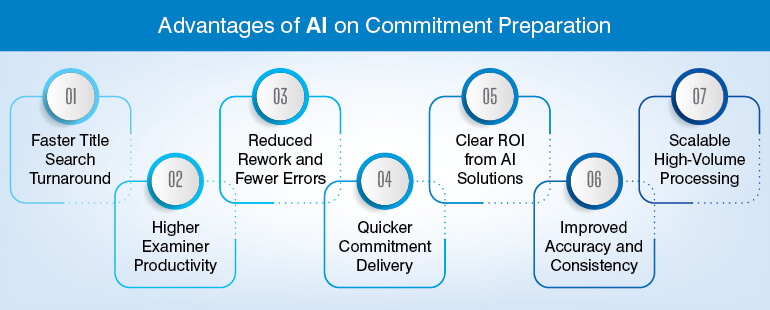
1. Reduced title search turnaround time
Documents processing and data extraction with the help of AI cuts down the required time to complete a title search and prepare commitment.
2. Increased productivity for title examiners
Manual and repetitive tasks seek a lot of time and human energy. However, AI helps examiners focus on complex analysis and work on overall output per resource.
3. Lower rework and fewer errors
AI-driven automated validation and confidence scoring prevents early-stage inconsistency. Thus, reducing the need for repeated reviews and corrections.
4. Faster delivery of commitments to clients
Well-managed workflows enable quicker compilation of title records which directly help companies meet deadlines around the corner.
5. Measurable ROI from AI title search solutions
Moreover, the operational costs and efficiency can also be improved through automation, making it convenient for the companies to track straight performance and financial gains.
6. Better Accuracy and Consistency
Now a days, the advancements ensure structured extraction, standardization and interpretation which also decreases the risk of manual judgement errors.
7. Scalability Growth for High Volume Operations
AI systems can process loads of files, without the need to increase manual workforce. This makes scaling more cost-effective.
See how AI integrates into your existing workflow.
Request for a free consultation! »Manual vs Automated Title Search Workflows
The table below provides a clear comparison between manual and AI-powered title search workflows.
| Area | Manual Workflow | AI-Powered Workflow |
|---|---|---|
| Document handling | Fully manual review | Automated classification using AI |
| Data extraction | Manual reading and typing | NLP and OCR-based extraction |
| Error rate | Higher due to human fatigue | Lower with validation checks |
| Speed | Slow and inconsistent | Faster and scalable |
| Scalability | Limited by workforce | Handles high volumes easily |
| Turnaround time | Longer | Reduced significantly |
This comparison shows how title search automation improves efficiency across the entire process.
Looking ahead, these improvements are weaving the future of the title industry.
Business Impact and the Future of AI for Title Companies
AI is all set to bring title operations to the next level by improving efficiency, accuracy, and scalability across the entire workflow. Let’s explore some of the future trends below:
- AI will automate most of the title workflow, simultaneously supporting examiners with insights and decision-making.
- Bring faster and seamless access to county records. This will be enabled through improved system integrations.
- The intelligent systems will encourage improved accuracy and reduce errors by better detecting liens, encumbrances, and inconsistencies.
- Smart systems will focus more on standardized data and document formats, making automation more reliable.
- Companies will be able to scale operations more effectively without increasing the staff.
- Support faster turnaround times to reach the industry standard.
- The automation will improve speed and accuracy to drive better customer satisfaction and trust.
Machine learning and automation are offering title companies a much-needed upgrade from manual handling to smart workflows. Your title company should definitely utilize it.
Conclusion
The title industry is moving rapidly toward faster, more automated processes as manual methods struggle to keep up with growing demand and complexity.
Those who act early will gain a measurable edge in turnaround time, client satisfaction, and operational cost efficiency.
The shift toward title search automation is no longer just an upgrade, and it is becoming a necessity for modern title companies.
Modernize and scale title commitment processing with ai-driven automation.
Request for a Free Quote! »


Snehal Joshi , Head of Business Process Management at HabileData, leads a 500-member team of data professionals, having successfully delivered 500+ projects across B2B data aggregation, real estate, ecommerce, and manufacturing. His expertise spans data hygiene strategy, workflow automation, database management, and process optimization - making him a trusted voice on data quality and operational excellence for enterprises worldwide. 🔗Connect with Snehal on LinkedIn