
Email appending adds and enriches verified email addresses to your existing B2B database, thus improving delivery, personalization, and efficiency in the sales process. It turns incomplete databases into reliable, compliant, and robust lead-generation assets.
Contents
A B2B company’s success depends on two key factors: reaching the correct decision-maker(s) at the correct time; and executing a well-timed campaign. Even if a B2B marketer has invested in sophisticated marketing automation, CRM, or sales enablement tools, the foundation of each is accurate contact data.
Unfortunately, most B2B databases deteriorate at an annual rate of 20-30 percent as a result of job changes, company restructuring, and stale data. As a result, a significant number of B2B marketers’ emails are unable to reach actual buyers. The solution to this challenge lies in using email appending, which provides missing or outdated email addresses for contacts already included in your database.
In contrast to buying new lists or simply taking a guess at a contact’s e-mail address, you will use email appending to supplement your existing CRM records with verified, business-ready e-mail data. The end results are improved outreach, increased response rates, and a healthier sales pipeline.
For companies providing high-value products or services (e.g., SaaS providers, IT companies, product-based businesses), email appending will provide a substantial growth accelerant. The method ensures that every campaign, sales follow-up, and nurturing sequence is delivered to real prospects who can make purchase decisions.
What is email appending?
Email appending is the practice of using your current contact records (names, company names, phone numbers, etc.) to locate and confirm missing business e-mail addresses in trusted data sources. Therefore, instead of starting from scratch, you will be enhancing the data you currently possess.
As an example, if your CRM includes a lead’s name, company, and job title, however, does not include a valid e-mail address. Email appending will fill the void, include a confirmed business e-mail address to ensure it reaches the right contact, empowering your marketing and sales teams to interact directly with the prospect.
Within the context of B2B environments, this process is particularly beneficial since B2B buying cycles are long and involve numerous stakeholders. The more comprehensive your contact data is, the more easily you can identify and interact with buying committees, tailor your outreach efforts, and nurture leads through the sales funnel.
If executed correctly utilizing compliant and validated data sources, email appending will transform the fragmented, incomplete data bases previously unusable as revenue generators.
Why does B2B email data matter in lead generation?
Lead generation in B2B is highly dependent upon email marketing, account-based marketing, and sales outreach. However, the absence of accurate and/or missing e-mail addresses generates friction throughout the entire sales funnel. Hard bounces negatively impact your sender reputation, reduced deliverability limits your visibility, and incomplete data renders segmentation virtually impossible.
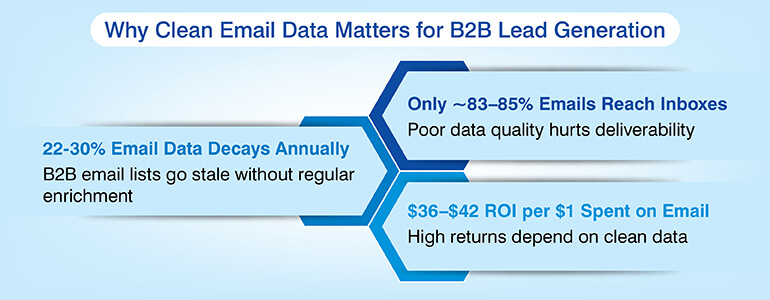
Additionally, poor data quality can lead to wastefulness in marketing dollars spent. Marketing teams invest money in campaigns that do not reach the intended recipients’ inboxes, while sales teams waste time pursuing leads that cannot be contacted. Ultimately, the cumulative effect of this issue erodes trust in the CRM and leads to revenue leakage.
Email appending eliminates each of the aforementioned issues by ensuring that every record in your database is usable, accessible, and relevant. Each of these benefits will positively affect the performance of each lead generation-related activity that follows.
Clean your B2B email data
Get Started »10 ways email appending supports B2B lead generation
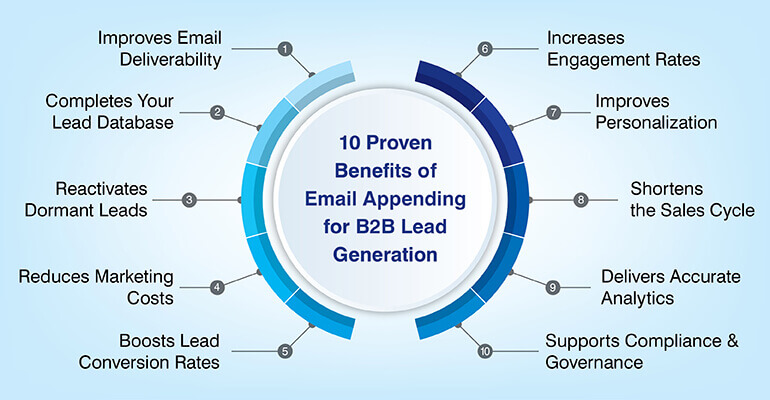
1. Increases email deliverability
Deliverability is one of the greatest obstacles faced by B2B marketers. Service Providers and e-mail platforms track bounce rates, spam complaints, and e-mail engagement. If there are too many bounced e-mails or e-mails left unopened, your domain is flagged and even legitimate e-mails may be sent to spam.
Email appending replaces missing or out-of-date e-mail addresses with active business e-mail addresses.
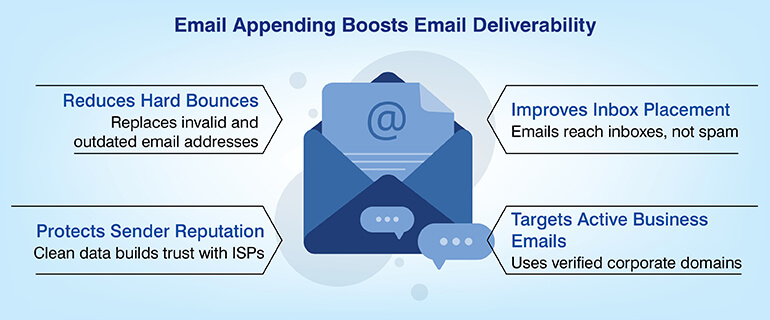
Consequently, this greatly decreases bounce rates and enhances inbox placement. With consistent delivery to actual people, your open rates and response rates improve as well; therefore, your sender reputation continues to strengthen over time.
2. Enhances and completes your lead database
Most B2B databases are partially complete. A B2B company may have thousands of contacts, yet only a small percentage of those contacts will have usable e-mail addresses. As a result, most B2B marketers’ marketing and sales activities will be limited to a small segment of their overall audience.
Email appending completes the gaps in your partially complete database; thus, you will turn partially complete records into fully actionable leads. Additionally, by completing your database, you will maximize the capabilities of your existing CRM, marketing automation, and analytical tools without acquiring new leads.
3. Provides improved targeting and segmentation
Segmentation is a fundamental element of successful B2B marketing. Decision-makers in financial departments need to receive different messages than IT Directors or Procurement teams. Because of the lack of e-mail data, B2B marketers are unable to effectively target and communicate with these groups.
Once the e-mail addresses are appended to your database, you can organize your contacts by company size, industry, job function, or buying cycle and send targeted campaigns that directly relate to the needs of each group. The relevance of the message will significantly increase engagement, resulting in better quality leads for your sales team.
4. Reengages dormant or lost leads
Dormant B2B leads are typically lost over time due to either changing jobs, expanding companies, or losing contact information. Updating non-existent or incorrect e-mail addresses (using contact data appending) will enable you to reconnect with those “inactive” leads previously unavailable for communication purposes.
Once you’ve updated their e-mail addresses, and then used CRM email enrichment to update the e-mail address; you’ll be able to use the appended e-mails to review dormant segments using real-time engagement indicators.
Using an appropriate strategy, you’ll be able to evaluate the likelihood that dormant leads may have become active again; which could result in new revenue streams without the expense of purchasing new leads.
- Increases ability to communicate with previously unreachable leads
- Enhances contact through updated e-mail addresses
- Enables lead scoring using appended e-mail addresses
- Reactivates dormant segments that were previously within your CRM
5. Reduces marketing costs
Wasting money on sending e-mails to people who no longer exist or do not receive them is just one example of how inaccurate contact data hurts B2B marketers. The best way to clean up lead generation data is to ensure that your email campaigns are being sent to valid e-mail addresses.
In doing so, businesses can significantly lower their reliance on expensive lead purchases. Better yet, businesses can gradually improve the performance of their email marketing campaigns using enriched data. And, by doing so, business can allocate budget dollars to various campaigns strategically.
With the support of trusted email append providers; this process significantly lowers the cost per lead, and at the same time increases overall marketing efficiency.
- Reduces amount spent on bounced or non-deliverable e-mail
- Improves targeting through cleaned CRM data
- Lower cost per lead using existing databases
- Facilitates efficient, data-driven communication
6. Boosts lead conversion rates
When sales and marketing teams are communicating with the correct decision-maker, at the right time, and with the most current contact information, they tend to experience higher levels of lead conversion. When you’re using CRM email enrichment; you’re ensuring that you’re engaging with decision makers, not old contact information.
When you have more accurate contact information, it’s easier to segment leads, personalize messages, and assign lead scores with appended e-mail addresses. And with cleaner input, teams will be able to focus on the highest priority prospects and respond much faster.
When used together, appending email addresses and launching marketing campaigns using enriched email addresses contributes to increased engagement, higher response rates, and greater success in developing pipeline performance.
- Increases engagement by providing more accurate email targeting
- Provides smarter ways to segment and personalize
- Increases response and conversion rates
- Strengthen follow-up sales efforts with richer data
7. Reduces the sales cycle
Data inaccuracies create frustration for sales teams when they cannot find the right contact information for their leads. Emails bounce back, follow-ups are delayed, and reps spend too much time verifying information before being able to sell. The process of appending contact data eliminates this frustration by creating a verified and reachable email address where sales outreach will start.
By enabling increased reachability through CRM email enrichment, sales representatives can communicate with their leads at the correct time, speed up early-stage conversations, and consistently communicate with their leads as they move down the sales funnel. The result is less time spent waiting between touchpoints and fewer interruptions that delay closing the deal.
- Eliminates delay between initial outreach and follow-ups: Verified emails allow initial outreach to go directly to the decision-maker, reducing the amount of time wasted because of bounced or misdirected emails.
- Speeds up sales conversations: The sooner reps can make connections, the sooner they will have discovery calls, demos, and follow-ups. Overall, this speeds up the sales cycle.
- Increases efficiency of follow-ups: Once sales teams have accurate contact data, they can execute structured follow-up cadences without being interrupted by bad data.
- Creates momentum down the funnel: Having consistent engagement that is created by having good data, will help to keep deals moving forward and prevent them from being stalled by communication gaps.
Turn incomplete leads into opportunities
Contact Us »8. Enhances personalization and engagement
In today’s B2B buying environment, generic messaging does not work anymore. Email appending creates an opportunity for customer data improvement by providing verified email addresses in addition to firmographic and role-based data. Marketing and sales teams are able to personalize messages and tailor messaging to the who the buyer is and what the buyer cares about.
Once personalized email marketing has been created using enriched data, the recipient of the message will see the relevance of the message and will have a positive perception of the outreach. Positive perceptions build trust, encourage engagement and ultimately develop long term relationships with buyers.
- Allows role-based personalization: With enriched data, marketing and sales teams are able to create messaging that reflects the responsibilities, challenges and decision-making authority of the prospect.
- Provides industry-specific messaging: Campaigns can be developed that incorporate industry-specific messaging to enable outreach that feels informed and not generic.
- Enhances quality of engagement: Messages that are relevant to the interests of the prospect, will generate higher levels of clicks, replies and meaningful conversations.
- Develops trust over time: Messages that are personalized to the prospect, signal to the prospect that you understand them and not just send automated messages to them; which develops trust over time.
9. Provides better campaign metrics
When marketing analytics include invalid or outdated email addresses in a database, the accuracy of the analytics is diminished. High bounce rates and inconsistent delivery rates skew performance metrics and create confusion regarding what is actually working.
Email appending cleans lead gen data by sending campaign communications only to valid and reachable contacts. Cleaner data provides a clear picture of engagement so that marketing teams can assess the effectiveness of content, the level of responsiveness of their target audiences and the trending patterns of conversions.
- Eliminates skewing of performance metrics: By eliminating invalid emails, bounce rates and delivery rates will be accurate and provide a true measure of performance.
- Reveals the true levels of engagement: Metrics such as opens and clicks will reflect actual behavior of the buyer and not the errors in the data.
- Provides more reliable conversion tracking: With cleaner data, conversion tracking will be more reliable and accurate across all campaigns.
- Provides better guidance for optimizing content, targeting and budget allocation: Better insights will provide guidance to marketing teams for optimizing content, targeting and budget allocation.
10. Supports Compliance and Governance
If done correctly, email appending can strengthen data governance instead of increasing the risk of exposing the company to compliance issues. A trusted email append provider adds new information to existing records versus adding unknown or non-permissioned contacts to the record.
This method of appending is consistent with the compliance framework of the organization and supports the development of ethical customer data.
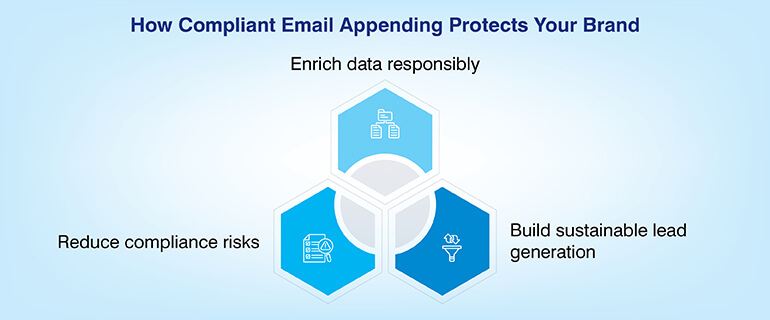
By controlling the process of developing and using enriched data, organizations can minimize their exposure to compliance risks, minimize the potential damage to their brands and ensure that lead generation practices continue to be viable and compliant over time.
- Performs responsible enrichment of owned data: Appending focuses on enhancing existing data records as opposed to importing untested and potentially problematic third-party lists.
- Aligns with existing governance frameworks: Clean methods of enrichment support both the internal data quality and compliance standards of the organization.
- Reduces regulatory exposure and potential damage to brands: Practices of responsible data handling minimize exposure to financial and reputational consequences resulting from compliance violations.
- Provides sustainable lead generation growth: Long-term scalability of lead generation practices is supported by compliant data usage.
How email appending works
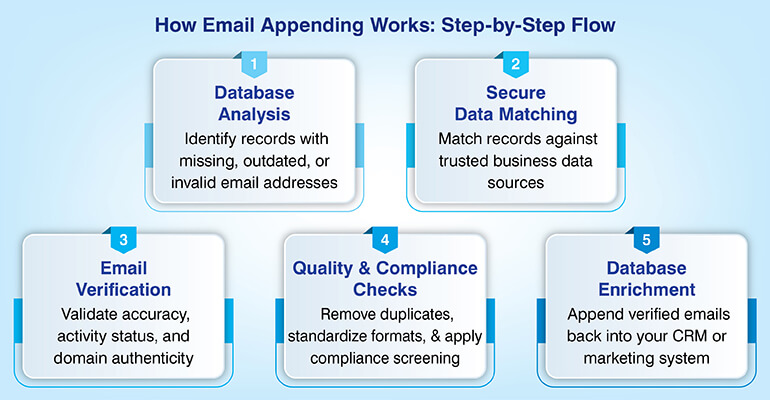
Email appending works by first identifying incomplete or incorrect email records within your existing database; these records are then matched against trustworthy business data sources and validated before they are added back to your system.
As part of data enrichment with email appending, providers also apply verification on applied email addresses for applied email addresses, remove duplicate records and perform compliance checks. Following email appending best practices, ensures that enhanced data is accurate, useable and ready for sales & marketing outreach efforts.
Common misconceptions about email appending
Many people confuse email appending with buying email lists, whereas both are completely different activities. In reality, email appending enhances the data you already own. You are just reconnecting with existing leads more effectively.
Another misconception is that appending of email data is unreliable. When done properly with verification and quality control, appended data is often more accurate than what already exists in most CRMs.
Conclusion
Email Appending fixes incomplete records and strengthens B2B databases so what was earlier just garbage clogging your success, now has become an actionable asset. It improves deliverability, segmentation and outreach efficiency. It is directly responsible for boosting lead generation through email appending. So, for modern businesses with a digital presence cannot overlook or avoid email appending exercise. It brings your missing leads to life.
Improve deliverability and conversions
Optimize Now »


Snehal Joshi , Head of Business Process Management at HabileData, leads a 500-member team of data professionals, having successfully delivered 500+ projects across B2B data aggregation, real estate, ecommerce, and manufacturing. His expertise spans data hygiene strategy, workflow automation, database management, and process optimization - making him a trusted voice on data quality and operational excellence for enterprises worldwide. 🔗Connect with Snehal on LinkedIn