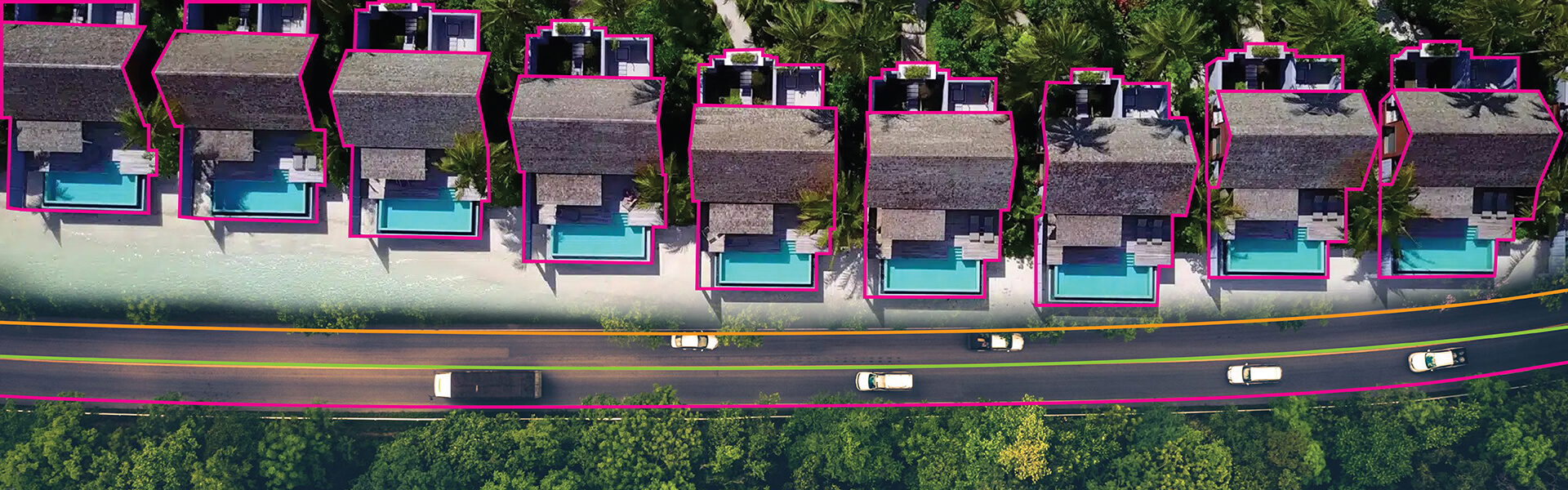

The goal of any property listing is to draw the attention of the potential purchaser and push him or her to take the next step in the sales funnel. It highlights the property’s features with visuals and text to interest the buyer and a listing also provides the legal details of the property a buyer needs to decide whether it fits his or her vision.
Before planning site visits or contacting property agents, around 51% of today’s homebuyers do online prospecting to decide if a property is worth further time or attention. This data is backed by the National Association of Realtors. Online property searches now becoming a mainstream choice, the quality of online real estate listings has become critical to real estate sales.
Each detail, every feature a purchaser looks for when searching for a property, needs to be present in a listing through video, images and text, and their accuracy and comprehensiveness determine how long it takes to sell the property. Let’s walk through some of the key property attributes that shape the property market and buyer experience.
Here is what a good real estate property listing mainly contains:
Property Details
- Location & address of property.
- Price of the property.
- Must-have property features such as bedrooms, bathrooms, and square footage.
- Year built, date of last renovation/remodeling, parking availability and so on.
- Details about extra rooms, outdoor spaces, and any desirable home features like a pool or garage.
Visuals and Description
- High-quality professional photos.
- Drone and video shots.
- Property description showing unique selling points and benefits.
Contextual Information
- Dates and times for scheduled open house events.
- Information about the local area and community.
- Listing history, including the number of days the property has been on the market.
Legal and Financial Details
- Zoning details of the property.
- Necessary disclosures such as flood zones.
- Property taxes and Homeowners Association (HOA) dues.
Marketing and Contact Information
- Contact details of the listing agent.
- A map showing the property’s location.
When property listings are accurate and descriptive, real estate marketplaces can match buyers, properties and brokers better. High quality real estate listings also prevent the need for multiple queries and make other listings easier to compare.
Thus, strong visuals and accurate information become important for listings, as properties with inferior listings fail to gain buyer interest and remain unsold.
10 Best property attributes to make real estate listings stand out
Here are the 10 key property attributes that greatly improve listing quality, increase visibility, enhance buyer confidence, and overall sales performance.
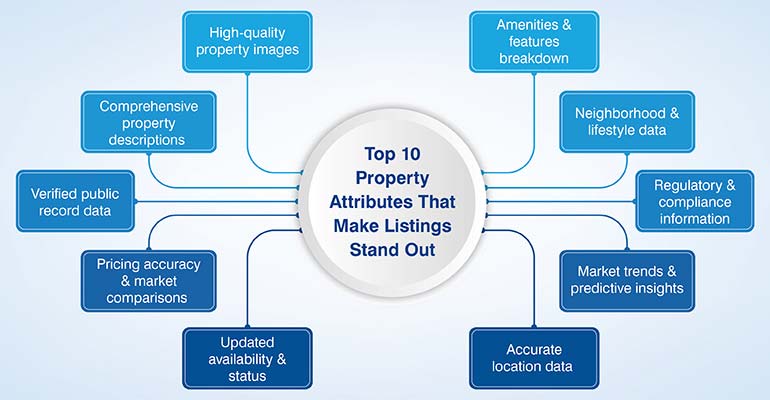
1. High-quality property images
What is the first thing you notice about real estate listings?
It’s photos, because in real estate that’s the only visual idea you can gain of a property without physically visiting a site.
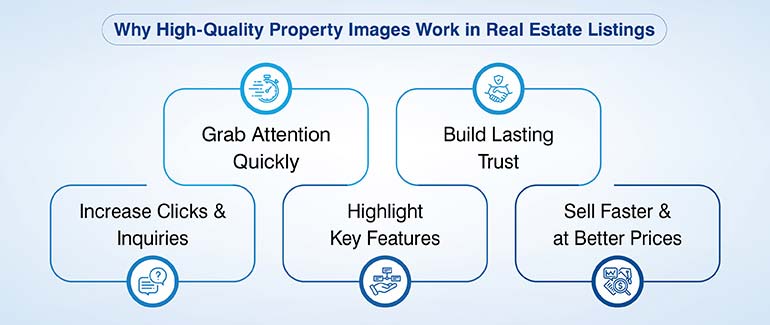
So, photos sell, and statistics show that professional photos actually sell 32% faster. Good photos don’t just scream for attention; they grab the attention of buyers and set the stage for everything else. If you found the property photos in a listing unappealing, you’ll immediately move on to the next listing without giving a second thought or bothering to check details.
And listings with professional or HD images will make you stop browsing and check out details. how would you get those eye-catching photos?
- Try HDR photography to give an inviting feel and focus on natural light.
- Aerial drone shots give bird’s-eye view of the layout and the neighborhood, from above.
- 360° virtual tours give a “walkthrough” to buyers without leaving their home.
It’s the next best thing to being there in person. Don’t forget to balance colors, remove clutter and make photos look polished. Great photos are all about selling the house.
2. Comprehensive property descriptions
Great photos attract eyeballs, but descriptions actually takes the interest to the next level. Just putting plain bullet points of features will not help. Compelling property description tells a story and helps prospective buyers picture themselves living there. Clear, correct and unambiguous property descriptions help boost rankings of your listings, show up better on search and increase salability of the listed properties.
Good property descriptions clearly supply all needed information to the buyer, infuse life into the listing, but do not feel like marketing fluff. They save everyone’s time by reducing back and forth questions, are better optimized for search results and help your listings stand out.
So what are the pointers to include in property listings? Start with basics of property such as total area, layout, number of bedrooms, bathrooms and any other additional features. Always share a floor plan to help buyer understand the flow of the property and don’t forget to mention features which could be deal breakers like a renovated kitchen, a backyard pool, or maybe a bright home office.
Keep your language simple and clear. Avoid long, complicated sentences and any jargon the purchaser may not understand. Do not just state what is there like dead statistics, but focus your description, and visuals to highlight how the property can add value to a resident’s life. After all, you want readers to stop scrolling and click on the inquiry button.
Want to make your listings stand out with accurate, insight-rich property data today?
Get in touch »3. Verified public record data
Trust really counts in real estate transactions transactions. Buyers get worried about listings that are too good to be true. And they discover that the home they dream of is nothing, but a fake advertise with tall claims. That’s where verified public record data steps in.
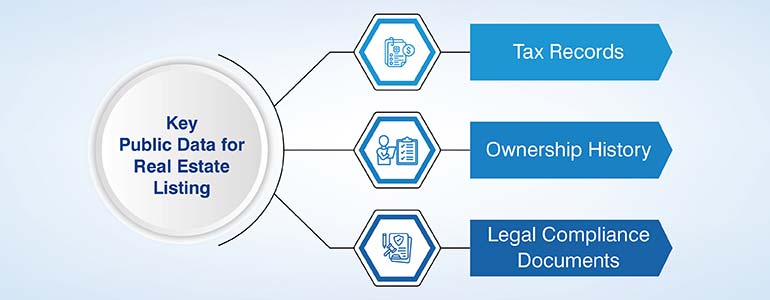
After all, when buyers actually see real, verifiable info, they relax. The best property listings don’t just hype up or create buzz about the property. They back it up with facts, so buyers feel good about making an offer.
There are a few types of public data that really help:
- Tax records, so buyers know how much they’ll owe in annual property taxes.
- Ownership history, which shows who’s owned the home before and who has it now.
- Legal compliance documents, so you know the place has the right permits and follows the zoning rules.
When a listing shows this kind of verified info, it helps buyers and brokers trust each other and get deals done.
4. Pricing accuracy & market comparisons
Real estate listings are not about pulling in crowds or virtual traffic on site. It is about generating buzz or creating interest among qualified buyers. Pricing and market comparison are among the best ways to pull qualified buyers. But pricing can work as a double-edged sword.
But how?
A home priced too high can sit on the market for months together, whereas low pricing can result in loss. Accurate data-driven pricing ensures the property reaches the right audience.
Key data sources for accurate pricing:
- Market comparison of similar properties sold in the area.
- Historical sales data that tracks trends over a period of time.
- Predictive analytics for future market behavior and buyer demand.
Discover the best ways to list optimization for your business needs.
Contact us »5. Updated availability & status
Few things can be really frustrating. But the one that tops the list is coming across a property listing that’s sold or under contract. Outdated listings hurt credibility and are a complete waste of everyone’s time. In order to build a positive buyer experience, maintain current status update.
Key updates to track:
- Available – ready for showing and offers.
- Pending – an offer has been accepted, but it is not finalized.
- Under contract – sale is in progress.
- Sold – property is no longer available.
It is important to continuously check, verify and update listings to improve sales performance. Outdated listings destroy trust between agents and buyers.
6. Amenities & features breakdown
Buyers want more than just a list of rooms. They want to see how a home can fit in their life. They look for details about comfort, convenience, and that little something extra.
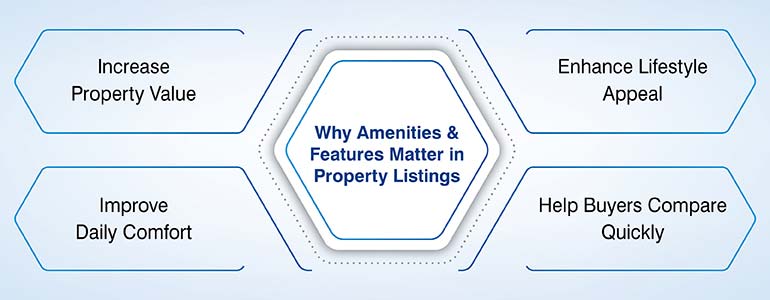
And modern buyers look for things like smart home tech, energy-saving updates, or high-end appliances.
Custom cabinets, too. Don’t skip the outdoor perks, either, a garden, deck, or pool can really catch someone’s eye. And if the neighborhood offers bonuses like a gym or security, that’s worth mentioning. When you list these details in a standard way, your listing looks good on the MLS and all the big real estate sites. Using structured data tags helps too, since buyers can search and filter the features they care about. In the end, more specific information pulls in buyers who know what they want and keeps them interested.
That’s how you help them picture their life in a new home.
7. Neighborhood & lifestyle data
When you’re looking to buy a property, there are lots of factors that come into decision making such as desirable neighborhood traits, health & safety and lifestyle.
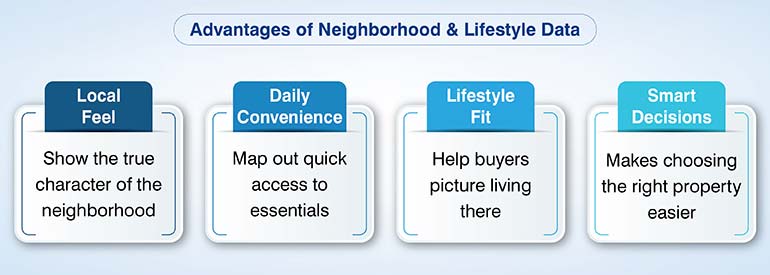
Neighborhood insights can really take buyer engagement to the next level and help listings shine in crowded markets. When buyers can see how a location fits with their lifestyle, they may schedule a viewing or make an offer.
It is important that your real estate listings answers the following questions:
- What is the quality of local schools and education?
- What is the crime rate?
- How close are healthcare facilities and emergency services?
- What are the options for entertainment, shopping and nearby dining?
- What is commuting times to nearby areas and connectivity?
Including information in a listing that answers these questions not only adds value but also increases buyer confidence.
8. Regulatory & compliance information
Buying property is very challenging and not just a random purchase.
It can put a strain on a buyer at both emotional and financial levels as he or she keeps on searching, calculating budget, trade-offs, location fit and all other parameters. The information needs to be clear and upfront. Just think how you would feel if you found out that you missed compliance or legal information pertaining to the property. If a property listing misses out on important regulatory or compliance details, buyers start to doubt everything about the property.
On the other hand, when a listing gives the regulatory info right from the word go, buyers can make smart and informed choices.
Here is the information that you should include:
- Disclosures related to the property’s condition or any past issues.
- Zoning laws as people are interested to know what they can and can’t do with the place.
- Flood zone data or environmental risks.
And don’t forget important occupancy certificates and building permits. Listings that are open about compliance details sell faster and steer clear of legal headaches.
Partner with our expert team for high-quality, buyer-ready real estate listings.
Let’s talk »9. Market trends & predictive insights
Real estate, by its very name, is considered one of the most important investments a family can make, whether for rent, lease or purchase, and can give certain returns if conditions are right and there are no major economic upheavals.
So, there is no cheap marketing effort here because you are targeting people who are seriously considering a lifetime investment. Only attracting such buyers is insufficient; the listing must also convey all the information they need in a no-nonsense manner.
Your listings must clearly show why the locality is growing and explain why this place will be easy to rent or sell. It must have supplementary information like area market trends and predictions to help people make intelligent investments. Good listings don’t just show pretty pictures.
High-converting property listings answer several questions that buyers/investors might have, such as:
- How much are the prices in the area likely to go up in future?
- What kind of rental returns can investors expect?
- What’s happening with demand for similar properties in the neighborhood?
10. Accurate location data
When you’ve got info related to past sales, what’s happening in the market right now, and how buyers are behaving currently, it becomes easy to spot properties with serious growth potential.
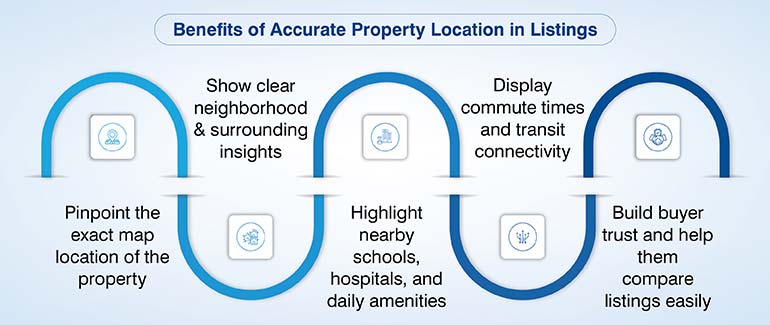
We need to under the psychology of buyers while creating real estate listings. It is not just about the property. There are several other things that play on a buyer’s mind. A simple feature of using geocoding that puts the location of the property on a map helps users check nearby areas. Buyers can also verify with public data.
Location of the property on the map can help answer several questions that might crop up in the minds of buyers, like:
- Are there schools nearby?
- How far is the property from the hospital?
- Is it on a high street?
- Is it close to the train station?
- How far is the drive to the airport?
Buyers like to check the street view and what it feels like to live in the area.
Here are simple to use-case scenarios of how listings can help different types of buyers:
- For families with young children: Listings with clear school information get their attention first.
- For working professionals: Quick glance at commute times. A listing can help calculate the hours they might spend reaching office.
- For first-time homebuyers: They check the map pin to verify the accuracy of listing and match with public records.
- For investors: Listings with clear area insights lets them quickly assess rental history.
Buyers naturally tend to trust listings with clear and precise location and other details.
Conclusion
Good property listing is much more than an online data repository and strikes a balance between detail and readability without sounding overwhelming. It helps guide the buyer to the next step in the real estate sales funnel to express interest, contact an agent or book a site visit. For that next step, the property listing needs first to have the 10 attributes we have discussed as they do more than listing facts about a property. Rather, they differentiate, motivate serious/qualified buyers, and drive measurable growth. So, when creating real estate listings do not approach them as static advertisements, but as untapped resources that can give you long-term market advantage and help close deals.
Ready to boost property listing visibility and inquiries?
Call us now »


Snehal Joshi , Head of Business Process Management at HabileData, leads a 500-member team of data professionals, having successfully delivered 500+ projects across B2B data aggregation, real estate, ecommerce, and manufacturing. His expertise spans data hygiene strategy, workflow automation, database management, and process optimization - making him a trusted voice on data quality and operational excellence for enterprises worldwide. 🔗Connect with Snehal on LinkedIn