
The work of managing real estate listings properly requires doing a series of tasks, which range from data collection, cleansing, visual enhancement, and real-time updates to data governance. These steps reduce errors and support automated valuations that help MLS platforms win customers.
Real estate listing management is a process that requires spending time, cost and effort and involves a very data intensive process. You need to handle the volume, velocity, variety and veracity of real estate data flowing in real time from across MLS feeds, public records, brokerage systems and property marketplaces. And the challenges of collecting data multiply as soon as you focus on maintaining its accuracy, consistency and trust.
Over the years, we’ve realized that using inaccurate or incomplete listings makes direct financial and operational losses inevitable. Duplicate records or incorrect property details and outdated photos damage your market credibility and frustrates buyers. Almost all modern property sites now offer automated property valuations, so any data inaccuracy can lead to flawed investments or properties stagnating on shelves.
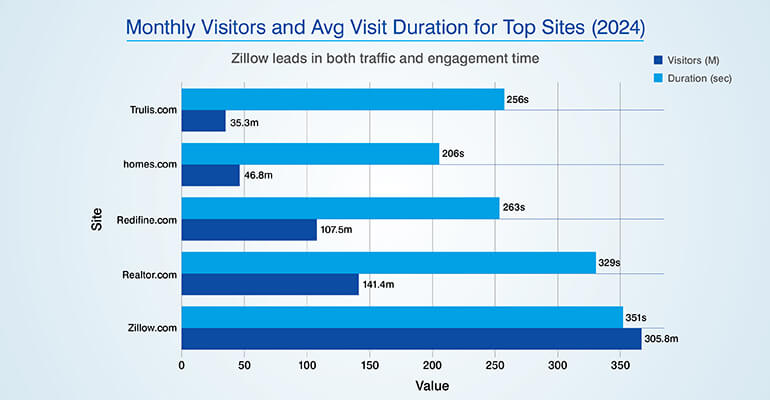
Leading real estate websites showed important variation in 2024 when it comes to monthly visitors and average visit durations, with Zillow leading in both metrics. Zillow attracted 365.8 million visitors with an average session of 5:51 (351 seconds) far outpacing others.
This graph shows how zillow did in terms of traffic and the important jump in 2024 against previous years. So what is it that Zillow did differently from competitors to gain this stature?
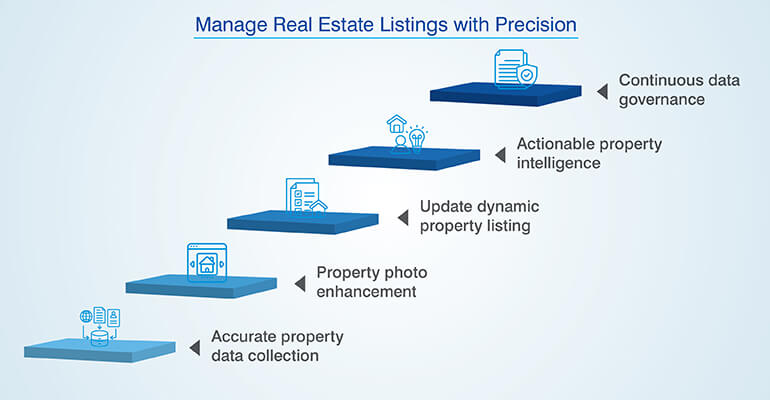
Several property listing sites today follow the 5 steps process for managing real estate listings with precision to lead this race.
Precision listing management is no longer about cosmetic updates. Instead, it’s a robust and disciplined process that’s a combination of collecting, cleansing, structuring and managing real estate property datasets that can showcase market realities, fuel analytics and support informed decisions. All these ensures that your property listing site delivers verified insights and reliable user experiences.
Want precise listing data management for improved trust, accuracy, and market performance?
Get in touch »How to manage real estate listings with precision
In this article we’ll take you through a five step process for managing real estate listings with precision. It talks about everything right from initial data collection to ongoing data management. Each of the step compliments operational efficiency with intelligence backed outcomes, while ensuring that the property data on your listing site serves as a competitive asset for users.
Step 1: Accurate real estate data collection
Accurate data collection is the steppingstone to precise real estate listing management. Every property record is a mixture of structured and unstructured information collected from tax records, zoning authorities, MLS systems, brokers and third party APIs. In absence of standardized and validated property records, your property listings instantaneously become outdated and misleading.
1.1 Identify authentic data sources
Reliable listings depend on accurate data which further depends on the credibility of the source it’s collected from. County assessor databases, municipal land registries, MLS systems and licensed brokerage feeds are some of the verified authoritative data sources which should be used to feed your listing ecosystem. Make efforts to identify and map such authentic data sources to minimize data duplication and ensure traceable lineage.
The next most important thing to do is cross referencing property records with multiple databases, before publishing them on your listing site to eliminate ownership, zoning or valuation inconsistencies. Building a multi source validation layer will give your real estate listing site a clear edge in data reliability.
1.2 Extract and standardize real estate data
So now that you’ve identified authentic sources to collect real estate data from, it’s time to extract information. The process of data extraction is a combination of automated scraping, API integration and direct feed ingestion wherever applicable. Scripts and macros are used to parse property attributes like address, parcel ID, square footage, lot size, year built, amenities and valuation metrics.
This then is followed with standardization of collected real estate data. It’s done to convert heterogeneous field structures into unified schemas for mapping fields like “property_type” or “number_bedrooms”, or” number_balconies”. Applying schema mapping across data sources makes sure data format consistency in downstream applications. Normalization, as part of data standardization, aligns formats, i.e., convert addresses to geocoded coordinates or standardize measurement units.
1.3 Data validation and cleansing
Now that you’ve collected, standardized and normalized the property data, it’s time to authenticate that data. Define validation rules that can keep a check for completeness and logical accuracy of your information. Validation is done to confirm if the values fall within valid thresholds, and then you can apply cross field validation for coherence of fields like living area < lot area. As a property listing site owner, you can use geospatial verification to confirm location coordinates.
Next thing you do is apply an automated data cleansing workflow. It’ll flag null fields, duplicates and various other data anomalies. Human intervention in such automated cleansing workflows will effectively add qualitative verification and catch data inaccuracies such as incorrect property status or typographical errors that automation might have missed out.
1.4 Metadata and tagging
Now is the time to organize the property data using metadata classification to make it retrieval and integration ready. Having a robust metadata framework also will help you with a seamlessly cross system integration. Make sure you include identifiers like MLS ID, APN and property type tags for each listing of your residential, commercial, industrial data sets. Don’t forget to add status tags like active, pending and sold. It’ll make sure your data remains searchable, linkable and updatable across platforms, and keep the lifecycle up to date.
Once you have the verified datasets handy with you, now focus on visual accuracy. Yes, it’s time you enhance property images to make them match your precise real estate listings.
Step 2: Enhance property photos to entice customers
Property photos and videos are crucial for positive buyer perception and enhanced listing credibility. Not to forget, for real estate listing sites, image consistency is as important as data accuracy. Let’s have a look at some stunning facts about real estate photography:

All the facts suggest that high quality property visuals aren’t only important to improve user engagement, but they also make sure that the data and photographs are compliant to MLS and marketplace standards.
2.1 Automated quality control for visual consistency
Every property image used on any MLS or real estate marketplace should meet quality parameters like sharpness, resolution, color balance and framing. Automated quality checks keep a tab on low light, pixelated or distorted images and either rejects those or sends it for enhancement.
Every image uploaded to an MLS or marketplace must meet specific quality parameters. Automated quality control checks evaluate image sharpness, resolution, color balance and framing. Algorithms identify low light, pixelated or distorted images for rejection or enhancement.
Maintaining uniform image standards across thousands of listings reinforces brand trust and professional presentation.
2.2 Photo editing and enhancement
Photo enhancement involves controlled image correction and optimization. Editing workflows include brightness and exposure adjustment, color balancing, sky replacement, clutter removal and perspective correction.
For virtual staging or architectural photography, HDR blending and white balance calibration make sure accuracy between visual presentation and real world property features. All edits comply with MLS and portal specific specifications for aspect ratio, resolution and watermark guidelines.
2.3 Image metadata optimization
Every property photo should carry embedded metadata linking it to its corresponding listing record. Tags like property ID, photo type (interior, exterior, aerial), timestamp and location coordinates improve searchability and reduce mismatches.
Metadata alignment also helps automated synchronization when listing updates occur, preventing image mix ups or outdated visuals.
2.4 Automation and AI integration
Automating visual tagging activities like recognizing rooms, exteriors, pools and several other amenities is nowadays done using AI vision models. These systems are designed for efficiency in automated categorizing of images, validation and of course to fast track listing uploads.
And that’s not all. These automation tools are programmed to identify duplicate, distorted and obsolete images. This functionality not only makes sure that the listing galleries remain current but also reduces manual editing and minimizes turnaround time even for large scale listing portfolios.
Now that both visuals and property listing data is standardized, it’s time to make arrangements that maintain live synchronization that guarantees inclusion of every market change in real time.
Outsource professional photo editing and retouching for MLS-compliant, conversion-ready listings.
Contact us now »Step 3: Maintain dynamic listing updates
Maintaining dynamic property listing updates warrants continuous synchronization of real estate data from across MLS feeds, property brokerage systems and a plethora of real estate listing platforms. Automated change detection attribute is tuned to track changes like price revisions, status changes and property feature updates on near real time basis.
Workflows backed with API integration make sure that consistent and uninterrupted propagation is done across channels. Simultaneously validation of data according to business rules prevents stale or conflicting data. Constant monitoring dashboards track update latency, completeness and accuracy so that your property listings site always showcases current market conditions.
Process Area
Maintain Dynamic Listing Updates
Key Activities
- Price changes
- Status updates
- Attribute modifications
Business Impact
- Data accuracy
- User trust
- Platform credibility
Process Area
Real-Time Data Synchronization
Key Activities
- RETS integration
- RESO Web API
- Bi-directional feeds
Business Impact
- Real-time updates
- Cross-platform consistency
- Reduced latency
Process Area
Change Detection & Version Control
Key Activities
- Delta identification
- Historical comparison
- Version tracking
Business Impact
- Audit readiness
- Data integrity
- Compliance support
Process Area
Data Enrichment & Supplementary Fields
Key Activities
- Neighborhood data
- School proximity
- Zoning insights
Business Impact
- Deeper insights
- Better analysis
- Investor confidence
Process Area
Maintain Dynamic Listing Updates
Key Activities
- Latency tracking
- Accuracy checks
- Feed monitoring
Business Impact
- Operational scalability
- Faster corrections
- Continuous reliability
Once you’ve synchronized the data flow and now, you’re monitoring it in a regular fashion; you can mine that data for actionable intelligence to help investors and brokers make informed decisions.
Step 4: Derive actionable property intelligence
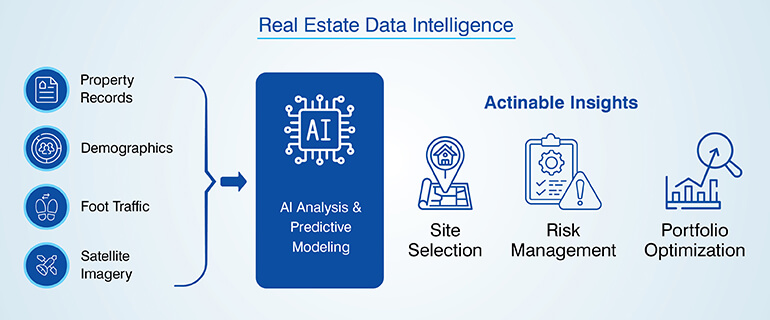
Managing information / data on property listing sites is work half done. What about deriving intelligence and actionable insights from the precious, structured and relevant property data. Accurate, comprehensive and real time property data serves as a steppingstone for predictive analytics, spatial insights and performance forecasting.
4.1 Data aggregation for analytics
Aggregating, standardizing and validating property data enables multi-dimensional analytics. It empowers real estate marketplaces to conduct comparative market analysis, CMA, monitor fluctuations in property prices by demographics and identify emerging trends in property market.
If property databases are integrated with BI tools, it results like a cherry on the cake. It results in hands on dashboards that help in tracking active inventory, absorption rates and average days on market. This empowers your platform and your clients with data driven visibility.
4.2 Predictive and spatial analytics
Thoughtful use of Machine learning, ML models helps in analyzing price trends, buyer behavior and seasonality to forecast valuation shifts and of course property demand.
Said that, benefits of Spatial analysis are no less. Using GIS overlays will deliver location intelligence, proximity to amenities, flood zones or high demand areas if you wish to find out. These insights empower your platform to visualize market heatmaps and assist brokers and investors to identify zones with high potentials.
4.3 Sentiment and public record integration
Having structured property data at your fingertips isn’t enough. Next what you need is to integrate social sentiments, crime statistics, economic indices and other such external datasets for your clients to have a fuller picture about the properties on your listing site.
Investors benefit from the combination of review sentiments and public records in form of informed perspective about quantitative / qualitative property attributes for risk assessments.
4.4 Delivering intelligence outputs
All those who use your property listing portal tend to consume the analytical outputs in different formats. Configurable role based access, dashboards for brokers, reports for investors, alerts for analysts; makes sure that the data visibility your platform provides is aligned to business roles. The property data intelligence you provide isn’t mere raw property listings. Instead they’re now real estate strategic insights. This further will help your platform evolve from simple data aggregators into strategic decision enablers.
To sustain this level of accuracy and intelligence, a governance model must be embedded across all operational layers.
Step 5: Establish continuous data governance
Robust and agile property data governance is a promise of long term reliability, consistency and scalability of listing operations. In absence of data governance even the most advanced tools, technologies and automation frameworks will eventually fail due to unmonitored errors and inconsistent updates.
5.1 Data governance framework
Ownership, accountability and quality benchmarks are the attributes of a structured governance framework. Data policies that talk about acquisition, validation, security and privacy are maintained by governance teams. Also it’s mandatary to see to it that the data is compliant to industry standards like RESO and CMLS to make sure interoperability. For maintaining regulatory compliance across jurisdictions, adherence to data retention and access policies is necessary.
5.2 Accuracy monitoring and audits
Regularly auditing accuracy, completeness and update frequency of property data plays a vital role in platform upkeep. Monitor and analyze error logs for root cause like human data entry errors, data discrepancies and integration failures. As a property listing platform you’re supposed to track key performance indicators, KPIs such as data freshness rates, duplicate ratios and verification turnaround times. To reinforce accountability and maintain operational precision deploy continuous audit loops.
5.3 Scalability and future readiness
Now is the time to check if you have the infrastructure that’s ready to scale along with increasing listing volumes. A lot of platforms nowadays use cloud based architectures with elastic data pipelines for dynamic resource allocation during peak listing periods.
For automated validation, versioning and deployment of new data pipelines without downtime, adopting DataOps and MLOps principles have proved its worth for some of the leading property listing players. Scalability makes sure precision even under heavy data loads.
To transform your property listing management from a reactive process to a proactive intelligence operation, continuous governance in place is a non-negotiable aspect.
Conclusion
Operational hygiene alone isn’t precision in real estate listings, but it’s a strategic advantage. Accurate data collection, enhanced visuals, dynamic updates, actionable intelligence and continuous governance are the 5 proven steps that help property listing platforms to build on the previous to create a seamless real estate data ecosystem.
Partnering with property listing data experts helps MLS platforms and real estate marketplaces to apply scalable listing frameworks for precision, reliability and compliance at every stage. In a market driven by data velocity and visibility, precision isn’t optional. It’s the standard that separates trustworthy listing ecosystems from the rest of the market.
Partner with us to build scalable, accurate, and compliant property listing ecosystems.
Contact us now »


HabileData is a global provider of data management and business process outsourcing solutions, empowering enterprises with over 25 years of industry expertise. Alongside our core offerings - data processing, digitization, and document management - we’re at the forefront of AI enablement services. We support machine learning initiatives through high-quality data annotation, image labeling, and data aggregation, ensuring AI models are trained with precision and scale. From real estate and ITES to retail and Ecommerce, our content reflects real-world knowledge gained from delivering scalable, human-in-the-loop data services to clients worldwide.