
Dynamic pricing completely depends on accurate information scraped from volumes of data. This makes data scraping crucial. Data scraping involves collection of information from websites, online marketplaces, ecommerce sites, competitor sites with minimal human efforts. This process is complex, and comprises of multiple stages, tools and software.
Contents
This is dynamic pricing which uses algorithms to adjust prices in real time based on changing demand and supply scenarios, competitor pricing, and market environment. Dynamic pricing does not function on the whims and fancies of companies or intuition of individuals. It is far more sophisticated and driven mainly by algorithms and data. The success of dynamic pricing relies heavily on fresh and reliable data.
Businesses cannot gain insights by merely checking competitor pricing once a week or updating spreadsheets. By the time you update the data, it is already outdated and unable to keep pace with how fast the market moves.
Data scraping allows to cover this gap. It gives the latest details related to pricing, product availability, promotions, surge and directly feeds data into pricing models. Businesses get the much-needed constant updates to respond without delay.
Importance of data scraping in dynamic pricing
Dynamic pricing works effectively only if businesses have continuous access to fresh, detailed and voluminous data. And it is not just about data; it is having the right data, at the right time.
How data scraping powers dynamic pricing?
So, you must be thinking that data scraping is all about gathering information. But what is its role in dynamic pricing? Well, dynamic pricing is not just about data collection. It is about using that information to make pricing-related decisions. Still not clear?
What would happen if you’re running an online store with hundreds and thousands of products and prices of products keep on changing. Whether it is due to market scenarios, rise in demands, seasonal demand or competitors’ discounts, you will find it very difficult to manually track changes and get correct information.
So how do you adjust to changes in pricing? Where do you get information? The answer is ecommerce data scraping. It collects, organizes, and feeds the information to your pricing system. Everything happens in real time, and your pricing system makes changes.
Now take a look at the step-by-step process of the workflow.
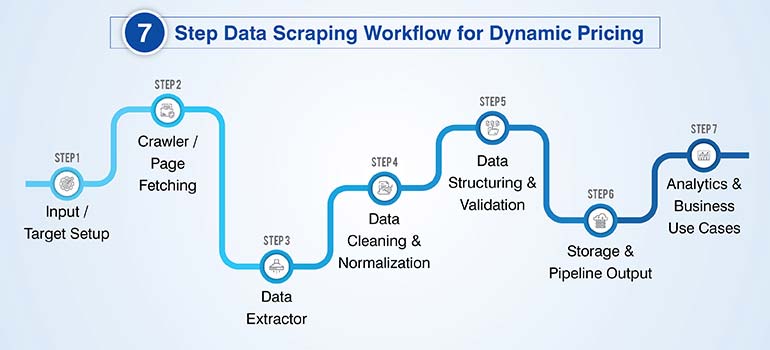
Let’s have a detailed look at why data scraping is critical for dynamic pricing:
- Input / Target Setup Data scraping for dynamic pricing begins by setting clear input targets, which usually include lists of product URLs, category-level pages, or structured sitemap and API endpoints for comprehensive source coverage.
- Data collection using crawlers The crawler sends automated HTTP requests to defined sources while using rotating proxies and dynamic user-agents to mimic real user behavior and prevent request blocking or throttling during data collection. It employs headless browsers such as Puppeteer or Selenium to fully render and load JavaScript-heavy, dynamic web pages, ensuring complete visibility into pricing and promotional content hidden behind asynchronous calls.
- Data extraction from defined sources The extractor module identifies and retrieves critical pricing attributes like current price, product SKU, stock levels, and competitor offers, directly reflecting real-time market movements across retail channels. Extraction processes operate on various data formats, including HTML through CSS or XPath selectors, JSON-LD or microdata embedded in web pages, and raw API responses collected via XHR or asynchronous requests.
- Data cleaning & normalization Collected data undergoes cleaning steps to remove unnecessary currency symbols, parse numeric values correctly, and maintain consistent formats across SKUs to ensure accurate cross-source comparisons and analysis. Normalization processes convert unstructured promotional text into labeled, structured fields while efficiently handling missing, incomplete, or duplicate records to maintain a reliable dataset for pricing intelligence workflows.
- Data structuring & validation Cleaned data is structured into machine-readable formats like JSON, CSV, Parquet, or SQL datasets. This creates standardized outputs compatible with analytics tools and storage systems. Schema validation ensures adherence to predefined data models. Data comparison algorithms track price fluctuations and inventory changes over time, to monitor competitor movements and trends.
- Data storage & analytics ready output Processed data is stored in relational databases like PostgreSQL or MySQL for efficient querying and integration with pricing or decision-support tools. For scale, it moves into cloud warehouses such as BigQuery or Redshift and data lakes like AWS S3, Azure, or Google Cloud Storage, then feeds dashboards in Tableau, Power BI, or Looker that convert raw competitive data into actionable pricing insights.
- Data analytics & use cases Comprehensive pricing analytics deliver real-time price intelligence, revealing margin opportunities and enabling rapid responses to competitor moves or demand shifts. Scraped data supports continuous competitor monitoring, inventory visibility, promotion benchmarking, and automated repricing. This adjusts prices using competitor trends, stock levels, and demands to maximize profitability.
Power eCommerce pricing with smarter data scraping.
Let’s get started »5 Key benefits of data scraping for dynamic pricing
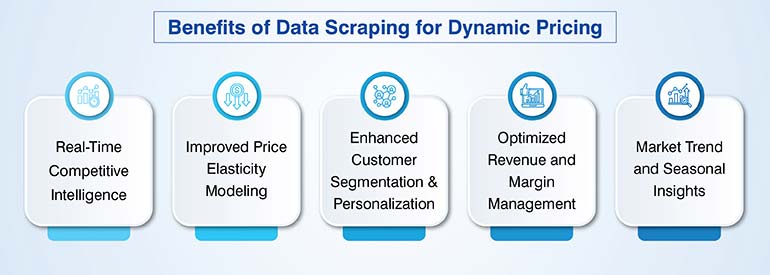
Real-time competitive intelligence
When it comes to online sales, your competitors can change pricing at any time. Sometimes pricing can change several times in a matter of a few hours. If you don’t see the changes coming and react as they happen, you fall behind.
With data scraping running in the background, you can get a steady flow of information and changes related to competitor listings.
Scrapers are mainly scheduled to run at regular intervals to keep track of important changes. Proxy rotation helps them avoid getting blocked, and smart bot-detection bypassing ensures flow of data even when marketplaces tighten their defenses. This real-time competitive intelligence allows you to make smart decisions related to price shifts, stockouts, discounts and more.
Improved price elasticity modeling
Have you ever tried to find answer to the question “If I change the price, how will customers react?” Price elasticity modeling helps you find an answer and understand how sensitive customers are to price changes. While some products are very sensitive to price change, others are less sensitive.
Customers might still buy the product as they trust the brand or there are limited options. But you can’t just guess the point where customers start to hesitate from purchasing. Price elasticity modeling studies these reactions using historical data, competitor patterns, and real-time market signals. This is where the role of data scraping is important.
Data scraping helps you understand customers patterns with far more accuracy because it gives you detailed, real-time information at the product level.
Scraped data feeds directly into elasticity models, giving them the volume and variety required to become more reliable.
Fuel your eCommerce pricing strategy with reliable market data.
Request a free consultation »Enhanced customer segmentation and personalization
Most people think pricing is just a simple calculation or math problem. Add some numbers, subtract a bit, and voila you are done. Sadly, that’s not the case. Dynamic pricing is all about understanding people, what they care about, what they value and what they are willing to pay premium. That’s what data scraping comes into picture.
When you scrape data from user conversations online, you will be able to see a whole new dimension of customer. Here is where you can scrape data from real user conversations.
- Q&A threads
- Forum discussions
- Social media chatter
- Ratings and review platforms
This data is a goldmine of information, and very often you will find the kind of insight you will never see in a dashboard. And the best part is that it comes straight from the audience. Once this information feeds into your pricing engine, you are free from “one-size-fits-all” prices. You can tailor pricing based on the type of customer right in front of you.
Taxi-hailing apps use this approach as their prices change based on demand, timing, and even customer behavior. They adjust prices dynamically.
Optimized revenue and margin management
Did you know what is the biggest dilemma of retail businesses or ecommerce stores? It is mainly to stay competitive and maintain margins. Data scraping in dynamic pricing exactly helps them achieve the goal. Instead of taking shots in the dark, your decisions are based on real numbers that are updated frequently. Now you exactly know when to drop price, give heavy discounts, or increase rates. You can change your pricing policy in real-time based on customer behavior and not just random guesswork.
Here is how retailers boost profits and stay ahead:
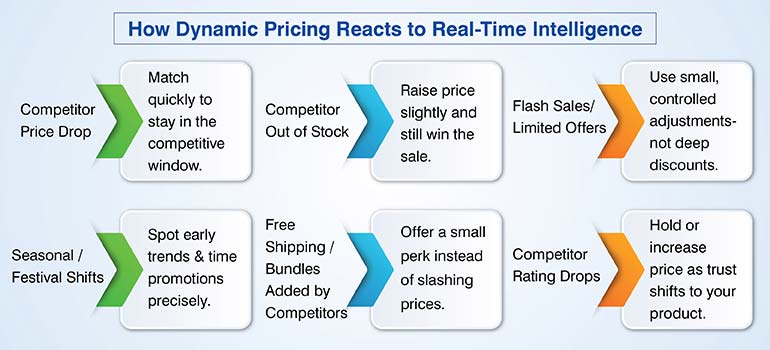
Discounts and surcharges
With data, you can reduce prices exactly at the point it actually matters and increase prices when demand ramps up. So, no more blanket discounts or random price hikes.
Better inventory turnover
Anxious about dealing with stale stock? Data scraping shows you the best time to lower prices of stock. This information will come handy if you are dealing with perishable products or seasonal goods.
Flash sales
When competitors give hefty discounts or freebies, you don’t just watch like a spectator. You have “Plan B” ready. Scraped data allows to adjust your prices and protect margins.
Market trends and seasonal insights
Have you ever tried to analyze trends or understand demand during peak or off-peak seasons? It keeps changing. It is like a pendulum swinging from one direction to another. But it is important to understand the reason behind the movement. Lot of factors such as business cycles and market volatility are responsible for the changes. The demand for products is never the same throughout the year.
Customers behave differently during festivals, long weekends and off-peak season.
When you get data regularly, it is very simple to find out the pattern. These insights help you adjust your dynamic pricing strategy well before the crowd catches on.

Use case scenarios
Industry
Retail & Omnichannel
Data Scraped
- Competitor pricing data
- In-store stock levels
- Online stock trends
- Seasonal buying patterns
- Consumer perception signals
How Dynamic Pricing Works
- Real-time price updates
- Flash discounts for slow movers
- Personalized segment offers
- Consistent omnichannel pricing
Business Impact
- Higher product sell-through
- Reduced unsold inventory
- Improved gross margins
- Strong competitive pricing
Industry
eCommerce
Data Scraped
- Marketplace competitor prices
- Brand-site pricing data
- Browsing behavior insights
- Cart abandonment trends
- Demand and review signals
How Dynamic Pricing Works
- Automated price changes
- Competitor-based adjustments
- Demand-spike responses
- Personalized loyalty discounts
Business Impact
- Maximized high-demand profit
- Improved conversion rates
- Higher order values
- Gained competitive advantage
Industry
Manufacturing, Logistics & SCM
Data Scraped
- Raw material costs
- Fuel index changes
- Supply chain constraints
- B2B sales patterns
- Transportation rate shifts
- Capacity and lane demand
- Weather and traffic alerts
How Dynamic Pricing Works
- Predictive pricing analytics
- Customer-specific pricing tiers
- Dynamic freight pricing models
Business Impact
- Increased overall profitability
- Optimized supply efficiency
- Improved brand perception
- Navigated market shifts
- Better capacity utilization
- Lower transport overhead
Challenges and ethical considerations in data scraping for dynamic pricing
Data scraping drives price optimization. But if you think, it’s just copying information that is available online. You are sadly mistaken. Teams come across technical headaches, tricky compliance rules, and a whole lot of ethical questions. Overcoming these challenges isn’t just about better using technologies.
It is actually about following rules, acting responsibly and showing a commitment to build trust and keep everyone safe.
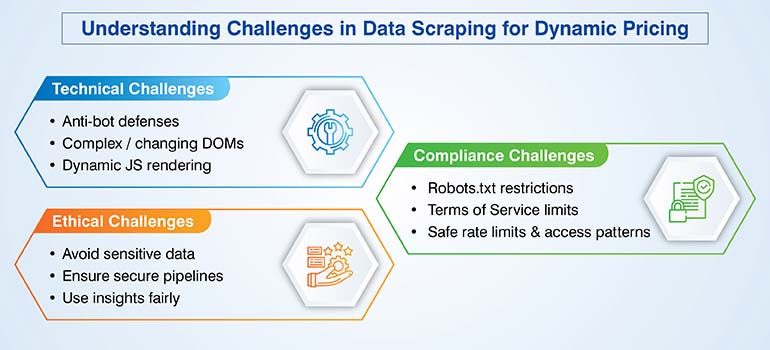
Everything about data scraping should be within limits and not cross any legal boundaries. And, there are no exceptions for anyone.
When you do data scraping the right way, it is one of the most powerful tools for dynamic pricing.
Conclusion
When it comes to online marketplaces, change is the only constant. Things keep on changing literally every minute. Customers constantly compare, competitors might come with a surprisingly good offer, and demand can touch the sky. Prices can’t stay the same. Dynamic pricing is the way to stay ahead. It is not just about being reactive to market realities, it is about being proactive.
Data scraping provides the pricing intelligence to seize the opportunity. Without the regular data flowing, your pricing strategy would be just a guessing game. Data scraping give us real time updates on what’s changing and how quickly you need to rethink your market-based pricing strategy.
At HabileData, we have helped several businesses globally to make smart and informed pricing decisions. Our ecommerce data scraping services are designed to handle large workloads in tune with market moves. If you’re looking to improve your pricing strategy, explore how to use AI in pricing optimization, or want a team that can support you, we’re here to help.
Turn scraped eCommerce data into profitable pricing decisions.
Talk to our experts »


HabileData is a global provider of data management and business process outsourcing solutions, empowering enterprises with over 25 years of industry expertise. Alongside our core offerings - data processing, digitization, and document management - we’re at the forefront of AI enablement services. We support machine learning initiatives through high-quality data annotation, image labeling, and data aggregation, ensuring AI models are trained with precision and scale. From real estate and ITES to retail and Ecommerce, our content reflects real-world knowledge gained from delivering scalable, human-in-the-loop data services to clients worldwide.