

Processing numerous resumes on an almost-daily basis creates a consistent and persistent operational bottleneck for staffing companies. CV formatting solutions capture and extract data from resumes, giving greater visibility of candidate skills and improving the efficiency of their recruiting processes.
Contents
CV formatting challenges combined with high resume volumes create a daily operational bottleneck for recruitment agencies. Recruiters spend significant time manually reviewing poorly formatted, outdated Word files or complex PDF resumes with images instead of engaging candidates or clients.
Poor formatting also limits ATS performance in extracting data, identifying keywords, and enabling job search visibility. As a result, qualified candidates are overlooked, screening cycles lengthen, and recruiter productivity declines.
According to 2025-2026 data by SHRM the modern CV/resume landscape is heavily influenced by Applicant Tracking Systems (ATS) and a shift toward brevity. With 73% of hiring managers rejecting candidates due to poor formatting. This makes CV formatting all the more critical for staffing agencies.
Poorly formatted resumes that misrepresent candidate qualifications reduce client confidence and can cause candidates to disengage from the hiring process. CV formatting services allows standardizing CVs and ensuring ATS compatibility.
This improves resume processing speed, accuracy of data extraction, visibility of skills, and candidate comparison which results in in faster placements, higher recruiter efficiency, and improved client satisfaction.
Why CV formatting matters for staffing agencies
Competitive hiring environment requires staffing agencies to present candidates professionally. CV formatting directly influences how quickly, clearly, and credibly profiles are evaluated. Here are some impacts for your ready reference:
The business impact of poor resume formatting
- Delayed candidate submissions: Poorly formatted resumes require manual cleanup, causing avoidable delays that slow down client submissions and weaken first-mover advantage in competitive hiring cycles.
- Lower ATS ranking scores: Inconsistent layouts and misplaced keywords confuse applicant tracking systems, reducing keyword matching accuracy and pushing qualified candidates lower in automated rankings.
- Inconsistent employer branding: Unstructured resumes dilute agency branding, making submissions look unprofessional and inconsistent, which negatively impacts client trust and perceived service quality.
- Higher recruiter workload: Recruiters spend excessive time reformatting, correcting, and standardizing resumes instead of focusing on candidate engagement, screening, and relationship-building activities.
- Slower time-to-fill metrics: Formatting inefficiencies delay profile approvals, extend hiring cycles, reduce placement speed, directly affecting agency revenue, client satisfaction, and recruiter productivity.
By standardizing and optimizing CV formatting, staffing agencies can accelerate placements, enhance brand credibility, improve ATS performance, and deliver faster, higher-quality hiring outcomes.
Optimize CV formatting to reduce hiring delays.
Talk to Our Experts »10 CV formatting challenges for modern staffing companies
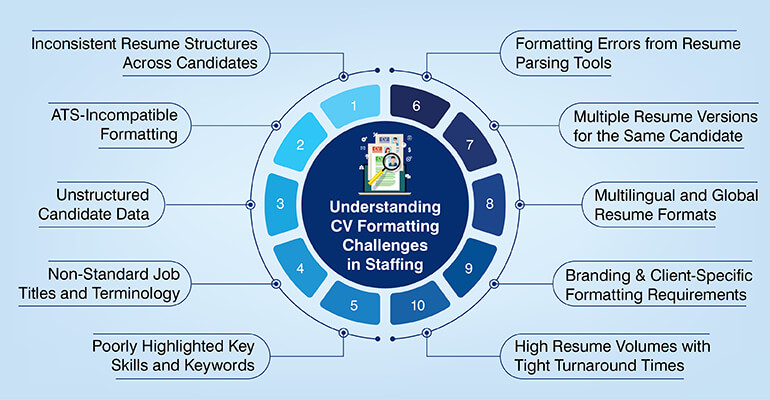
Inconsistent resume structures across candidates
Each day, staffing agencies face CV standardization challenges and inconsistency in CV formatting issues which can greatly hinder speed in reviewing candidates. The many different ways that resumes are structured make it difficult to compare or screen candidates efficiently.
The major issues related to structuring resumes include:
- Varied Section Headings: “Experience” (or “Work History”) versus “Background Career” creates a challenge when attempting to extract information consistently across all resumes.
- Varied Fonts and Sizes: Resumes can be printed using anything from traditional font styles such as Times New Roman, to new modern fonts such as Sans Serif. It causes confusion regarding visual hierarchies of the resume information for both the person reviewing the resume and the parser systems used.
- Inconsistent Resume Layouts: Resumes can be either single column or multi-column layouts, and the placement of information on these different layouts is unpredictable.
- Mixed Chronological Ordering: Some candidates list their most current experiences first, and other candidates list their earliest experiences first.
ATS-Incompatible formatting
Modern staffing relies on applicant tracking systems (ATS) as a technological backbone; however, most resumes are formatted in ways that make them un-readable to these systems. When an ATS program cannot identify compatible formatting elements.
It cannot retrieve necessary candidate information to allow ATS to create a searchable database of qualified candidates.
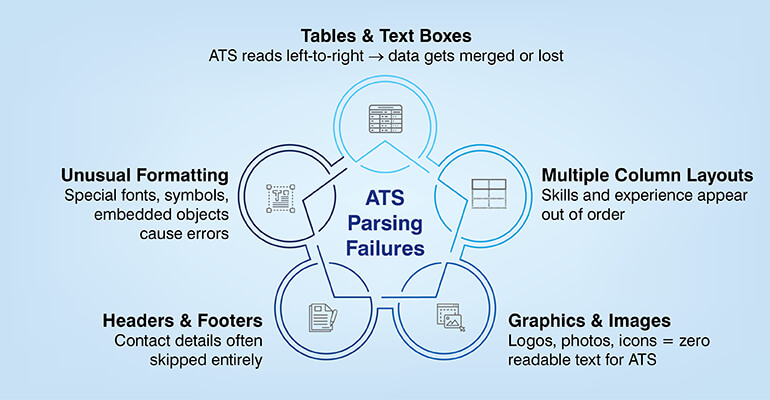
Typical ATS parsing failures are:
- Tables and Text Boxes: The ATS reads left-to-right, resulting in either incorrect merging of tabular data or complete loss of tabular data when being extracted by the ATS system.
- Multiple Column Layouts: Data may flow randomly, making it difficult for the ATS system to accurately pull up skills and/or experience listed within the resume.
- Graphics and Images: The ATS system does not recognize visual elements of a resume, such as logos, photographs, infographics, etc., because they do not provide any readable text data.
- Headers and Footers: Frequently, contact information placed in these areas is not identified by the ATS system.
- Unusual Format Options: Complex formatting options used in resumes, such as special characters, unique fonts, and embedded objects can result in parsing errors by the ATS system.
Unstructured candidate data
Candidates who fail to organize their resume data clearly, are creating a significant number of challenges when it comes to managing their database. When candidates combine their education credentials, professional experience, technical skills and certifications into one area with no defined sections, extraction accuracy is significantly compromised by this lack of structure.
The following structural deficiencies exist:
- Inconsistent header titles (i.e., “Qualifications” may have included skills, education, etc.).
- Embedded information (Skills were only referenced in a job description as opposed to having a section on Skills).
- Unpredictable categorization (Professional Development, Licenses, Training, etc.).
Non-Standard job titles and terminology
The trend of using creative job titles, and those specific to the companies is increasing. This is making it difficult for recruiters to determine the true level of experience and responsibilities for the job.
An example would be the term “Sales Ninja”, this could mean “Account Executive”, and a “Customer Happiness Hero”, this could mean a “Support Representative”.
These are just two examples of how the creative nature of the terms will make it challenging for a recruiter to find a qualified candidate.
Common challenges for staffing firms include:
- Candidate submission with creative or ambiguous job titles which do not clearly reflect market recognized job titles.
- Uncertainty associated with candidate matching and candidate short-listing.
- Inability to effectively map candidate job titles to client job description and requirements.
- Manual effort to normalize candidate submitted job titles for use in applicant tracking systems (ATS) and client facing submission.
- Lengthened screening cycles, and greater likelihood of incorrect role alignment.
Poorly highlighted key skills and keywords
When resumes are so unclear as to hide important resume keywords and critical skills, it slows down the recruiting process, from screening to short-listing. Staffing companies (or other companies) can spend more time reading through entire paragraphs searching for the most relevant information.
If they have to dig into paragraphs looking for the key competencies, this problem is worse when candidates leave out keywords that are common to their respective industries that are used by both ATS platforms and recruiters to filter, rank and search for candidates.
Common problems for staffing companies:
- Keywords hidden in large amounts of paragraph writing rather than being easily found in a separate section(s).
- Keywords missing from resumes; or keywords are sporadically placed throughout a resume.
- Less visible to recruiter and ATS keyword searches.
Formatting errors from resume parsing tools
Resume parsing tools are often plagued by poorly formatted outputs even if a hiring firm has invested heavily in these tools. The nature of resume formatting makes it difficult for resume parsing tools to format resumes consistently.
So, it is common for them to have problems extracting data properly resulting in the need for large amounts of manual processing to correct them. There are several ways in which resume parsing errors can be problematic:
- Garbage output: Text extracted from a resume will appear jumbled (unreadable characters, dates and phone numbers will be mangled).
- Broken bullet points: Bullet point list formatting in a resume will collapse into one paragraph of text rather than maintain the list format.
- Irregular spacing: Line breaks will either disappear or multiply causing the resume to become extremely long or short.
- Data placement issues: Experience will populate where skills should be placed, dates may appear in a candidates name field.
Multiple resume versions for the same candidate
Recruiters often have many different versions of a job applicant’s resume (versions) because the applicant applies for various positions or updates his/her/their credentials over time. Tracking all the different versions in absence of a sophisticated system is a challenging situation.
It poses problems with maintaining an accurate view of what each version represents in terms of job applicant qualifications and other data integrity issues. Some of the most important version control concerns are:
- Conflicting Dates of Employment: Resume versions with conflicting dates of employment for the same job.
- Different Skill Sets: A candidate will list different skills depending on the job they are applying for, which can create differences among their resume versions.
- Outdated vs. Current Credentials: Some resume versions may include the latest certification(s), education, etc. while older versions may still show previous certifications and/or education.
- Changes to Contact Information: The phone number, email address(es) and/or street address(es) listed on a candidate’s resume versions may differ.
Standardize CV formatting to hire faster.
Contact Us »Multilingual and global resume formats
International staffing firms face resume issues in multiple countries that have vastly different resume writing standards as well as cultural standards of what can be included on a resume. It is difficult to normalize the resumes from the various regions of the world to allow for global access to the same talent pool.
There are several key areas where international resume formatting create problems:
- Different date formats (DD/MM/YYYY vs. MM/DD/YYYY vs. YYYY-MM-DD) cause confusion and possible errors when sorting or searching resumes.
- Some countries include a photo, age, and marital status while other countries may not include this type of information due to privacy laws.
- Non-Latin alphabets, accented characters, and right-to-left text causes resume parsing failures.
- The names of educational credentials vary greatly among countries’ educational systems.
Branding and client-specific formatting requirements
Staffing agencies are confronted with two conflicting requirements; maintaining a consistent staffing agency branding, as well as meeting the client’s specific resume format needs.
This will lead to an enormous administrative burden. The key areas in which the challenges of customizing resumes for clients, as well as branding the staffing agency, occur are as follows:
- Customized Resume Templates for Clients: The need to accommodate varying resume formats, logo colors, layouts and other design elements to meet the needs of each major client.
- Prioritizing Information in Resumes: A number of clients request that recruiters use a “skills first” format when preparing resumes, while others prefer that recruiters use a “chronological” format, emphasizing work experience.
- Placement of Agency Logo(s) and Branding Elements: Finding a balance between showcasing a recruiter’s agency brand on a resume, while also demonstrating their ability to meet the client’s branding expectations through co-branding.
- File Format Preferences: Determining whether to prepare client submitted resumes in a PDF format, or a Word document format, as these can vary widely among clients.
High resume volumes with tight turnaround times
During peak hiring seasons and/or major client project implementations, staffing firms see cyclical demand for resumes surge to a significant level, which can cause an overabundance of work for internal teams.
Internal teams have excessive workload; quality of formatting is compromised and submitting candidates by deadline is difficult.
Operational issues related to volume include:
- Q1 hiring (new year) and holiday retail staffing, summer internships – Seasonal increases in hiring volumes create large surges in volume.
- Large contract acquisition – Enterprise clients that require a new candidate pipeline as quickly as possible.
- Reduced quality control – Overwhelming administrative burden leads to rushed formatting resulting in errors, inconsistency and missing information in data entry.
- Burn out on recruiters – Excessive administrative work results in lower morale among recruiter staff and increased potential for recruiter turnover.
How CV formatting services eliminate recruitment bottlenecks
Companies providing professional resume formatting services solve the problems of the staffing industry through a standardized approach and scalable process. This enables a company to work more efficiently throughout their entire recruitment cycle.
By having a third party perform the formatting for resumes, staffing agencies can free up internal staff to focus on generating revenue for the company while maintaining the quality of the resumes and ensuring the integrity of the resumes in the company’s database.
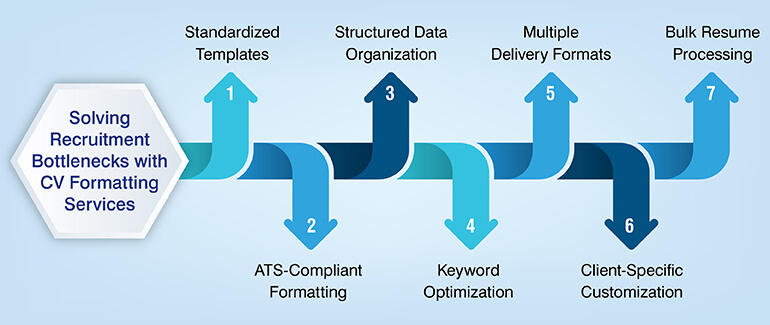
The comprehensive types of formatting services provided for resumes are as follows:
- Templates: All of the resumes formatted have the same basic template. Therefore, it is easy to compare and evaluate each applicant’s resume.
- Formatting compliant with Applicant Tracking Systems: By eliminating tables, text boxes, and graphics from the resumes, they will be parsed by the systems and therefore easily accessible.
- Optimization of Keywords: Relevant keywords from the applicant’s resume are strategically placed to make the resume more easily discoverable by potential employers.
- Delivery of Resumes in Multiple Formats: The resume can be delivered to the employer or potential employer in multiple formats such as Word, PDF, and ATS ready formats. Therefore, the resume can be viewed in the format that is most suitable to the employer or the applicant tracking system used by the employer.
- Customized Templates for Clients: Each of the employer clients can receive a customized resume template that reflects the company’s branding. However, the resume is still formatted in an ATS compliant manner.
Conclusion
CV formatting is not just visual presentation or looks. It plays a very important role in solving CV data extraction errors and CV formatting challenges, enabling skills and experience standardization, and supporting efficient recruitment workflow automation.
When resumes follow consistent structures, staffing companies can improve resume quality control, accelerate high-volume resume processing, and ensure accurate candidate profile normalization across systems. This directly improves ATS performance, recruiter searchability, and candidate-to-role matching.
Staffing firms aiming to streamline operations and reduce administrative overhead should consider CV formatting outsourcing services as a strategic capability.
HabileData’s CV formatting services provide scalable, ATS-optimized solutions that eliminate CV formatting challenges and manual rework. By standardizing resumes at scale, recruitment teams can shift focus from operational cleanup to faster placements, stronger client delivery, and sustained revenue growth.
Create ATS-ready CV formatting with clean data.
Request a Consultation »


Snehal Joshi , Head of Business Process Management at HabileData, leads a 500-member team of data professionals, having successfully delivered 500+ projects across B2B data aggregation, real estate, ecommerce, and manufacturing. His expertise spans data hygiene strategy, workflow automation, database management, and process optimization - making him a trusted voice on data quality and operational excellence for enterprises worldwide. 🔗Connect with Snehal on LinkedIn