An independent comparison of 10 leading data collection companies in India for outsourcing. Covers web scraping, survey research, AI training data, market intelligence, pricing models, security certifications, and scalability. Includes a side-by-side vendor matrix, cost benchmarks, selection checklist, and actionable evaluation framework for buyers.
Contents
- Why Businesses Outsource Data Collection to India
- How We Evaluated These Data Collection Companies
- Top 10 Data Collection Companies in India
- Side-by-Side Vendor Comparison Matrix
- Data Collection Outsourcing Costs in India: Pricing Guide
- How to Choose the Right Data Collection Company
- Vendor Selection Checklist
- The Future of Data Collection Outsourcing in India
- Choosing the Right Partner: What Matters Most
- FAQ
Choosing the wrong data collection partner costs businesses months of wasted effort. Bad data leads to flawed analytics, missed opportunities, and compliance headaches.
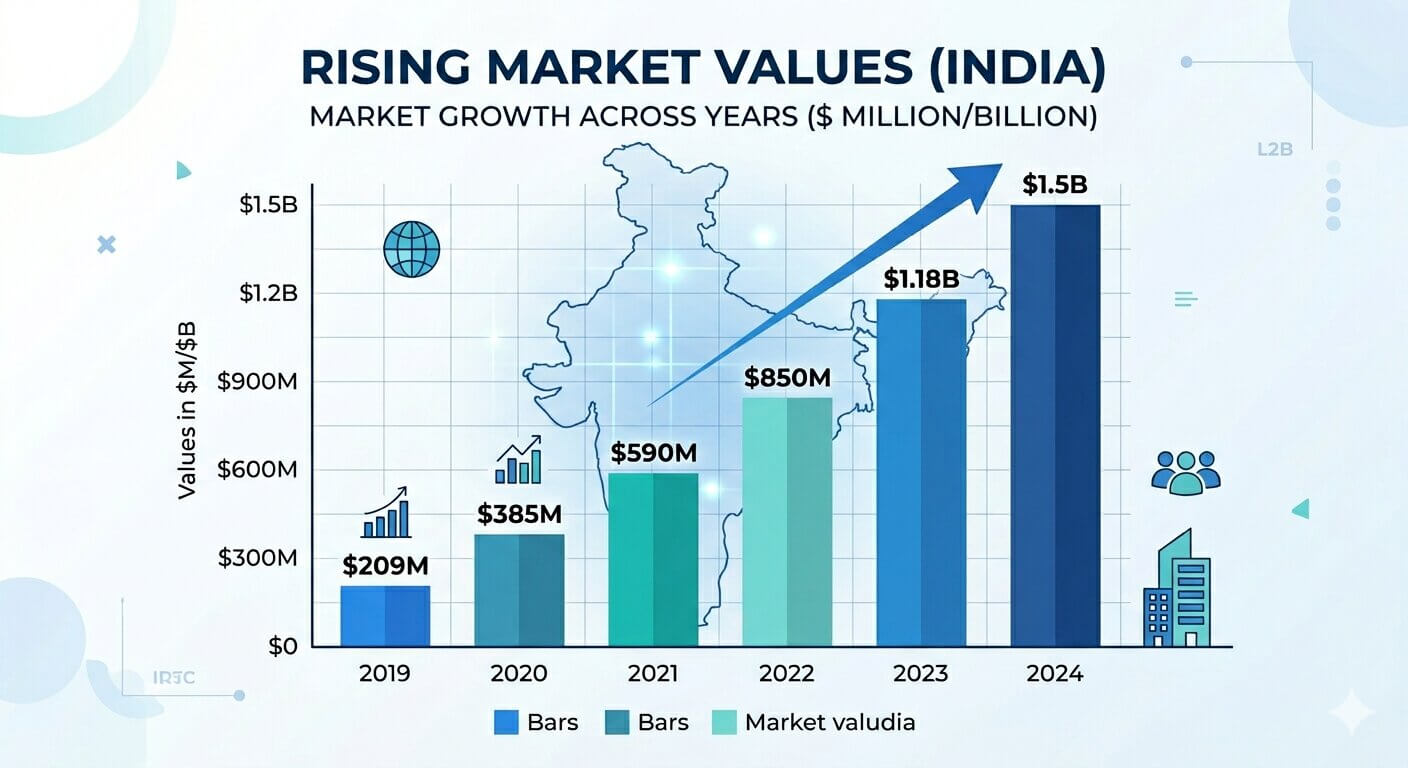
India dominates global data collection outsourcing. The sector generated USD 209 million in revenue in 2023. Industry projections estimate it will surpass USD 1.5 billion by 2030, growing at a 32.6% CAGR.
But not every Indian vendor delivers equal quality. Pricing models differ. Security certifications vary. Specializations range from survey research to AI training data collection.
This guide compares 10 leading data collection companies in India across dimensions that matter to outsourcing buyers. We cover methods, pricing, security, scalability, and honest strengths and limitations.
Why Businesses Outsource Data Collection to India
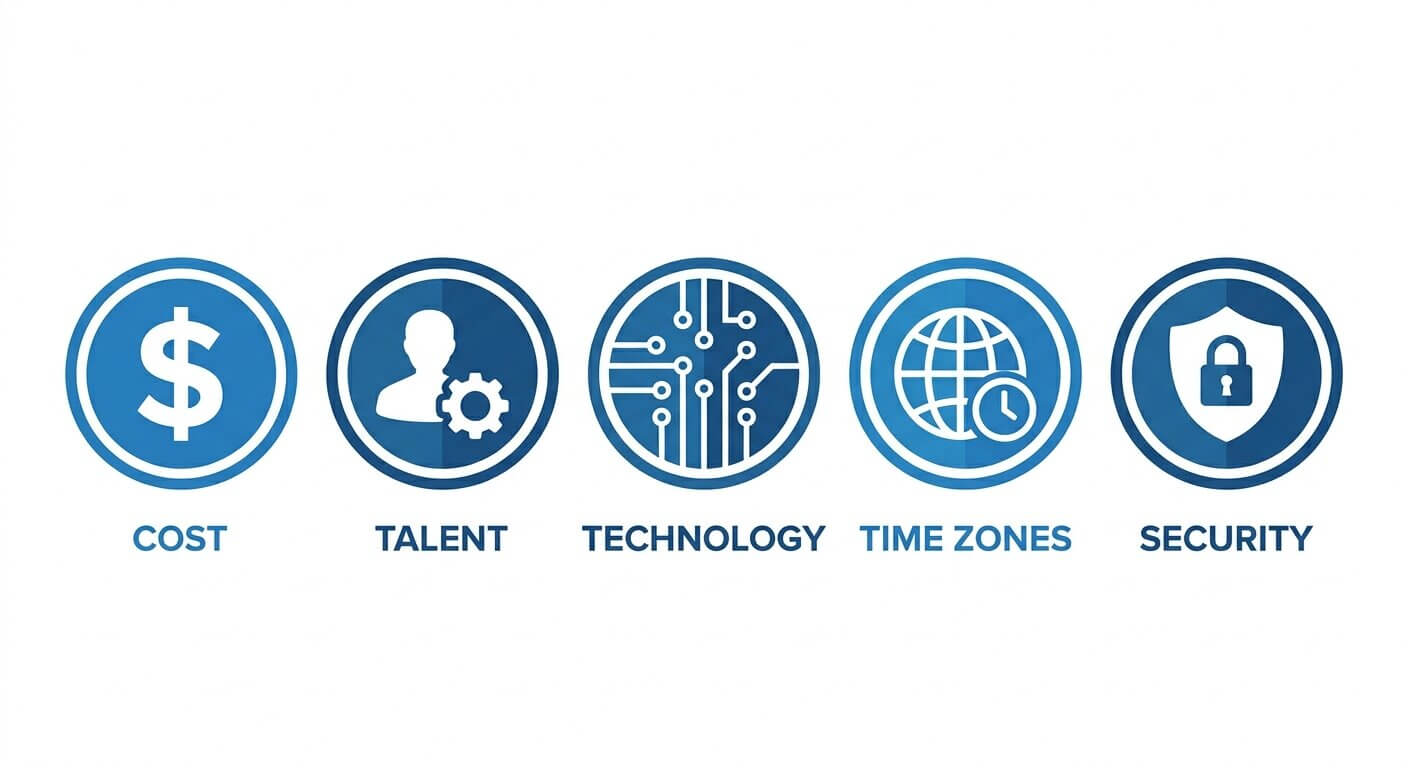
India’s outsourcing advantage extends beyond cost savings. Here are the operational reasons global companies choose Indian data collection vendors.
Cost Efficiency Without Quality Compromise
Outsourcing data collection to India typically reduces operational costs by 40-60%. This comes from lower labor costs, established infrastructure, and mature operational workflows.
However, the cheapest vendor rarely delivers the best ROI. Factor in accuracy rates, rework costs, and project management overhead when comparing.
Deep Talent Pool for Specialized Data Work
India produces over 1.5 million IT and data professionals annually. Specialists in web scraping, survey programming, AI data annotation, and market research are readily available.
NASSCOM estimates demand for data science and AI professionals in India will exceed 1 million by 2026. This growing workforce directly benefits outsourcing quality.
Technology Infrastructure and Automation
Leading Indian vendors deploy AI-powered tools including OCR for document digitization, NLP for unstructured text extraction, and RPA for automated web scraping.
The combination of human expertise and automation delivers higher accuracy at scale. Top vendors report 99.5%+ accuracy on structured data collection projects.
Round-the-Clock Operations
India’s GMT +5:30 time zone enables 24/7 data processing for US, UK, and European clients. Your data collection continues while your in-house team sleeps.
This time zone advantage shortens project turnaround by 30-50% compared to single-shift domestic operations.
Security and Regulatory Compliance
Reputable Indian vendors comply with GDPR, CCPA, ISO 27001, and HIPAA. India’s Digital Personal Data Protection (DPDP) Act has further strengthened domestic data protection.
Always verify certifications independently. Request audit reports, not just marketing claims on a website.
How We Evaluated These Data Collection Companies
Our Evaluation Methodology
As data collection service providers ourselves, we regularly evaluate competitor capabilities for clients running multi-vendor assessments. This comparison draws on our direct industry knowledge, published case studies, verified Clutch and G2 reviews, and publicly available company data. We applied the same evaluation criteria to our own companies (HabileData and Hitech BPO) as to every other vendor on this list.
We assessed each vendor across seven operational dimensions that directly impact project outcomes.
| Criterion | What We Assessed |
|---|---|
| Collection Methods | Web scraping, surveys (CATI/CAPI/online), IoT, API-based, field research |
| Industry Specialization | Sectors served, depth of domain expertise, relevant case studies |
| Technology Stack | AI/ML tools, OCR, NLP, automation platforms, custom crawlers |
| Security Certifications | ISO 27001, SOC 2, GDPR compliance, HIPAA, NDA processes |
| Scalability | Team size, ramp-up speed, geographic coverage, multi-site BCP |
| Pricing Model | Per-record, per-hour, project-based, monthly retainer options |
| Client Validation | Clutch/G2 ratings, documented case studies, client references |
Top 10 Data Collection Companies in India
Ipsos

Ipsos is the world’s third-largest market research firm. Their India operations focus on quantitative and qualitative primary research using CATI, CAPI, online panels, and mixed-mode survey methodologies.
The company has completed over 47 million interviews globally with 5,000+ clients. They excel in large-scale survey-based data collection for market research, public opinion studies, and brand tracking.
Strengths: Massive global survey panel infrastructure. Multi-country research design expertise. Proprietary online platforms for real-time data capture. Deep experience in FMCG, media, and government research.
Limitations: Primarily focused on survey and market research data. Not structured for web scraping, AI training data, or operational data processing. Enterprise-level pricing may not suit SMBs or mid-market companies
Best for: Large enterprises needing multi-country survey research, consumer insights, and public opinion data collection at scale.
Hitech BPO
Hitech BPO is a data outsourcing company with 30+ years of operational experience. They have delivered over 3,100 projects for clients across the USA, UK, Canada, and Australia. Their services span data extraction, web scraping, data processing, and AI training data annotation.
The company specializes in large-scale data collection using a combination of automated crawlers, manual validation, and AI-assisted quality checks. They serve ecommerce, real estate, healthcare, and B2B data aggregation verticals.
Strengths: Three decades of operational track record with documented project history. Strong hybrid automation approach combining AI capture with human validation. Multi-domain expertise across real estate, ecommerce, and healthcare verticals. Established compliance framework with ISO and HIPAA certifications.
Limitations: Primarily serves English-language markets. Less visibility in consumer panel research or large-scale survey methodologies compared to global research firms like Ipsos or Kantar. Brand recognition is lower outside the outsourcing industry.
Best for: Mid-to-large enterprises needing high-volume data extraction, web scraping, and AI training data with established compliance infrastructure.
HabileData
HabileData is a data management and business process outsourcing company, operating as a division of HitechDigital Solutions. They provide data collection, data entry, data cleansing, data annotation, and image editing services.
Their data collection capabilities include web scraping, competitive intelligence gathering, B2B lead data collection, and AI/ML training dataset creation. The company serves clients across real estate, ecommerce, manufacturing, and the ITES sector.
Strengths: Broad service portfolio covering the full data lifecycle from collection through processing and enrichment. Specialized teams for AI data annotation with 300+ annotators. Strong in ecommerce product data and real estate data collection. Established client base across US, UK, Canada, and Australia.
Limitations: Overlap with parent company Hitech BPO can create confusion for buyers evaluating both. Limited presence in survey-based primary research or consumer panel data. Smaller scale than global BPO giants like WNS or Infosys BPM.
Best for: Companies needing end-to-end data services from collection through processing and annotation, particularly in ecommerce, real estate, and AI training data
Kantar

Kantar (formerly Kantar IMRB in India) is one of the world’s largest data, insights, and consulting companies. Their India division specializes in primary research, consumer panels, and media measurement.
They provide customized research solutions combining quantitative fieldwork with advanced analytics. Their emerging market expertise makes them strong for India-specific consumer data collection projects.
Strengths: Deep expertise in consumer panel data and media analytics. Strong India-specific market knowledge with decades of local operation. Proprietary tools for behavioral data capture and audience measurement.
Limitations: Focused on market research and consumer insights only. Not structured for operational data processing, web scraping, or AI training data workflows. Enterprise pricing puts them out of reach for smaller projects.
Best for: Brands and agencies needing consumer behavior insights, media measurement, and India market-specific research data at enterprise scale.
SunTec India
SunTec India is a mid-sized BPO providing data collection focused on web scraping, data extraction, and online research. They serve clients across ecommerce, real estate, and healthcare sectors.
Their team uses custom scripts, API integrations, and AI-assisted crawlers for large-scale web data extraction. They also offer survey-based collection, document digitization, and data processing.
Strengths: Flexible engagement models suitable for SMBs. Broad service portfolio including data entry, mining, and cleansing alongside collection. ISO 27001:2022 certified with secure FTP and VPN data transfer protocols.
Limitations: Smaller scale than enterprise players. Limited publicly documented case studies for large-scale AI training data projects. Less brand recognition in international markets compared to established names.
Best for: SMBs and mid-market companies needing web scraping, product data extraction, and online research at competitive price points.
Flatworld Solutions

Flatworld Solutions is a diversified BPO offering data collection services alongside data processing, call center, and engineering services. They operate delivery centers in India, Philippines, Bolivia, and Colombia.
Their data collection capabilities include automated web crawling, API-based data harvesting, competitive intelligence gathering, and B2B lead data extraction. They deploy ETL protocols and cloud-native ingestion models.
Strengths: Multi-country delivery center infrastructure provides geographic redundancy. Over 20 years of BPO experience. Strong automation capabilities with ETL pipelines and cloud-native data ingestion. Broad industry coverage.
Limitations: Diversified service portfolio means data collection is one of many offerings, not a primary specialization. Client reviews suggest variable quality across different service lines. Pricing transparency could be improved.
Best for: Enterprises needing a single BPO partner for multiple services including data collection, processing, and call center operations.
Data-Entry-India.com
Data-Entry-India.com offers data collection covering web scraping, competitive intelligence, lead data gathering, and AI/ML training data creation. They serve clients in finance, healthcare, ecommerce, and real estate.
Their services extend to source discovery and validation, multi-format extraction, and structured dataset delivery. They offer specialized collections for insurance claims data and financial market intelligence.
Strengths: Dedicated AI/ML training data collection capabilities. Domain-specific solutions for insurance, finance, and healthcare. Structured approach to source validation and regulatory compliance in data gathering.
Limitations: Smaller operational scale than global research firms. Limited publicly available client testimonials for independent verification. Website and brand presence could be more professional.
Best for: Companies needing structured datasets for AI model training, competitive intelligence, and industry-specific data collection with compliance requirements.
Top Hawks
Top Hawks is an end-to-end outsourcing provider specializing in field-based data collection. Their core strength is capturing data from geographically dispersed locations across India, including rural and remote areas.
They provide customer satisfaction surveys, market segmentation research, product positioning studies, and competitive intelligence through on-ground data collection teams deployed across Indian geographies.
Strengths: Strong field data collection network covering rural and Tier 2/3 Indian cities. Experience in on-ground surveys, face-to-face interviews, and physical retail audits. Cost-effective for India-specific primary research.
Limitations: Primarily India-focused with limited international operations. Weaker in digital data collection methods compared to tech-driven competitors. Relatively newer company with shorter track record (8 years).
Best for: Businesses needing ground-level primary data collection across Indian geographies, particularly for FMCG, retail, and agricultural sector research.
Impetus Research

Impetus Research is a marketing research agency providing syndication services for online and offline data collection. Their services cover survey programming, hosting, data analytics, and full-cycle research support.
They handle both qualitative and quantitative data collection with emphasis on responsiveness and custom solutions. Their mixed-method approach combines online surveys with offline field research.
Strengths: End-to-end research support from survey design through analytics delivery. Flexibility in handling mixed-method data collection projects. Responsive and customized approach to individual research requirements.
Limitations: Primarily serves the market research vertical. Limited visibility in web scraping, AI data, or large-scale operational data collection. Smaller team size limits capacity for very high-volume projects.
Best for: Research agencies and brands needing mixed-method primary research with integrated survey programming and analytics support.
Uniquesdata

Uniquesdata is an outsourcing data digitization firm offering data collection alongside data entry, data processing, and document conversion services. They emphasize a client-centric approach with dedicated project teams.
Their data collection services focus on online data extraction, web research, and database building. They serve clients across education, healthcare, finance, and ecommerce sectors with structured data delivery.
Strengths: ISO-certified quality management processes. Multiple security measures including NDA, firewall, and antivirus protocols. Dedicated project teams with consistent point-of-contact for each engagement.
Limitations: Smaller company with limited publicly available case studies. Narrower technology stack compared to AI-driven competitors. Less suitable for complex web scraping requiring anti-detection capabilities.
Best for: Small-to-mid businesses needing reliable data collection and digitization at budget-friendly pricing with dedicated project management.
Side-by-Side Vendor Comparison Matrix
Use this matrix to quickly compare all 10 vendors across the dimensions that matter most for your project.
| Company | Methods | Pricing | Scale | Best For |
|---|---|---|---|---|
| Ipsos | Surveys, CATI, CAPI, Panels | Enterprise (custom) | 18K+ global | Large-scale survey research |
| Hitech BPO | Scraping, Extraction, AI Data | Per-project, Retainer | 500+ team | High-volume data extraction & AI data |
| HabileData | Scraping, Mining, Annotation | Per-record, Project | 500+ team | End-to-end data lifecycle services |
| Kantar | Panels, Fieldwork, Analytics | Enterprise (custom) | 70+ markets | Consumer insights & media data |
| SunTec India | Scraping, APIs, Research | Per-project, Retainer | Mid-size | SMB web data extraction |
| Flatworld Solutions | Crawling, ETL, APIs, Intelligence | Custom quotes | 300+ specialists | Multi-service BPO with data collection |
| Data-Entry-India.com | Scraping, AI Data, Intel | Per-record, Project | Mid-size | AI training data & compliance |
| Top Hawks | Field surveys, Audits, CAPI | Project-based | India field network | Rural & Tier 2/3 field data |
| Impetus Research | Online/Offline Surveys | Project-based | Boutique | Mixed-method research |
| Uniquesdata | Web research, Extraction | Budget-friendly | Small-mid | Budget data collection & digitization |
Disclosure
HabileData and its parent company Hitech BPO are data collection service providers based in India. Both appear in the ranking below. This guide is based on our industry research and hands-on experience working alongside and competing with these vendors. We have applied the same evaluation criteria to our own companies as to every other vendor listed.
Data Collection Outsourcing Costs in India: Pricing Guide
Pricing varies significantly by data type, volume, complexity, and collection method. Here are typical market ranges for 2026.
| Collection Type | Pricing Model | Typical Range | Volume Discount |
|---|---|---|---|
| Web Scraping | Per 1,000 records | $15–$80 | 30–50% at 100K+ records |
| Survey Data (Online) | Per complete | $1–$8 per response | Tiered pricing at 5K+ |
| Field Research (CAPI) | Per interview | $5–$25 | Negotiable by geography |
| AI Training Data | Per annotated unit | $0.02–$0.50 | 40–60% at 50K+ units |
| Data Mining/Research | Per hour | $8–$20/hour | Monthly retainer available |
| Document Digitization | Per page | $0.10–$1.00 | 25–40% at 10K+ pages |
Important: The lowest price rarely delivers the best value. A vendor charging $50 per 1,000 records at 99% accuracy often costs less overall than one charging $20 with 90% accuracy, once you factor in rework and data quality failures.
How to Choose the Right Data Collection Company
Selecting a data collection partner requires structured evaluation. Use this framework to avoid costly vendor mismatches.
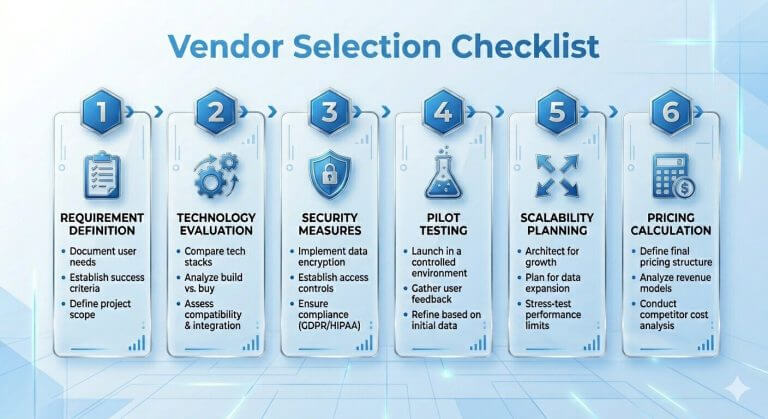
Step 1: Define Your Data Requirements Precisely
Document exactly what data you need before contacting vendors. Specify data type, source, format, volume, frequency, and accuracy threshold.
Vague briefs lead to mismatched vendors. A company strong in survey research may struggle with web scraping, and vice versa.
Step 2: Match Collection Methods to Your Data Type
Web scraping requires custom crawlers and anti-detection capabilities. Survey research needs panel access and questionnaire expertise. AI data needs annotation workflows.
Ask vendors to demonstrate their technology stack. Request sample outputs from similar past projects before committing.
Step 3: Verify Security Certifications Independently
Request copies of ISO 27001 certificates, SOC 2 audit reports, or HIPAA compliance documentation. Verify expiry dates and audit scope directly.
Ask about encryption standards, access controls, data retention policies, and breach notification procedures.
Step 4: Run a Paid Pilot Project
Never commit to a large engagement without testing. Run a 30-day pilot with a defined scope of 5,000-10,000 records.
Evaluate accuracy rate, turnaround time, communication quality, and the vendor’s ability to handle edge cases and exceptions.
Step 5: Assess Scalability and Business Continuity
Ask about maximum capacity, ramp-up timeline, and multi-site disaster recovery. A single-location vendor poses higher operational risk.
Understand how the vendor handles seasonal volume spikes. Can they double capacity within two weeks if needed?
Step 6: Compare Total Cost of Ownership
Evaluate total cost, not just unit rates. Include data validation, QA, project management, reformatting, and potential rework costs in your comparison.
Request detailed proposals breaking down every cost component. Watch for hidden fees around data cleaning or additional QA layers.
Vendor Selection Checklist
Use this checklist before signing any contract. Each item addresses a common failure point in data collection outsourcing.
| Checklist Item | Why It Matters |
|---|---|
| Data requirements documented with format, volume, and accuracy specs | Prevents scope creep and vendor mismatch |
| Vendor’s collection methods match your data type | Survey vendors cannot do web scraping effectively |
| Security certifications verified (ISO, SOC 2, HIPAA) | Protects against compliance violations |
| NDA and data processing agreement signed | Legal protection for sensitive data |
| Pilot project completed with measurable results | Validates vendor claims before full commitment |
| Pricing breakdown includes all cost components | Eliminates hidden fee surprises |
| Scalability plan and ramp-up timeline confirmed | Ensures vendor can grow with your needs |
| Communication protocol and escalation path defined | Prevents project management breakdowns |
| Data delivery format and integration agreed | Avoids post-delivery reformatting costs |
| Client references checked independently | Validates reputation beyond marketing materials |
The Future of Data Collection Outsourcing in India
The data collection landscape is evolving rapidly. Here are the trends shaping outsourcing decisions in 2026 and beyond.
AI-Augmented Data Collection Becomes Standard
Leading vendors now combine human expertise with AI-powered validation. Machine learning assists in source identification, anomaly detection, and automated quality checks.
This hybrid approach delivers faster turnaround without sacrificing accuracy. Expect AI-augmented collection to become the default by 2027.
Surging Demand for AI and ML Training Data
Generative AI, computer vision, and NLP applications drive massive demand for annotated training datasets. Indian vendors with large annotation workforces are uniquely positioned.
Companies investing in AI model development increasingly outsource training data collection to India for cost-effective, human-validated datasets at scale.
Stricter Compliance and Data Protection Requirements
India’s DPDP Act (entering full enforcement by November 2026) and global regulations are raising the compliance bar for data collection vendors.
Expect contracts to include more detailed compliance clauses, audit rights, and breach notification requirements going forward.
Real-Time Collection via Edge Computing and IoT
IoT devices and edge computing enable real-time data capture at scale. Indian vendors are investing in infrastructure to process data closer to the source.
This enables time-sensitive applications like live pricing intelligence, real-time inventory monitoring, and instant competitive analysis.
In-House Talent Shortage Drives Outsourcing Growth
The global shortage of data professionals continues. NASSCOM data shows demand-supply gaps of 60-73% for roles like data scientists and ML engineers in India alone.
This talent crunch pushes organizations toward outsourcing. Even companies with internal data teams outsource specialized or high-volume collection tasks.
Choosing the Right Partner: What Matters Most
The right data collection partner accelerates your business intelligence, strengthens AI initiatives, and reduces operational overhead. The wrong one wastes budget and delivers unreliable data.
Use the comparison framework and vendor checklist in this guide to evaluate providers systematically. Prioritize accuracy and security over the lowest price.
Run a pilot project before committing to any large engagement. Verify every certification claim independently. Check client references beyond what the vendor provides.
Data quality directly determines your business decision quality. Invest the time to choose the right partner – the returns compound across every project you run together.
Frequently Asked Questions
Costs vary by method and complexity. Web scraping typically runs $15-$80 per 1,000 records. Survey data costs $1-$8 per completed response. AI training data annotation ranges from $0.02-$0.50 per unit. Volume discounts of 30-60% are common for large projects.
Reputable vendors hold ISO 27001, SOC 2, and HIPAA certifications. India’s DPDP Act provides a domestic legal framework for data protection. Always verify certifications independently, sign NDAs, and conduct security audits before any engagement.
Indian vendors handle web scraping, survey research, field data collection, document digitization, AI training data annotation, competitive intelligence, lead generation, and market research. Both structured and unstructured data are supported.
Run a paid pilot with 5,000-10,000 records. Measure accuracy rate, completeness, formatting consistency, and turnaround time. Compare against your internal benchmarks. Request the vendor’s QA methodology documentation before starting.
Data collection is the broader term covering all methods of gathering data, including surveys, interviews, sensors, and manual research. Web scraping is one specific automated method that extracts data from websites using scripts and crawlers.
It depends on project scope. Global firms like Ipsos or Kantar suit multi-country research at enterprise scale. Mid-sized vendors like HabileData, SunTec, or Flatworld offer more flexibility, competitive pricing, and personalized service.
Timelines vary by scope. A web scraping project of 50,000 records typically takes 1-2 weeks. Large-scale survey research may require 4-8 weeks for fieldwork alone. AI training data projects with annotation can run 2-12 weeks depending on volume and complexity.
Need Expert Data Collection Services?
HabileData has delivered 500+ data collection and processing projects across ecommerce, real estate, healthcare, and AI training data. Our 500+ data professionals combine automation with human validation for 99.5%+ accuracy.
Talk to Our Data Experts »


Snehal Joshi , Head of Business Process Management at HabileData, leads a 500-member team of data professionals, having successfully delivered 500+ projects across B2B data aggregation, real estate, ecommerce, and manufacturing. His expertise spans data hygiene strategy, workflow automation, database management, and process optimization - making him a trusted voice on data quality and operational excellence for enterprises worldwide. 🔗Connect with Snehal on LinkedIn