
Outsourcing to India in 2026 is no longer a pure cost play. Companies offshore for skilled people, AI-ready operations, and round-the-clock delivery. India’s IT-BPM sector reached US$283 billion in FY25, with 5.4 million skilled workers. Here are the 10 real benefits, the risks to plan for, and what AI changed.
Contents
- Why companies still pick India for outsourcing
- 10 benefits of outsourcing to India in 2026
- Risks of outsourcing to India, and what to ask for in the contract
- Outsourcing to India in the AI era
- When outsourcing to India makes sense for your business
- How to choose the right outsourcing partner in India
- Industries where India outsourcing delivers the most value
- The honest take on outsourcing to India in 2026
- Frequently asked questions
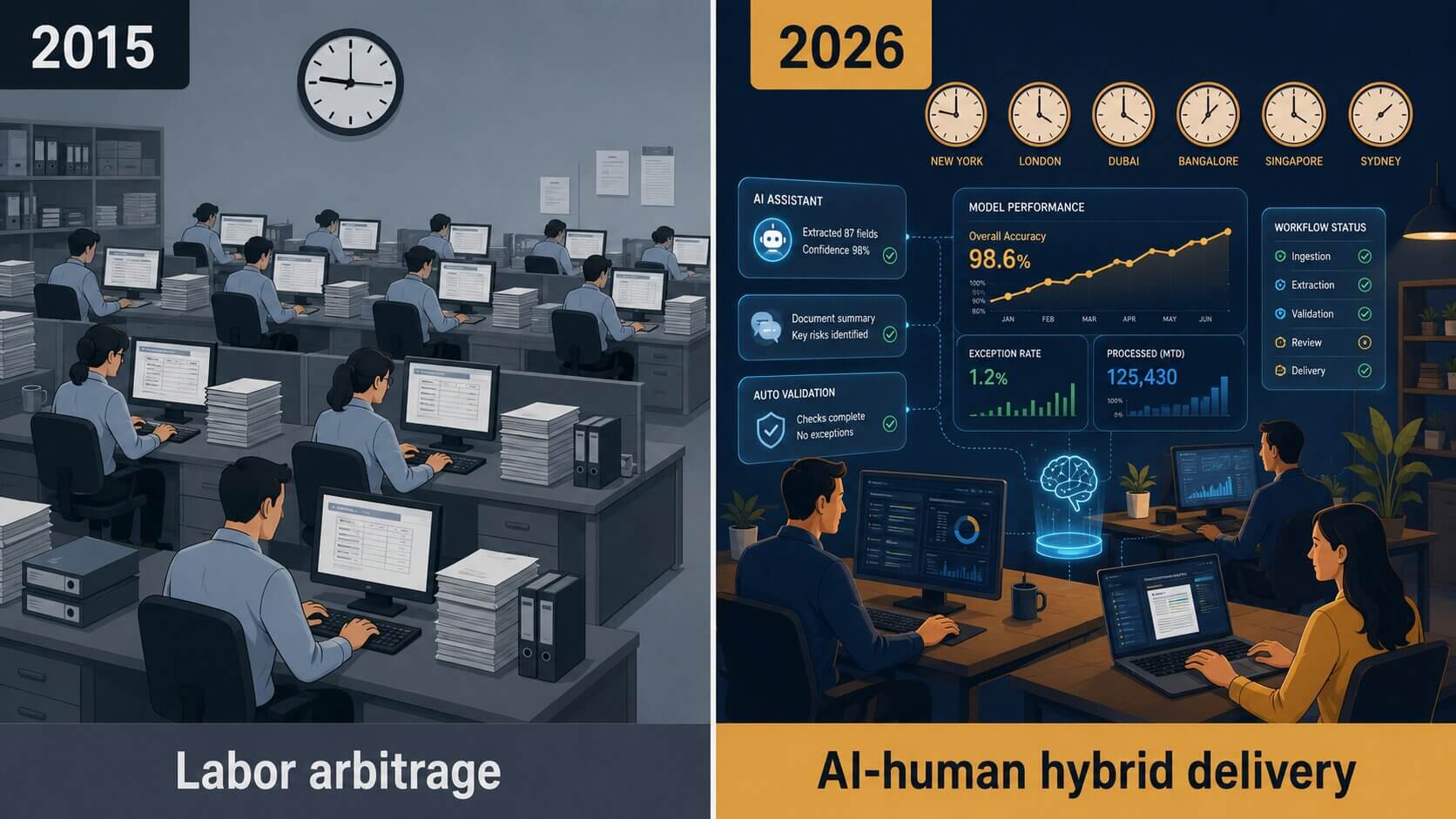
If you ran the numbers on offshore work in 2015, the case was simple. Labor in India cost a third of what it cost in the US. That was the whole story.
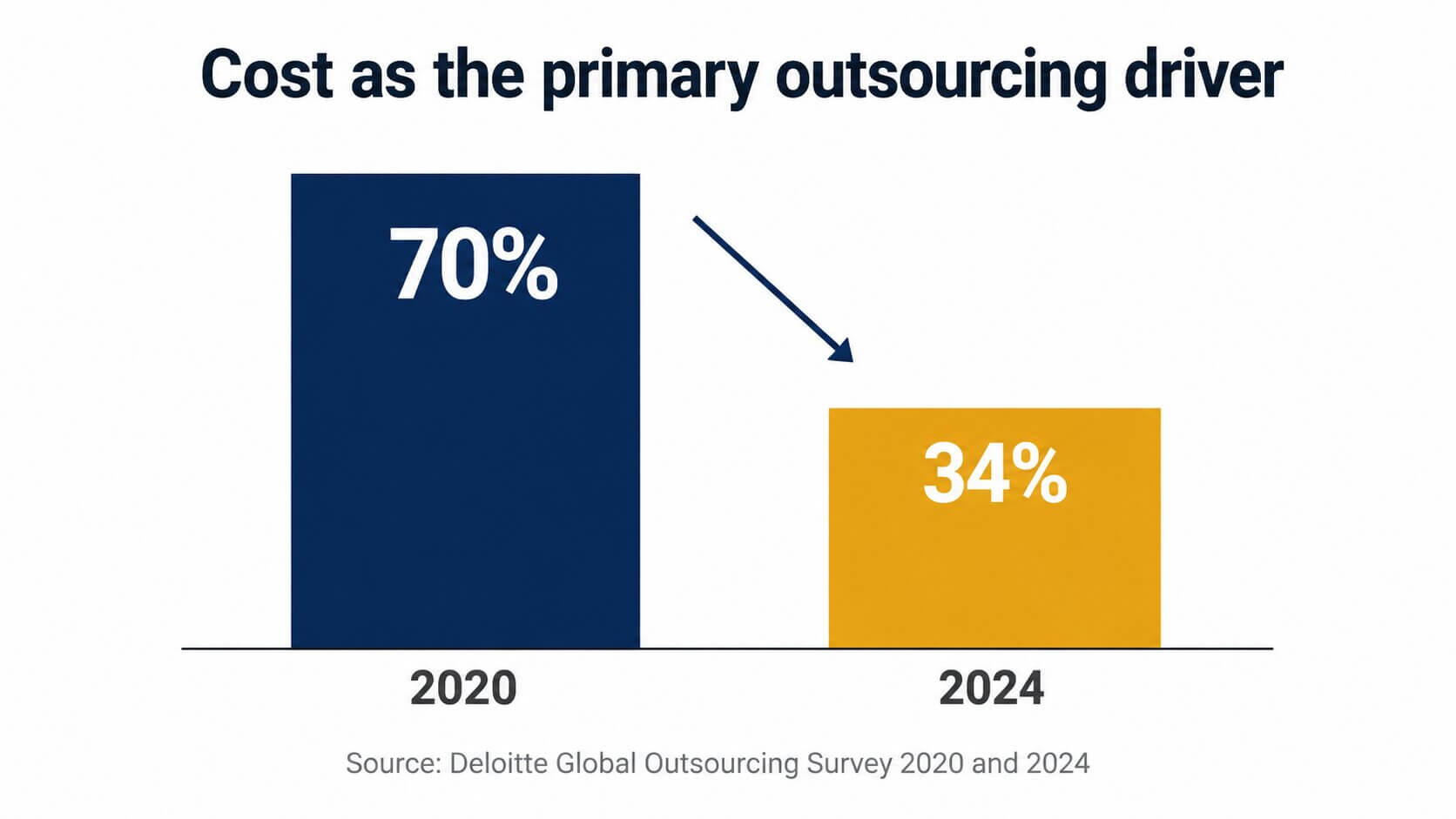
In 2026, the math still works, but it isn’t the reason most buyers sign. Deloitte’s 2024 Global Outsourcing Survey found that only 34% of executives now name cost as their primary driver, down from 70% in 2020. Skilled people, agility, and AI delivery have caught up.
This guide is what we’d tell a buyer evaluating an India partner today. Ten benefits, with the trade-offs included. The risks, with what to ask for in the contract. And the part that wasn’t on the table five years ago, which is what AI does to the whole equation. Most of what you’ll read comes from work HabileData has done across 6,500+ projects.
What changed since 2020
Cost savings of 40 to 60% are still on the table, but they’re a baseline now. Talent depth, AI-human hybrid delivery, and 83% AI adoption among outsourcing providers are the real reasons buyers pick India today. The risks moved too, away from communication gaps and toward AI governance and data residency.
Why companies still pick India for outsourcing
India’s position isn’t sentimental. It’s structural. Three numbers explain why.
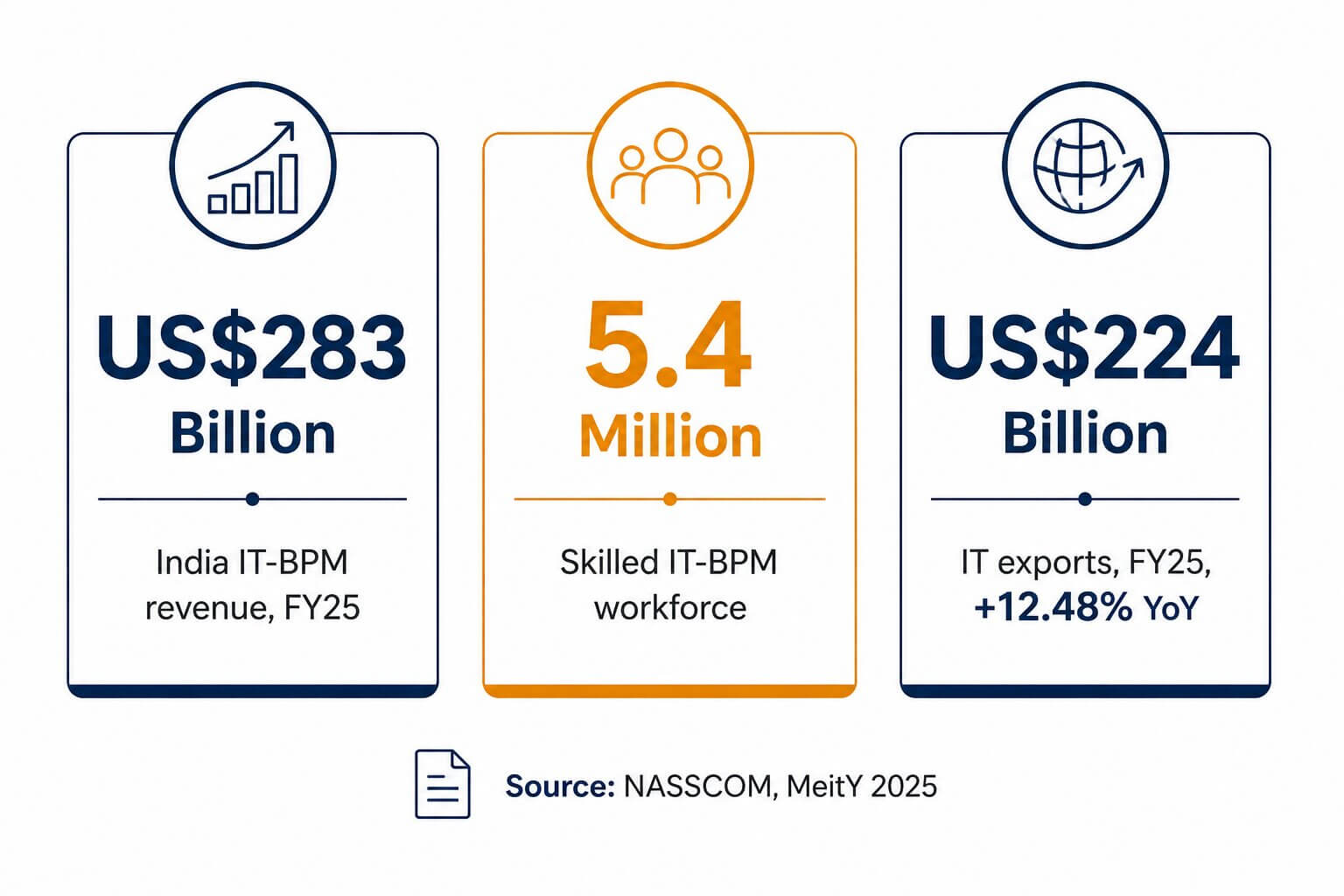
- Scale. India’s IT-BPM industry was worth US$283 billion in FY25, with IT exports of US$224 billion, up 12.48% year on year (NASSCOM, 2025).
- Talent. 5.4 million people work in IT-BPM, of whom roughly 2 million are digitally skilled in cloud, AI, and analytics (Invest India, 2025).
- Concentration. The US absorbs 54% of India’s IT services exports. The UK takes another 14%. India’s outsourcing footprint is built around English-speaking markets.
- AI adoption. 83% of executives globally now use AI as part of their outsourced services (Deloitte, 2024). Indian providers moved fastest on this curve.
These are not projections. India added US$13.8 billion in incremental tech revenue in FY25 alone and is on track to cross US$300 billion in FY26 (NASSCOM Strategic Review, 2025).
10 benefits of outsourcing to India in 2026
Every benefit below is grounded in current data. Where useful, I’ve added what we see operationally at HabileData. Most of these come with trade-offs, which is why the risks section comes right after.
1. Cost savings of 40 to 60%, still real, no longer the headline
Labor and infrastructure costs in India are 40 to 60% lower than equivalent operations in the US, UK, or Western Europe. For data-heavy, repeatable work, the gap holds even after you factor in management overhead.
What’s changed is what buyers do with the savings. The Deloitte 2024 survey shows 34% still cite cost as the main driver. Most of those buyers reinvest the difference into innovation or AI capability instead of treating outsourcing as pure expense reduction.
What we see at HabileData
On recent enterprise data-processing engagements, clients typically realize 45 to 55% total cost reduction in year one. The projects that succeed long term are the ones where savings get reinvested into automation, not pocketed.
2. Talent depth that’s hard to match anywhere else
India produces roughly 2.5 million STEM graduates a year, one of the world’s largest annual outputs (NASSCOM, 2024). It also reports the lowest tech talent demand-supply gap (25 to 27%) among major outsourcing markets, ahead of the US, UK, Canada, and Australia.
For specialized work like AI annotation, document intelligence, or data engineering, the talent pool in India is now deeper than most onshore alternatives. The Deloitte 2025 GBS Survey found that around 50% of companies investing in next-generation capabilities run their centers in India.
3. AI-human hybrid delivery, the biggest shift since 2020
Indian outsourcing providers no longer compete on headcount. They compete on how well they blend automation with human review.
83% of global executives now use AI as part of their outsourced services (Deloitte, 2024). Over 60% of Indian BPM organizations rank generative AI as a top investment priority for the next three years (NASSCOM, 2026).
A project that needed 100 analysts in 2018 may now need 30 analysts plus AI-assisted workflows. Same output, faster, with fewer errors.
4. 24-hour operations through time-zone difference
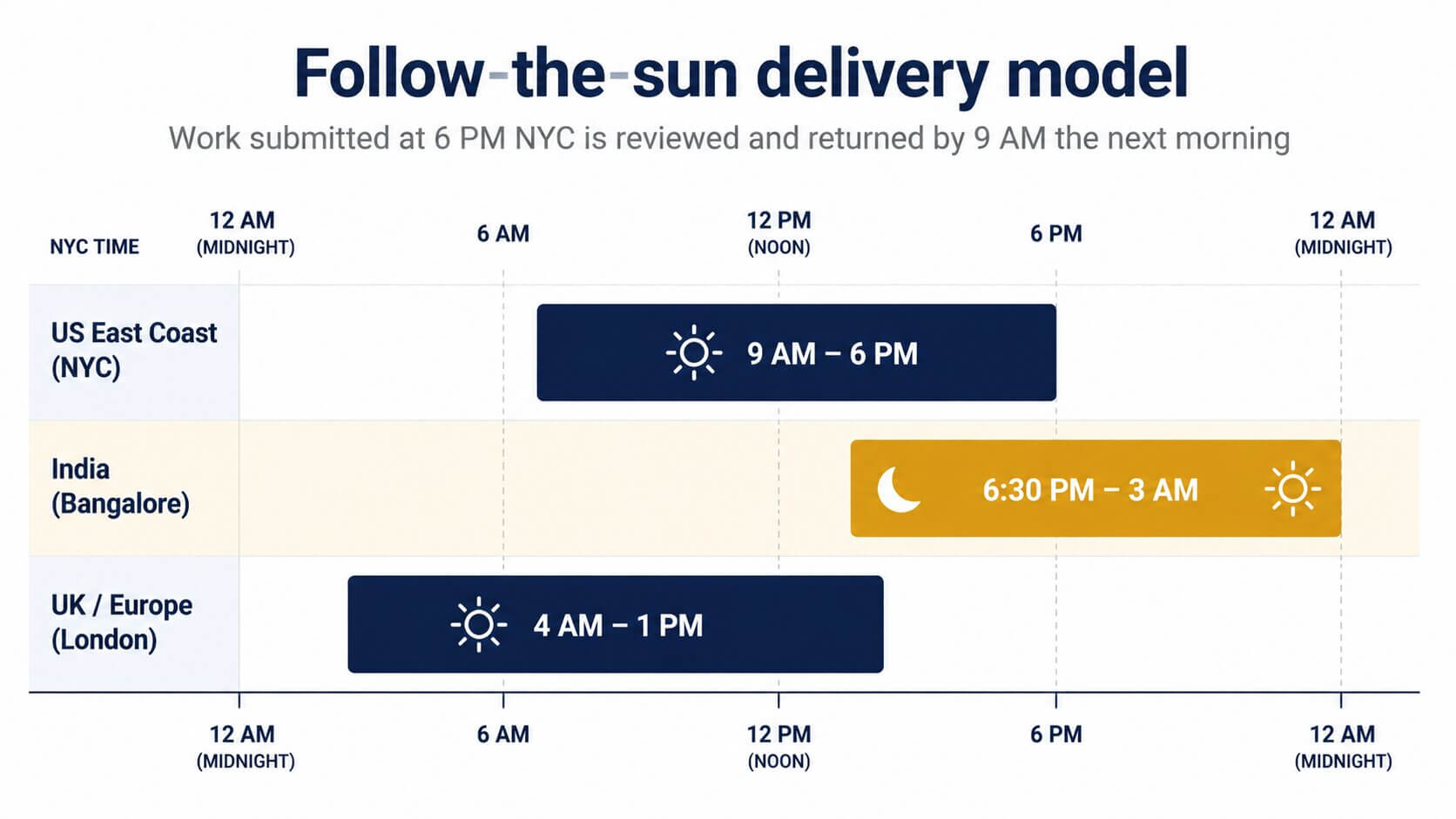
The 9.5 to 12.5 hour time difference between India and North America is structural. It’s not a bug to manage. It’s a feature to design around. Work submitted from New York at 6 PM is reviewed and returned by 9 AM the next morning.
Most mature providers run overlap shifts now, typically 4 to 6 hours of working-hour overlap with the US East Coast and full overlap with the UK and Europe. That removes the old asynchronous-only constraint.
5. Flexible engagement and scaling models
Indian outsourcing providers offer four main engagement models. The right one depends on how predictable your project is.
| Model | Best for | Pricing logic |
|---|---|---|
| Fixed-price | Defined scope, clear deliverables | One-time quote, milestone-based payments |
| Time and materials | Evolving requirements | Hourly or daily rates, monthly invoicing |
| Dedicated team | Long-term, ongoing operations | Monthly retainer per FTE |
| Outcome-based | Process-heavy work with measurable KPIs | Per-record, per-transaction, or SLA-linked |
Outcome-based delivery is rising fastest, according to the Deloitte 2024 survey. Clients increasingly want shared risk-reward, not just rate cards.
6. Faster ramp-up than onshore alternatives
A mature Indian provider can move from 5 to 50 trained operators in 4 to 8 weeks. Onshore equivalents typically need 4 to 6 months and cost 3 to 5 times more per FTE during ramp.
Operational reference
On a recent annotation engagement, our team scaled from 15 annotators to 70+ including senior reviewers, in six months. That kind of elasticity is hard to replicate with an in-house build.
7. Vertical-specific capabilities for ecommerce and real estate
Two industries where Indian outsourcing has built genuine depth in the last five years.
In ecommerce, the work spans product catalog management, image editing, and content moderation for Amazon, Shopify, and marketplace sellers. The cost is typically 50 to 70% lower than US equivalents, and providers know the platform-specific quirks.
In real estate, the work covers title research, MLS data processing, and property record digitization. Domain-trained teams handle this, often with BCP across multiple delivery sites.
8. Mature data security and compliance posture
Concerns about data security in India are mostly outdated for tier-1 providers. Established outsourcing firms hold ISO 27001, SOC 2 Type II, and where applicable HIPAA-compliant operations as table stakes, not differentiators.
What still varies vendor to vendor: data residency arrangements, NDA enforcement protocols, and biometric access controls at delivery centers. These are worth diligence on every shortlist. They aren’t safe to assume
9. R&D and innovation outsourcing, not just throughput
India hosts a growing share of Global Capability Centers (GCCs) for Fortune 500 firms. Roughly 50% of organizations investing in next-gen capabilities now run GCCs in India (Deloitte 2025 GBS Survey). The role has shifted from execution to co-development.
For mid-market companies, this means an experienced outsourcing partner can own discrete R&D workstreams. Things like model fine-tuning, data engineering pipelines, or automation development. Not just throughput tasks.
10. Mature ecosystem reduces the risk of getting it wrong
This benefit doesn’t show up in a chart, but it shows up in every project. India has been doing outsourcing at scale for over 30 years. Vendor selection consultants exist. Industry analyst coverage is deep. Reference checks are easy because most enterprises have already worked with multiple Indian providers.
Compare that with newer offshore destinations where you may be one of the first North American clients a vendor has handled. The maturity premium in India is real. If something goes wrong, there’s a playbook for fixing it.
Industry trade bodies like NASSCOM publish detailed benchmark data, and platforms like Clutch and G2 carry years of buyer reviews. The information asymmetry between buyer and vendor is much smaller in India than in any emerging outsourcing market.
Risks of outsourcing to India, and what to ask for in the contract
Every benefit above has a counterweight. The question isn’t whether risks exist. It’s whether your provider has a documented answer for each one.
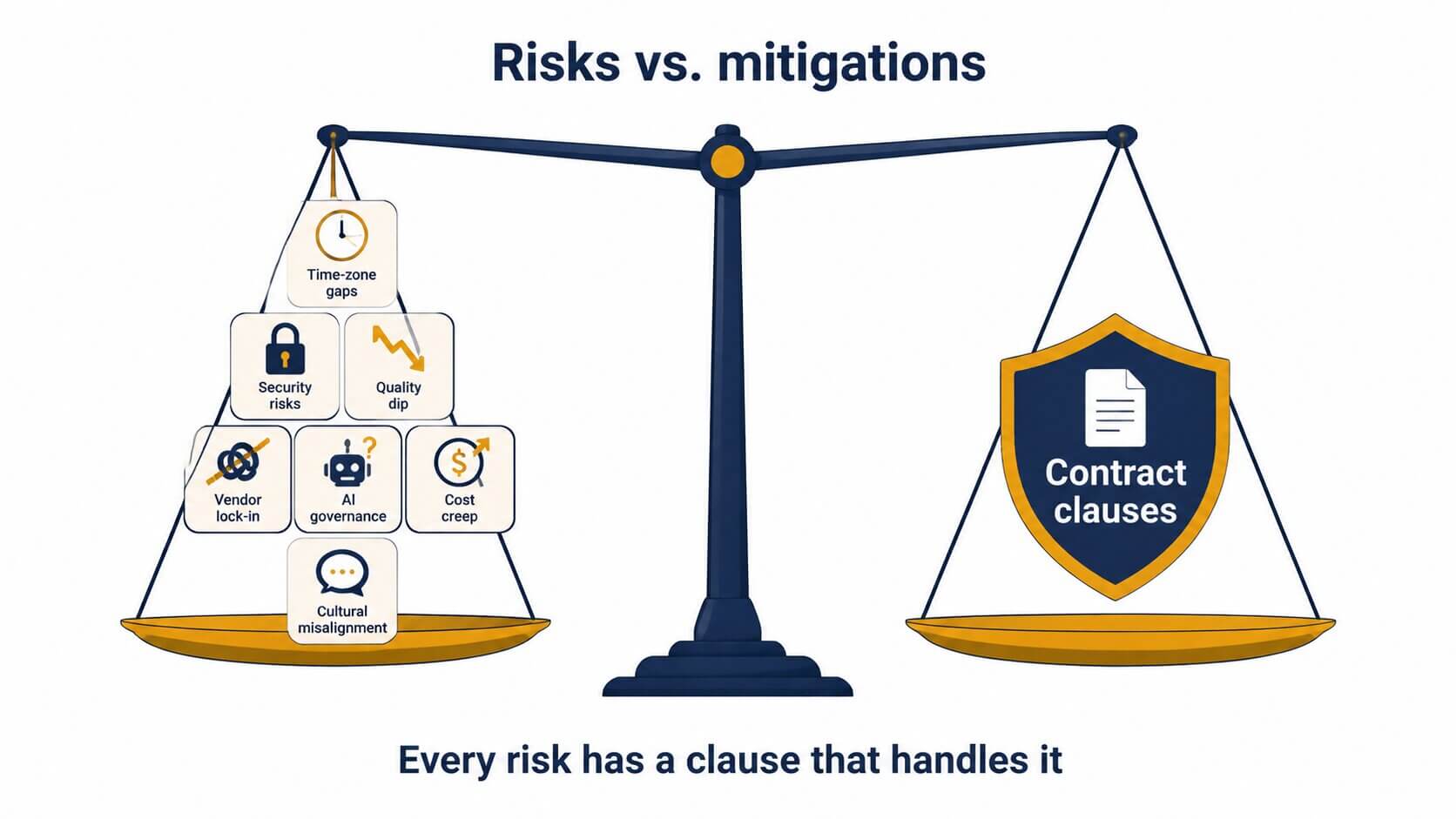
| Risk | How it shows up | What to demand from your provider |
|---|---|---|
| Communication and time-zone gaps | Async delays, missed nuance, slow escalation | Overlap shifts (4 to 6 hours with US East), named project manager, weekly video reviews |
| Data security and residency | Sensitive data leaving home jurisdiction, GDPR or HIPAA exposure | ISO 27001, SOC 2 Type II, signed NDAs per operator, data residency clauses, biometric access logs |
| Quality control during ramp-up | Output quality dips when team scales fast | Pilot project before scale, documented QA methodology, sample-based audits, inter-reviewer agreement scoring |
| Cultural and process differences | Different defaults on escalation, status reporting, deadline framing | Onsite kickoff, shared playbooks, named cultural liaison on the provider side |
| Vendor lock-in | Hard to move work once embedded in vendor systems | Source code and data ownership clauses, documented runbooks, exit-transition SLA in contract |
| AI governance gaps | Provider uses AI on your data without explicit governance | Written AI usage policy, model lineage disclosure, opt-in for any LLM exposure of client data |
| Hidden cost creep | Change-order pricing, scope expansion fees | Locked rate cards, change-control process, capped overage clauses |
The Deloitte 2024 survey is blunt about AI governance specifically. 83% of organizations now use AI in outsourced services, but tangible gains have been limited because contracting hasn’t caught up. Ask your provider what their AI policy says. If they don’t have a written one, that’s a flag.
Not sure which model fits – offshore, nearshore, or India? Download the free 2026 whitepaper with TCO model, risk checklist, and rollout roadmap.
Download the free whitepaper now »Outsourcing to India in the AI era
Five years ago, outsourcing was a decision about labor. Today, it’s a decision about how AI and humans get woven together. Different evaluation, different questions, different contracts.
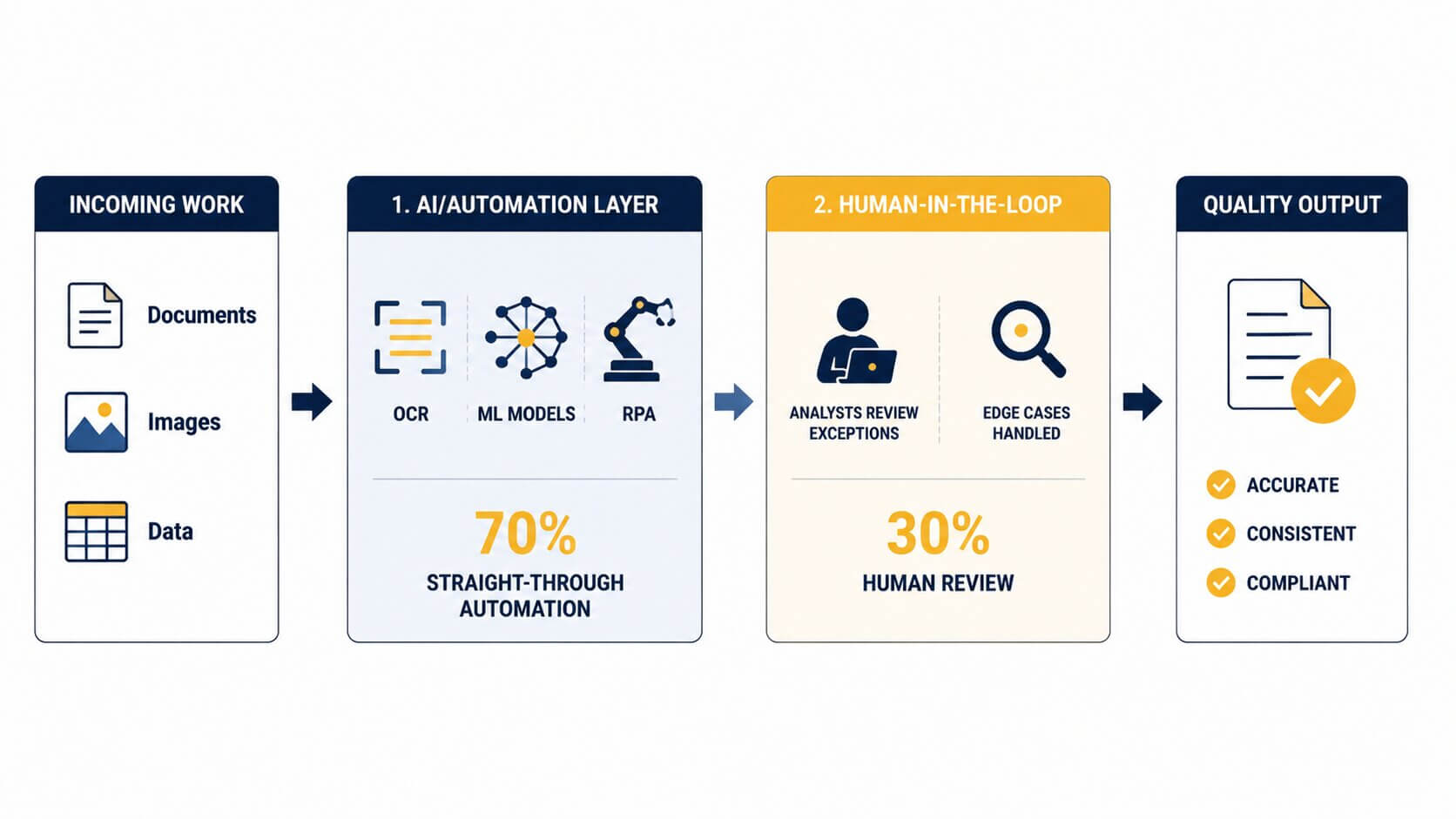
Four shifts that matter
Pricing is moving away from per-FTE to per-record, per-document, or outcome-based. When you talk to providers, ask for unit economics, not just headcount rates.
Human-in-the-loop is now standard. AI handles the easy 70%. Humans handle the 30% of edge cases that determine quality. The best Indian providers have invested heavily in this layer because that’s where they earn their margin.
AI training data is a new outsourced category. Image annotation, video labeling, RLHF feedback, synthetic data generation. None of this existed as outsourcing line items in 2018. They’re now among the fastest-growing service lines.
Quality measurement got more rigorous. Inter-annotator agreement, gold-standard sets, consensus scoring. These are standard QA practices for AI-related work now, not nice-to-haves.
If your provider is still selling 2018-style headcount outsourcing, you’re paying for a model that’s already been disrupted. The question to ask: what percentage of your delivery is AI-assisted, and how do you measure quality on the human side?
When outsourcing to India makes sense for your business
Outsourcing isn’t right for every company. The decision comes down to three honest answers about your own operation.
| Question | Outsourcing to India fits well | Probably keep in-house |
|---|---|---|
| Is the work repeatable and process-defined? | Yes – data entry, catalog ops, annotation, document processing | No – strategic, highly contextual, or one-off creative work |
| Is volume meaningful? | 10K+ records per month, 5+ FTE-equivalent | Sub-scale or one-time projects under ~$10K |
| Can quality be measured objectively? | Yes – accuracy %, SLA times, defect rates | No – subjective judgment work without clear metrics |
If you answered yes to all three, India is almost always the strongest offshoring choice. If you answered no on any, run a small pilot first. Two providers in parallel works well for comparison.
How to choose the right outsourcing partner in India
Most evaluation checklists are generic. Here’s a tighter version, organized by what actually predicts success.
Capability fit
- Domain experience in your specific work type, not just “data entry” but what kind, what volume, what tools
- Technology stack: which OCR engines, annotation platforms, automation tools they use today
- AI integration maturity, with a documented human-in-the-loop methodology
Operational discipline
- ISO 27001 and SOC 2 Type II certifications, verify dates not just claims
- BCP and multi-site delivery (single-site shops are a concentration risk)
- Documented QA methodology with quantitative quality metrics
Commercial transparency
- Clear pricing model with locked rate cards and capped change-order pricing
- Defined exit-and-transition SLA in the contract from day one
- Real client references in your industry, ask to talk to two
Cultural fit
- Named project manager (not a rotating cast) with overlap-shift availability
- Working English fluency at the operator level, not just sales
- Willingness to run a paid pilot of 30 to 60 days before scaling
A practical tip: run a parallel pilot
Send the same 1,000-record sample to two shortlisted providers under identical instructions. Compare accuracy, turnaround, and how each one handles edge cases. The differences are usually larger than the rate-card differences, and they predict the long-term relationship far better.
Industries where India outsourcing delivers the most value
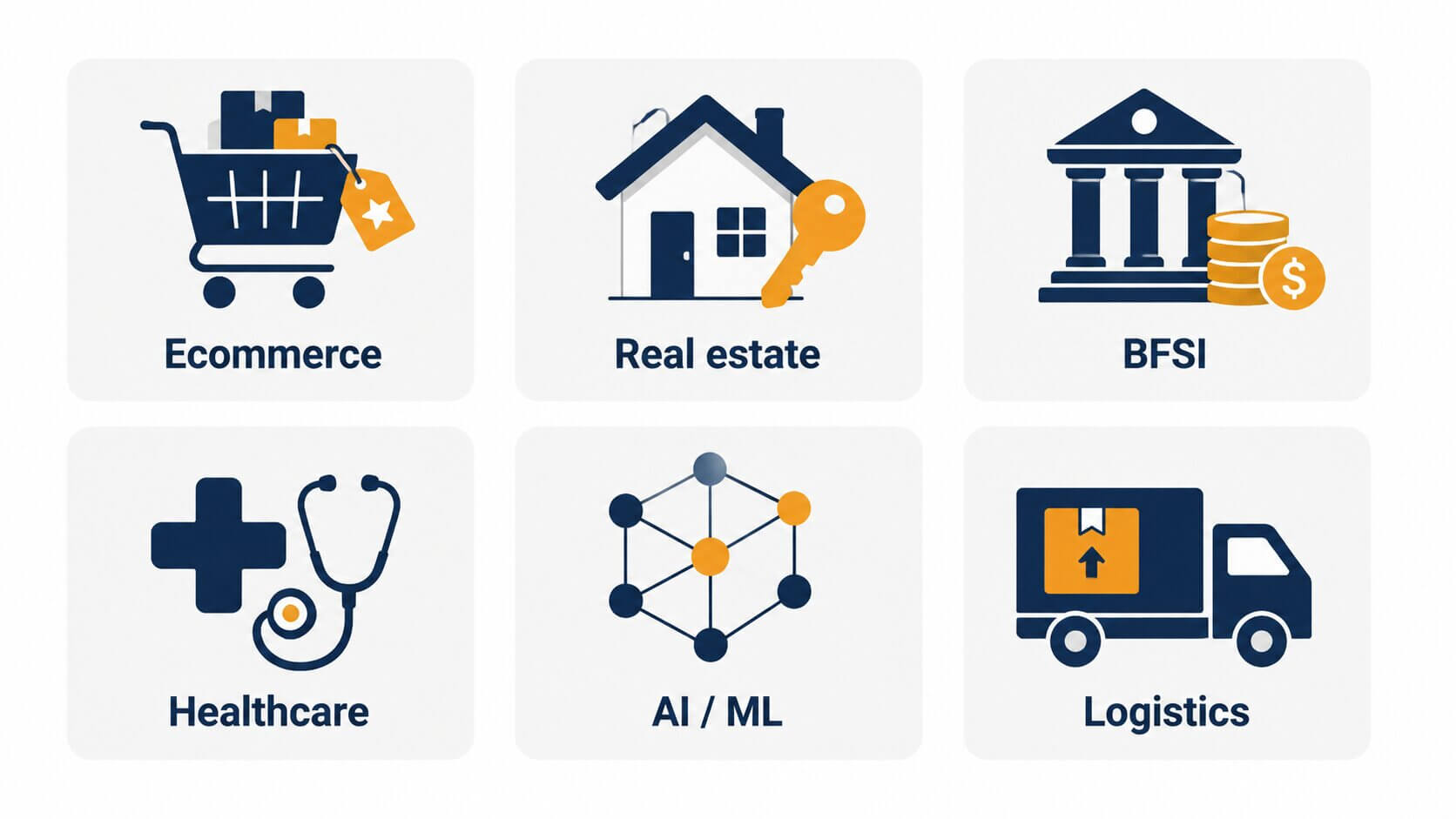
Based on volume, maturity, and measurable ROI, these are the verticals where Indian outsourcing is most defensible in 2026.
| Industry | Most outsourced functions | Typical savings |
|---|---|---|
| Ecommerce | Product catalog management, image editing, content moderation | 50 to 65% |
| Real estate | Title research, MLS data, property records digitization | 45 to 60% |
| BFSI | Document processing, KYC, loan origination support | 40 to 55% |
| Healthcare | Medical records digitization, claims processing, transcription | 40 to 55% |
| AI / ML companies | Data annotation, RLHF, synthetic data generation | 55 to 70% |
| Logistics | Order processing, freight documentation, invoice management | 45 to 60% |
These ranges reflect typical engagements. They aren’t best-case marketing numbers. Actual savings depend on volume, complexity, and how much in-house overhead you avoid.
The honest take on outsourcing to India in 2026
Cost was the answer in 2015. It isn’t the answer in 2026. The buyers getting real value from Indian outsourcing today have stopped thinking of their provider as a labor pool. They write contracts around outcomes, build AI into the workflow from day one, and expect the partner to push back when something won’t work.
So if you’re weighing whether to offshore, the better starting question isn’t “how much will I save?” It’s “what would I do with the capacity I’d get back?” The answer to that one tells you whether outsourcing is a budget exercise or something that actually moves the business forward.
Frequently asked questions
Costs vary by service. Standard data entry runs about US$6 to 10 per hour for dedicated FTEs. AI annotation runs US$8 to 15 per hour depending on complexity. Specialized engineering or AI work runs US$20 to 40 per hour, still 50 to 70% below US equivalents.
It’s manageable, not eliminated. Tier-1 providers hold ISO 27001 and SOC 2 Type II certifications and operate biometric-access delivery centers. Verify certifications, demand data residency clauses, and signed NDAs at the operator level, not just the company level.
Most mature providers run overlap shifts. Typically 4 to 6 working hours overlapping with US East Coast, and full overlap with the UK and Europe. The remaining hours become a delivery advantage. Work submitted at end-of-day is reviewed by morning.
Small businesses are now a major segment. The minimum viable engagement has dropped to roughly 2 to 5 dedicated FTEs or US$3,000 to 5,000 per month. For project-based work, even smaller engagements are possible, though pilot pricing applies.
AI is shifting outsourcing from labor arbitrage to hybrid throughput. 83% of global executives now use AI in outsourced services (Deloitte, 2024). Indian providers have invested heavily in human-in-the-loop workflows where AI handles the bulk of the work and humans manage exceptions and quality.
In order of frequency: communication and time-zone gaps, AI governance gaps, hidden cost creep, vendor lock-in, and quality dips during ramp-up. All are mitigable with the right contract terms. The risk table earlier in this article covers the specific clauses to ask for.
Ecommerce, real estate, BFSI, healthcare, AI/ML companies, and logistics see the most measurable ROI. The common pattern is high-volume, process-defined work where quality can be measured objectively.
Considering outsourcing to India? Start with a paid pilot.
HabileData has delivered 6,500+ projects across data processing, AI annotation, ecommerce operations, and real estate data, for clients in the US, UK, Europe, and Australia. We run 30 to 60 day paid pilots so you can validate fit before scaling.
Get a free quote now! »

Snehal Joshi , Head of Business Process Management at HabileData, leads a 500-member team of data professionals, having successfully delivered 500+ projects across B2B data aggregation, real estate, ecommerce, and manufacturing. His expertise spans data hygiene strategy, workflow automation, database management, and process optimization - making him a trusted voice on data quality and operational excellence for enterprises worldwide. 🔗Connect with Snehal on LinkedIn