Poor data quality silently drains revenue, breaks AI models, and triggers compliance penalties. This independent guide compares 10 data cleansing companies on pricing, accuracy, certifications, and delivery models. Includes a side-by-side comparison table, real cost benchmarks, and a 30-day pilot framework to test vendors before committing.
Contents
- When Should You Outsource Data Cleansing?
- What to Look for in a Data Cleansing Partner
- Top 10 Data Cleansing Companies: Independent Comparison
- Side-by-Side Comparison Table
- How We Evaluated These Companies
- How Much Does Data Cleansing Cost?
- How to Run a 30-Day Pilot Project
- Case Study: B2B Data Cleansing in Practice
- Conclusion
- FAQ
Poor data quality costs U.S. businesses over $3 trillion annually. According to IBM’s 2025 research, more than a quarter of organizations lose upward of $5 million each year to dirty data alone.
With AI spending projected to surpass $2 trillion in 2026, the stakes have never been higher. Gartner predicts that 60% of AI projects will be abandoned by organizations lacking AI-ready data.
Choosing the right data cleansing partner is no longer optional. It is a strategic business decision that directly impacts revenue, compliance, and competitive advantage.
This guide provides a genuine comparison framework, practical outsourcing advice, real project data, and a structured evaluation of 10 leading data cleansing companies.
When Should You Outsource Data Cleansing?
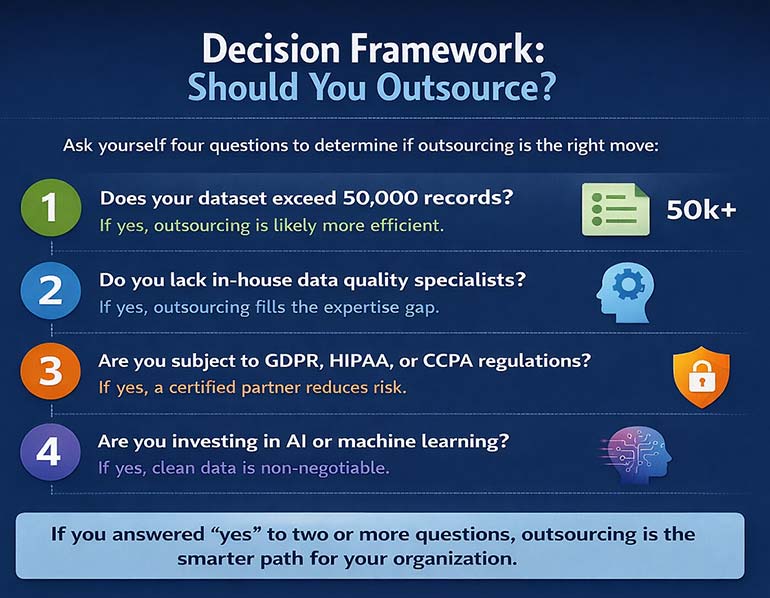
Not every organization needs to outsource. But clear signals indicate when it makes strategic and financial sense.
- Data Volume Thresholds: If your database exceeds 50,000 records, manual in-house cleansing becomes inefficient and error-prone. At 500,000+ records, outsourcing is almost always more cost-effective than building internal capability.
- Skill Gaps: Data cleansing requires specialized expertise in deduplication algorithms, fuzzy matching, and standardization logic. Most in-house teams lack these capabilities and the tools to execute them at scale.
- Compliance Requirements: Industries like healthcare, finance, and insurance face strict data regulations. Professional cleansing partners bring GDPR, HIPAA, and SOC 2 expertise that significantly reduces compliance risk.
- AI Readiness: AI and machine learning models trained on dirty data produce flawed, biased outputs. Clean, validated datasets are the prerequisite for every successful AI initiative.
What to Look for in a Data Cleansing Partner
Choosing a vendor based on marketing language is a common and costly mistake. Here are the concrete evaluation criteria that separate reliable partners from the rest.
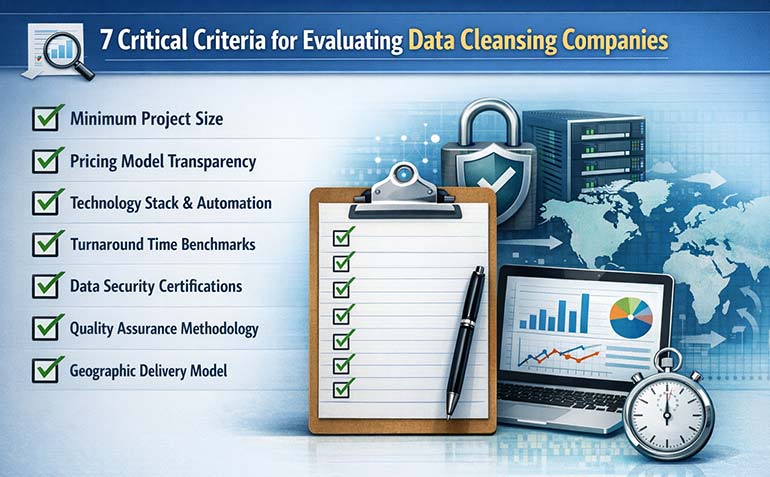
- Minimum Project Size: Some enterprise-focused companies won’t accept projects under 10,000 records. Others specialize in smaller, targeted cleanups. Confirm minimum commitments before engaging to avoid wasted time.
- Pricing Model Transparency: Data cleansing vendors use different pricing structures: per-record, per-hour, per-project fixed-fee, and monthly retainer models. Always request a total cost of ownership breakdown.
- Technology Stack & Automation: Ask about specific tools they use. Leading vendors combine OCR technology, AI-powered deduplication, and automated validation rules. The automation percentage tells you how scalable their process is.
- Turnaround Time Benchmarks: For a standard 50,000-record project, expect 5–10 business days from established providers. Turnaround depends on data complexity and the number of fields requiring cleansing.
- Data Security Certifications: Non-negotiable certifications include ISO 27001 for information security and SOC 2 for service organization controls. For healthcare data, HIPAA compliance is essential.
- Quality Assurance Methodology: Ask how they measure accuracy. Top providers use multi-pass validation with both automated and human review stages. Target accuracy rates should be 99.5% or higher.
- Geographic Delivery Model: Single-site operations carry business continuity risk. Multi-site delivery with redundant infrastructure ensures uninterrupted service during disruptions or natural events.
Top 10 Data Cleansing Companies: Independent Comparison
Each company below is evaluated using the same transparent criteria. Assessments are based on public information, verified client reviews on Clutch, G2, and Gartner Peer Insights, documented case studies, and our industry knowledge.
Company descriptions are analytical, not promotional. Every profile ends with a “Best for” qualifier to help you match your needs to the right partner.
1. Experian Data Quality
Experian Data Quality is a global leader in enterprise data management. Their platform integrates with existing CRM and ERP systems for real-time validation, address verification, and identity resolution.
- What they excel at: Real-time data validation, address verification, and identity resolution at enterprise scale. Their API-driven approach enables continuous data quality monitoring across all customer touchpoints.
- Where they fall short: Pricing is designed for large enterprises. Small and mid-size businesses often find their solutions cost-prohibitive for one-time or smaller cleansing projects.
Best for: Enterprise clients managing millions of customer records who need always-on data quality embedded into their operational systems.
2. Melissa Data
Melissa brings nearly four decades of expertise in contact data quality and identity verification. They offer both self-service tools and fully managed cleansing services.
- What they excel at: Address standardization and verification across 240+ countries. Their Clean Suite handles deduplication, geocoding, and email verification in a unified workflow.
- Where they fall short: Primary strength is contact and address data. Organizations needing specialized industry data cleansing (medical records, financial instruments) may need supplementary solutions.
Best for: Marketing and sales teams needing accurate, verified customer contact data across global markets.
3. Hitech BPO
Hitech BPO is a division of the ISO-certified global outsourcing company HitechDigital. They specialize in B2B data solutions including cleansing for email lists, CRM databases, and marketing contact data. With 3,100+ completed projects, they bring deep operational expertise.
- What they excel at: B2B data cleansing, CRM data hygiene, and email list cleanup. Their multi-pass human validation process delivers high accuracy for complex datasets. Rated 5.0 on Gartner Peer Insights.
- Where they fall short: Primarily a managed service provider. Organizations wanting self-service software tools for in-house teams will need to look elsewhere for that specific capability.
Best for: B2B companies and data aggregators needing high-volume CRM and email list cleansing with human-verified accuracy and offshore cost advantages.
4. HabileData
HabileData provides comprehensive data cleansing services covering B2B databases, CRM records, and enterprise datasets. With 6,500+ completed projects and a documented 99.9% accuracy rate, they combine advanced automation with human quality assurance.
- What they excel at: End-to-end data cleansing workflow: collection, validation, verification, standardization, and enrichment in a single engagement. Strong in real estate, ecommerce, and financial data verticals.
- Where they fall short: As an offshore managed service provider, real-time collaboration can be limited by timezone differences. Not a software vendor, so no self-service platform is available.
Best for: Mid-to-large businesses needing comprehensive, multi-stage data cleansing across CRM, B2B, and industry-specific databases with high accuracy requirements.
5. Data Ladder
Data Ladder provides proprietary data quality software focused on matching, deduplication, and profiling through their DataMatch Enterprise platform.
- What they excel at: Fuzzy matching algorithms and visual data profiling. Their Wordsmith tool enables bulk noise removal across entire datasets. Code-free, visual interface that business users can operate independently.
- Where they fall short: Primarily a software tool, not a managed service. Organizations still need internal staff to operate the platform effectively and interpret results.
Best for: Companies with in-house data teams who want powerful self-service tools for ongoing data quality management without writing code.
6. Talend (now part of Qlik)

Talend’s data quality capabilities are embedded within Qlik’s broader data integration and governance ecosystem. They automate validation, error correction, and transformation at enterprise scale.
- What they excel at: Automated data quality rules and workflows tightly integrated with data pipelines. Strong for organizations already using Talend or Qlik for data integration.
- Where they fall short: Implementation requires significant technical expertise. The learning curve is steep compared to simpler point solutions, and setup timelines can be lengthy.
Best for: Data engineering teams building scalable data pipelines who need quality checks embedded directly into their ETL workflows.
7. Informatica Data Quality
Informatica offers enterprise-grade data profiling, cleansing, validation, and governance through their Intelligent Data Management Cloud (IDMC).
- What they excel at: Master data management, complex enterprise data governance, and AI-driven anomaly detection. Handles massive data environments with sophisticated rule engines.
- Where they fall short: The most expensive option on this list. Implementation timelines are lengthy and often require dedicated consulting engagements.
Best for: Fortune 500 companies with complex, multi-system data environments requiring robust governance frameworks.
8. DQ Global
DQ Global provides dedicated CRM data cleansing services with strong Microsoft Dynamics integration. They offer both managed services and self-service tools like their DQ for Excel plugin.
- What they excel at: Duplicate detection and prevention within CRM systems. Their Excel plugin empowers business users to cleanse data without technical expertise.
- Where they fall short: Focus is primarily on CRM and contact data. Not suitable for large-scale database cleansing across operational or financial systems.
Best for: Mid-size businesses seeking hands-on CRM data cleanup with professional service support and accessible Excel-based tools.
9. Data8
Data8 specializes in real-time data validation directly within CRM platforms. Their tools integrate natively with Microsoft Dynamics and Salesforce.
- What they excel at: Point-of-entry data validation that prevents dirty data from entering your systems. Their UK address lookup and phone validation are particularly strong.
- Where they fall short: Their geographic strength is concentrated in the UK and Europe. Organizations needing global data coverage may need supplementary solutions.
Best for: UK and European businesses using Microsoft Dynamics who want embedded data quality controls within their CRM.
10. WinPure
WinPure offers guided data cleansing software that doesn’t require heavy technical expertise. Their wizard-driven Clean & Match interface walks users through deduplication and standardization step by step.
- What they excel at: Ease of use. Designed for business users, not data engineers. Step-by-step workflow makes complex matching and deduplication accessible to non-technical teams.
- Where they fall short: Limited scalability for very large datasets (10M+ records). Advanced users may find the guided approach restrictive compared to code-based platforms.
Best for: Small to mid-size businesses wanting a user-friendly, affordable data cleansing tool they can operate without IT support.
Side-by-Side Comparison Table
| Company | Best For | Pricing | Min. Size | Certifications | Accuracy |
|---|---|---|---|---|---|
| Experian | Enterprise real-time | Subscription | Large | ISO 27001, GDPR | 99%+ |
| Melissa | Contact data | Per-record | Flexible | SOC 2, GDPR | 99%+ |
| Hitech BPO | B2B/CRM data | Per-project | 5K+ records | ISO 27001 | 99.5%+ |
| HabileData | Multi-stage cleansing | Per-record/project | Flexible | ISO 27001 | 99.9% |
| Data Ladder | In-house teams | License | No minimum | SOC 2 | Varies |
| Talend (Qlik) | Data pipelines | Subscription | Mid-large | SOC 2, GDPR | Varies |
| Informatica | Enterprise governance | Enterprise | Large | ISO 27001, SOC 2 | 99%+ |
| DQ Global | CRM (Dynamics) | Project-based | Small-mid | GDPR | 98%+ |
| Data8 | CRM validation (UK/EU) | Pay-per-use credits | No minimum | GDPR | Varies |
| WinPure | Non-tech teams | License | No minimum | GDPR | Varies |
How We Evaluated These Companies
Transparency in methodology is essential for building trust. Here is the detailed process behind this comparison.
Our Information Sources
We evaluated each company using publicly verifiable data. This included published case studies, verified reviews on Clutch and G2, Gartner Peer Insights ratings, and Glassdoor scores as a proxy for employee retention.
Employee retention directly correlates with service quality in data operations. High turnover means institutional knowledge is constantly lost, which degrades output consistency.
Evaluation Dimensions
Our analysis weighted seven factors equally: depth of cleansing capabilities, technology sophistication, verified client satisfaction scores, security certifications held, pricing transparency, proven scalability, and industry specialization.
What We Deliberately Excluded
We did not evaluate companies based on website design, Google ad spend, or social media following. These metrics have zero correlation with actual data cleansing quality.
We also excluded companies that could not demonstrate at least five years of continuous operation. Longevity matters in a field where data security and process maturity are critical.
Our Perspective as Industry Participants
As a data cleansing company ourselves, HabileData has worked alongside many of these vendors in competitive and complementary contexts. This gives us operational insight into how these companies perform.
We acknowledge this perspective introduces potential bias, which is why we publish our methodology, include ourselves transparently, and encourage readers to verify all claims independently.
How Much Does Data Cleansing Cost?
Pricing varies significantly based on project complexity, data volume, and service model. Here are realistic benchmarks based on our industry experience.
Per-Record Pricing
For straightforward deduplication and standardization, expect $0.02 to $0.10 per record. Complex cleansing involving enrichment, validation against external sources, and multi-field correction ranges from $0.15 to $0.50 per record.
Monthly Retainer Models
Ongoing data hygiene services typically range from $2,000 to $15,000 per month. This covers continuous monitoring, periodic bulk cleansing, and quality reporting dashboards.
Typical Project Costs by Dataset Size
| Dataset Size | Simple Cleansing | Complex Cleansing | Offshore Savings |
|---|---|---|---|
| 10,000 records | $200 – $1,000 | $1,500 – $5,000 | 40–60% less |
| 100,000 records | $2,000 – $10,000 | $15,000 – $50,000 | 40–60% less |
| 1,000,000 records | $20,000 – $100,000 | $150,000 – $500,000 | 40–60% less |
Hidden Costs to Watch For
Data migration fees, API integration charges, and per-user licensing can inflate quoted prices significantly. Always request a total cost of ownership breakdown before committing to any vendor.
How to Run a 30-Day Pilot Project
Before signing a long-term contract, run a structured pilot. Here is a proven 30-day framework based on our experience managing thousands of data projects.
Week 1: Preparation (Days 1–7)
Select a representative sample of 5,000–10,000 records from your database. This sample should reflect the full range of data quality issues you face.
Define measurable success criteria upfront. Typical metrics include duplicate reduction rate, field completion rate, and accuracy percentage post-cleansing.
Document your current data state with baseline measurements. Without a clear “before” snapshot, you cannot quantify improvement.
Week 2: Execution (Days 8–14)
Share the sample dataset with your chosen vendor. Provide clear instructions on business rules, required formats, and priority fields.
Request daily progress updates. A responsive vendor during the pilot is a reliable indicator of ongoing service quality and communication standards.
Week 3: Review (Days 15–21)
Analyze the cleansed output against your baseline metrics. Spot-check at least 500 records manually to verify automated accuracy claims.
Evaluate the vendor’s documentation. Quality providers deliver detailed cleansing logs showing what was changed, why, and how many records were affected.
Week 4: Decision (Days 22–30)
Calculate ROI based on pilot results. Consider time saved, error reduction, and downstream impact on reporting and analytics quality.
Negotiate contract terms based on actual pilot performance, not sales projections. Use pilot accuracy rates as contractual SLAs for the full engagement.
Case Study: B2B Data Cleansing in Practice
Understanding real-world outcomes sets realistic expectations. The following is an anonymized case study from HabileData’s portfolio of 6,500+ completed projects.
Project Snapshot
- Client: Mid-size SaaS company (B2B, 180,000 CRM contacts)
- Problem: Declining email deliverability, rising bounce rates, sales team frustration
- Duration: 3 weeks, multi-stage cleansing process
- Accuracy Achieved: 99.6% post-cleansing validation
The Problem
An initial audit revealed 23% duplicate records, 18% incomplete company information, and 12% outdated job titles for contacts who had changed roles. Sales productivity was declining measurably.
The Process
- Stage 1: Automated deduplication using fuzzy matching algorithms identified and merged 41,400 duplicate entries across multiple CRM fields.
- Stage 2: Standardization rules normalized company names, addresses, and industry classifications into a consistent taxonomy.
- Stage 3: External verification against business databases updated job titles and confirmed company operational status for all contacts.
- Stage 4: Human review of 3,200 edge cases that automated rules could not resolve with sufficient confidence.
The Results
| Metric | Outcome |
|---|---|
| Duplicate records | Reduced from 23% to 0.4% |
| Field completion rate | Improved from 72% to 96% |
| Email deliverability | Increased by 34% in the following quarter |
| Qualified lead conversions | 22% increase attributed to accurate targeting |
| Estimated recovered revenue | $340,000 over the following 12 months |
| Data maintenance cost reduction | 60% decrease in manual correction time |
Conclusion
Clean data is the foundation of every business decision, AI initiative, and customer relationship. The cost of ignoring data quality compounds silently over time.
This guide gives you the framework to evaluate data cleansing companies based on what actually matters: expertise, technology, security, transparency, and proven results.
Whether you choose enterprise software from Informatica or Experian, self-service tools from Data Ladder or WinPure, managed outsourcing from Hitech BPO, HabileData, or Melissa Data – the right choice depends on your data volume, budget, and technical capabilities.
Start with a pilot project. Test before you commit. Measure results against clear baselines. Let the data guide your decision.
FAQs About Data Cleansing Services
Indian data cleansing providers typically charge $0.02 to $0.15 per record for standard cleansing. Complex projects involving enrichment and multi-source validation range from $0.20 to $0.40 per record. This represents savings of 40–60% compared to US or UK providers.
Yes, provided you verify their security infrastructure. Look for ISO 27001 certification, SOC 2 compliance, and documented NDA processes. Confirm encrypted data transfers, role-based access controls, and a formal incident response policy before sharing any data.
In-house cleansing works for organizations with fewer than 50,000 records and existing data quality expertise. For larger datasets, outsourcing is typically more cost-effective. An experienced outsourcing partner can cleanse 100,000 records in 5-10 business days vs. 4-8 weeks in-house.
These terms are used interchangeably. Both refer to identifying and correcting inaccurate, incomplete, or duplicate records. Some providers use “data scrubbing” for surface-level cleanup and “data cleansing” for deeper, multi-stage processes, but this distinction is not standardized.
Data decays at approximately 2% per month. For CRM databases, quarterly cleansing is the minimum. High-volume databases that receive daily inputs benefit from continuous monitoring with monthly deep-cleansing cycles.
Healthcare, financial services, insurance, retail, real estate, and ecommerce see the highest ROI. These industries handle large volumes of regulated data where inaccuracies carry compliance penalties and direct revenue impact.
AI models learn patterns from training data. If that data contains errors, duplicates, or biases, the model outputs will be flawed. Clean data ensures more accurate predictions, reduced bias, and higher model confidence scores across all AI applications.
Need Expert Guidance on Choosing a Data Cleansing Partner?
HabileData has delivered 6,500+ data processing projects with 99.9% accuracy across 51 countries. Our team is available to help you evaluate vendors, design pilot frameworks, and implement data quality strategies.
Talk to Our Data Quality Experts »


Snehal Joshi , Head of Business Process Management at HabileData, leads a 500-member team of data professionals, having successfully delivered 500+ projects across B2B data aggregation, real estate, ecommerce, and manufacturing. His expertise spans data hygiene strategy, workflow automation, database management, and process optimization - making him a trusted voice on data quality and operational excellence for enterprises worldwide. 🔗Connect with Snehal on LinkedIn